
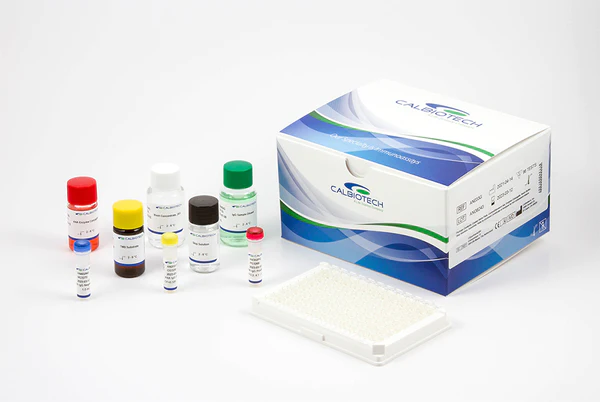
PSA ELISA

- 貨號 Cat. No.
- PS067T
- 規格 Size
- 96 Tests
- 品牌 Brand
- Calbiotech
Description
PSA ELISA
Category Name
Tumor Markers
Method
ELISA
Principle
ELISA
Controls Standards
0,2,4,8,25,50ng/ml
Sensitivity
0.585ng/ml
Sample
50 µl
Runtime
75 min
Wavelength
450 nm
Safety
Please refer to MSDS
Shelflife
18 Months
INTENDED USE
The Calbiotech PSA ELISA Kit is intended for the quantitative measurement of PSA in human serum.
Summary AND EXPLANTION
Prostate Specific Antigen (PSA) is a single chain glycoprotein produced by epithelial cells of the prostate gland. PSA is useful in the management of patients with prostate cancer. The measurement of serum PSA has become the most accepted test to indicate men who are at risk of having prostate cancer and who should be examined by other tests. Using a cut-off of 4 ng/ml, 92% of men over 50 years of age with malignant prostatic tissues, 8% of healthy men and 28% of men with benign prostate hyperplasia (BPH) test positive for PSA. Three major forms of PSA exist in the serum: free PSA, bound PSA and complex PSA. Bound PSA is found in higher concentrations in patients with prostate cancer; whereas, free PSA is detected in higher concentrations in patients with BPH. If the free PSA to total PSA ratio is >25%, it is unlikely that the patient has prostate cancer; whereas, if free PSA is <16% then prostate cancer is likely to be the cause. Serial measurement of PSA concentration in the serum is an important tool in monitoring patients with prostatic cancer and determining the potential and actual effectiveness of surgery or other therapies, or may allow for earlier discovery of residual or recurrent carcinoma after radical prostatectomy or radiotherapy. Current indications suggest that men over 50 years should be screened with digital rectal examination and PSA. Men with a high risk of prostate cancer, such as a family history or of African heritage, should begin annual testing at age 40 years. If both are normal, the patient can be followed with annual evaluations and monitoring to determine the rate of change. Slight elevations in PSA (4.1 ng/ml to 10.0 ng/ml) warrant a transrectal ultrasound (TRUS) to evaluate prostate volume and echogenicity of the gland. Hypo-echogenic lesions should be biopsied. Elevated PSA density (>0.15 ng/ml/cc), very high PSA (>10 ng/ml) or a free-to-total PSA ratio of <16% warrants systemic biopsy.
PRINCIPLE OF THE TEST
The PSA is a two-site sandwich ELISA method. Samples and diluent are added to the wells coated with Anti-PSA MAb. PSA in the patient’s serum binds to anti- MAb on the well. Unbound proteins are washed off by wash buffer. Anti-PSA HRP labeled second antibody is then adds. Unbound protein and HRP conjugate are washed off by wash buffer. Upon the addition of the substrate, the intensity of color is proportional to the concentration of PSA in the samples. A standard curve is prepared relating color intensity to the concentration of the PSA.
