
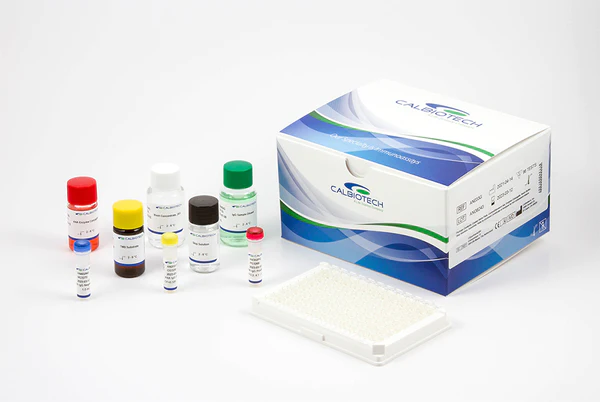
C-Peptide ELISA

- 貨號 Cat. No.
- CP097D
- 規格 Size
- 96 Tests
- 品牌 Brand
- Calbiotech
Description
C-Peptide ELISA
Category Name
Steroids
Method
ELISA
Principle
ELISA
Controls Standards
0,0.2,0.7,2.0,6,16ng/ml
Sensitivity
0.05ng/ml
Sample
100 µl
Runtime
110 min
Wavelength
450 nm
Safety
Please refer to MSDS
Shelflife
18 Months
INTENED USE
The Calbiotech C-Peptide ELISA Kit is intended for quantitative determination of C-Peptide in serum, plasma and urine.
SUMMARY AND EXPLINATION
Human C-Peptide has a molecular mass of approximately 3000 daltons. C-Peptide has no metabolic function. However, since C-Peptide and insulin are secreted in equimolar amounts, the immunoassay of C-Peptide permits the quantitation of insulin secretion. This is the reason for the clinical interest of serum and urinary determinations of C-Peptide. Moreover, C-Peptide measurement has several advantages over immunoassays of insulin. The half-life of C-Peptide in the circulation is between two and five times longer than that of insulin. Therefore, C-Peptide levels are a more stable indicator of insulin secretion than the more rapidly changing levels of insulin. A very clear practical advantage of C-Peptide measurement arising from its relative metabolic inertness as compared to insulin is that C-Peptide levels in peripheral venous blood are about 5-6 times greater than insulin levels. Also, relative to an insulin assay, the C-Peptide assay's advantage is its ability to distinguish endogenous from injected insulin. C-Peptide has also been measured as an additional means for evaluating glucose tolerance and glibenclamide glucose tests. C-Peptide levels are in many ways a better measurement of endogenous insulin secretion than peripheral insulin levels. C-Peptide may be measured in either blood or urine. With improved sensitive C-Peptide immunoassays, it is now possible to measure C-Peptide values at extremely low levels. The clinical indications for C-Peptide measurement include diagnosis of insulinoma and differentiation from factitious hypoglycemia, follow-up of pancreatectomy, and evaluation of viability of islet cell transplants. Recently, these indications have been dramatically expanded to permit evaluation of insulin dependence in maturity onset diabetes mellitus.
PRINCIPLE OF THE TEST
The C-Peptide Elisa Kit is based on the competition principle and the microplate separation. An unknown amount of C-Peptide present in the sample and a fixed amount of C-Peptide Conjugate compete for the binding sites of a polyclonal C-Peptide antiserum coated onto the wells. In a second step an Enzyme Complex binds to C-Peptide Conjugate. The unbound Enzyme Complex is washed off. Having added the Substrate Solution, the concentration of C-Peptide in the samples is inversely proportional to the optical density measured
