
Antibodies


Wortmannin is a PI3K with IC50 of 3 nM, first described PI3K inhibitors, but little selectivity within the PI3K family. Also blocks autophagosome formation and potently inhibits DNA-PK/ATM with IC50 of 16 nM and 150 nM. Phase 4.
| Size | Price | Stock | Quantity | ||||||||||||||||
|---|---|---|---|---|---|---|---|---|---|---|---|---|---|---|---|---|---|---|---|
| |||||||||||||||||||
 Distributor Tel: +886-2-2827-1197jimmy@new.abscience.com.tw
| Description | Wortmannin is a PI3K with IC50 of 3 nM, first described PI3K inhibitors, but little selectivity within the PI3K family. Also blocks autophagosome formation and potently inhibits DNA-PK/ATM with IC50 of 16 nM and 150 nM. Phase 4. | |||||
|---|---|---|---|---|---|---|
| Targets | MLCK | PI3K | DNA-PK | ATM | ATR | |
| IC50 | 170 nM [1] | 3 nM [3] | 16 nM | 150 nM | 1.8 μM [12] | |
| In vitro | The inhibition of MLCK by Wortmannin is not affected by calmodulin or peptide substrat, while reduced by high concentration of ATP. Wortmannin directly interacts with the catalytic domain of MLCK and leads to an irreversible loss of the enzyme activity. Wortmannin has no inhibitory to cAMP-dependent protein kinase, cGMP-dependent protein kinase, and calmodulin-dependent protein kinase II, and has little effect on protein kinase C activity. [1] Wortmannin inhibits N-formylmethionyl-leucylphenylalanine (fMLP)-stimulated PtdInsP3 (phosphatidylinositol 3,4,5-trisphosphate) formation with IC50 of 5 nM and this inhibition is completely abolished when pretreated with 100 nM Wortmannin in human neutrophils, with increased PtdInsP2 levels and no effects on cellular PtdInsP and PtdIns contents. Wortmannin could develop oscillatory changes in F-actin content and does not inhibit fMLP-stimulated actin polymerization in neutrophils. [2] Wortmannin irreversibly inhibits phosphatidylinositol 3-kinase (PI3-kinase) activity with binding to the 110-kDa protein (IC50 of 3 nM) and has no effect PI4-kinase in RBL-2H3 cells. Wortmannin also inhibits both Fc epsilon RI-mediated histamine secretion and leukotriene release, with no effect on the activation of the tyrosine kinase Lyn. [3]Wortmannin completely abolishes the insulin-induced hexose uptake in isolated rat adipocytes at 0.1 μM, without impairing isoproterenol-stimulated lipolytic activity. [4] Wortmannin suppresses insulin-induced production of nitric oxide by 50% at 500 nM in human umbilical vein endothelial cells, which is in response to IGF-1. [5] Wortmannin suppresses DNA double strand break (DSB) repair and has no effect on DSB levels or the kinetics of single strand break (SSB) repair in Chinese hamster ovary cells at 50 μM. Wortmannin could potentiate ionizing radiation (IR)-induced cytotoxicity with no toxicity by itself. [6] Wortmannin inhibits polo-like kinase (PLK1) activity IC50 of 24 nM in intact G2/M-arrested cells. [7] Wortmannin increases Toll-like receptor (TLR)-mediated accumulation of IL-6 in human macrophages with EC50 of 50 nM. Meanwhile Wortmannin significantly enhances TLR-mediated inducible nitric-oxide synthase (iNOS) expression and nitrite accumulation in mouse macrphages. Wortmannin activates the nuclear factor-κB and up-regulates the cytokine mRNA production. [8] Wortmannin also inhibits Polo-like kinase (PlK) 1 and PlK3, which play important roles in mitosis. Wortmannin treatment could lead to a reduction in phosphorylation of p53 on serine 20 induced by DNA damage. [9] Wortmannin suppresses hyaluronan-induced Akt phosphorylation and cell motility/migration in SW1990 cells. [10] | |||||
| In vivo | Wortmannin inhibits peritoneal metastasis of SW1990 in mice at 1 mg/kg, without any weight loss. [10]Wortmannin inhibits phosphatidylinositide 3-kinase-protein kinase B (PKB)/Akt phosphorylation in both normal tissues (lung, heart and brain homogenates) and tumor tissue in mice, without mortality or acute toxicity at 0.7 mg/kg. Combination with LY188011, Wortmannin significantly increases apoptosis and inhibit tumor growth in orthotopic tumor, while both monotherapy could not. [11] | |||||
| Features | ||||||
| MLCK assay | MLCK activity is assayed with peptide substrate (KKRPQRATSNVFS-NH2) or myosin light chain. The peptide substrate (24 μM) is phosphorylated in a reaction mixture containing 25 mM Tris-HC1 (pH 7.5), 0.5 mg/mL bovine serum albumin, 4 mM MgCl2, 0.5 mM CaCl2, 2.6 nM calmodulin, 1.5 nM MLCK, and 400 μM ATP in a final volume of 0.25 mL. After a 10-min preincubation at 28 ºC without ATP, the reaction is started by addition of ATP at 28 ºC and terminated by the addition of 0.1 mL of 10% (v/v) acetic acid after 30 min. The mixture is analyzed by high performance liquid chromatography: column, Unisil Pack 5C18 4.6 X 150 mm; solvent, 18% (v/v) acetonitrile, 0.1% (v/v) trifluoroacetic acid in water; flow rate, 1.0 mL/min; temperature, 40 ºC; detection, absorbance at 220 nm. Percent of reaction is calculated from the ratio of peak areas of phosphorylated form to those of unphosphorylated form. Specific activity measured under the conditions described above is 0.81 μmol/min/mg. Myosin light chain (108 μg/mL) is phosphorylated in a reaction mixture containing 25 mM Tris-HC1 (pH 7.5), 0.5 mg/mL bovine serum albumin, 4 mM MgCl2, 0.5 mM CaCl2, 4.2 nM calmodulin, 0.92 nM enzyme, and 10 μM[γ-32P]ATP (100-900 cpm/pmol) in a final volume of 0.25 mL. After a 3-min preincubation at 30 ºC without ATP, the reaction is started by the addition of [γ-32P]ATP at 30 ºC and stopped by the addition of 0.125 mL of trichloroacetic acid after 5 min. The acid-precipitable materials are collected on a nitrocellulose membrane filter and washed with four 1-mL aliquots of 5% (v/v) trichloroacetic acid. The radioactivity on the filter is measured in a toluene scintillation fluid, using a Packard Tri-Carb liquid scintillation spectrometer Model 4530. The specific activity measured under the conditions is 1.23 μmol/min/mg. [1] |
|---|---|
| PI3K assay | In an ordinary solution assay, partially purified PI3-kinase from calf thymus is used at a final concentration of 20 ng/mL. In the case of immunocomplex assay, P13-kinase activity is measured in immunoprecipitates with anti-PI3-kinase p85 antiserum, anti-phosphotyrosine antibody, or anti-Lyn antibody complexed with protein G-Sepharose 4FF beads. The partially purified enzyme or the immunoprecipitates are suspended in 50 μL of a buffer containing 20 mM Tris-HC1 pH 7.5, 100 mM NaCl, and 0.5 mM EGTA. Then 0.5 μL of 20 mg/mL PI dissolved in dimethyl sulfoxide is added to the reaction mixture to make micelles of PI. The mixture is preincubated at 25 ºC for 10 min. [γ-32P]ATP (1.0 μCi/assay; final concentration, 10 μM) and MgCl2, (final concentration, 20 mM) are added to start the reaction, and the mixture is incubated at 25 ºC for 30 min. During this period, the formation of phosphatidylinositol phosphate is linear. The reaction is stopped by the addition of 100 μL of chloroform, methanol, 11.6 N HCl (100:200:2). Following centrifugation, the lower organic phase is taken for thin-layer chromatography on Silica Gel plates to be developed in chloroform, methanol, 25% ammonium hydroxide, water (43:385:7). The radioactivity on the dried plate is visualized after development with a Fuji BAS2000 Bioimaging Analyzer. Inhibitor is preincubated for 10 min with the reaction mixture, and the phosphorylation reaction is started by the addition of [γ-32P]ATP and MgC12 as described above. [3] |
| Animal Models | Human pancreatic adenocarcinoma cells PK1 are injected both s.c. and orthotopically into SCID mice. |
|---|---|
| Dosages | 0.175, 0.35, and 0.7 mg/kg |
| Administration | Injected by i.v. |
| Solubility | 1% DMSO/30% polyethylene glycol/1% Tween 80, 8 mg/mL |
| NCT Number | Recruitment | Conditions | Sponsor /Collaborators | Start Date | Phases |
|---|---|---|---|---|---|
| NCT00534261 | Completed | Relapsing Remitting Multiple Sclerosis | Biogen Idec | 1999-11 | Phase 4 |
| Molecular Weight (MW) | 428.43 |
|---|---|
| Formula | C23H24O8 |
| CAS No. | 19545-26-7 |
| Storage | 3 years -20℃Powder |
|---|---|
| 6 months-80℃in DMSO | |
| Syonnyms | KY 12420 |
| Solubility (25°C) * | In vitro | DMSO | 86 mg/mL (200 mM) |
|---|---|---|---|
| Water | <1 mg/mL (<1 mM) | ||
| Ethanol | <1 mg/mL (<1 mM) | ||
| In vivo | 1% DMSO/30% polyethylene glycol/1% Tween 80, | 8 mg/mL | |
| * <1 mg/ml means slightly soluble or insoluble. * Please note that Selleck tests the solubility of all compounds in-house, and the actual solubility may differ slightly from published values. This is normal and is due to slight batch-to-batch variations. | |||
| Chemical Name | 3H-Furo[4,3,2-de]indeno[4,5-h]-2-benzopyran-3,6,9-trione, 11-(acetyloxy)-1,6b,7,8,9a,10,11,11b-octahydro-1-(methoxymethyl)-9a,11b-dimethyl-, (1S,6bR,9aS,11R,11bR)- |
|---|
| Stock Solution (1ml DMSO) | 1mM | 10mM | 20mM | 30mM |
|---|---|---|---|---|
| Mass(mg) | 0.42843 | 4.2843 | 8.5686 | 12.8529 |
 Click to enlarge | Rating | |
| Source | Dr.Milica Pesic from Institute for Biological Research .Wortmannin purchased from Selleck | |
| Method | MTT | |
| Cell Lines | NCI-H460, NCI-H460/R | |
| Concentrations | 0-10 uM | |
| Incubation Time | 72 h | |
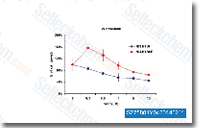
| Results | Cell growth inhibition of non-small cell lung carcinoma (NSCLC) by inhibitor of phosphoinositide 3-kinases (PI3Ks) Wortmannin. |
PtdIns(3,4,5)P3 is constitutively synthesized and required for spindle translocation during meiosis in mouse oocytes. [Zheng P, et al. J Cell Sci 2012;126(Pt 3):715-21]
Synergistic Activities of MET/RON Inhibitor BMS-777607 and mTOR Inhibitor AZD8055 to Polyploid Cells Derived from Pancreatic Cancer and Cancer Stem Cells. [Zeng JY, et al. Mol Cancer Ther 2013;13(1):37-48]
Low Amount of Salinomycin Greatly Increases Akt Activation, but Reduces Activated p70S6K Levels. [Kim JH, et al. Int J Mol Sci 2013;14(9):17304-18]
