
Antibodies


VX-680 (Tozasertib, MK-0457) is a pan-Aurora inhibitor, mostly against Aurora A with Kiapp of 0.6 nM, less potent towards Aurora B/Aurora C and 100-fold more selective for Aurora A than 55 other kinases. Phase 2.
| Size | Price | Stock | Quantity | ||||||||||||||||
|---|---|---|---|---|---|---|---|---|---|---|---|---|---|---|---|---|---|---|---|
| |||||||||||||||||||
 Distributor Tel: +886-2-2827-1197jimmy@new.abscience.com.tw
| Description | VX-680 (Tozasertib, MK-0457) is a pan-Aurora inhibitor, mostly against Aurora A with Kiapp of 0.6 nM, less potent towards Aurora B/Aurora C and 100-fold more selective for Aurora A than 55 other kinases. Phase 2. | |||||
|---|---|---|---|---|---|---|
| Targets | Aurora A | Aurora B | Aurora C | |||
| IC50 | 0.6 nM (Kiapp) | 18 nM (Kiapp) | 4.6 nM (Kiapp) [1] | |||
| In vitro | Although its multi-kinase profile, VX-680 induces similar cytotoxicity with IC50 of approximately 300 nM and exhibits an AUR B-like inhibitory phenotype of G2/M arrest, endoreduplication and apoptosis in BaF3 cells transfected with ABL or FLT-3 (mutant and wild type) kinases. VX-680 prevents the CAL-62 proliferation in a time-dependent manner. VX-680 treatment for 14 days significantly decreases the number and size of colonies by approximately 70% in the 8305C and 90% in the CAL-62, 8505C and BHT-101. Treatment of the different ATC cells with VX-680 inhibits proliferation with the IC50 between 25 and 150  nM. The VX-680 significantly impairs the ability of the different cell lines to form colonies in soft agar. Analysis of caspase-3 activity indicates that VX-680 induces apoptosis in the different cell lines. CAL-62 cells exposed for 12  hours to VX-680 showed an accumulation of cells with ≥4N DNA content. Time-lapse analysis demonstrates that VX-680-treated CAL-62 cells exit metaphase without dividing. Moreover, histone H3 phosphorylation is abrogated following VX-680 treatment. [2] VX-680 has significant inhibitory activity against BCR-Abl bearing the T315I mutation in patient-derived samples. [3] | |||||
| In vivo | VX-680 gives rise to a marked decrease in tumor size in a human AML (HL-60) xenograft model. In mude mice treateed with VX-680 at 75 mg/kg, twice a day intraperitoneally (b.i.d. i.p.) for 13 days, mean tumor volumes are reduced by 98%. Tumor growth decrease is dose dependent and significant at a dose of 12.5 mg/kg b.i.d. VX-680 is well tolerated, with a small decrease in body weight observed only at the highest dose. VX-680 also triggers tumor regresson in pancreatic and colon xenograft models. VX-680 also displays potent antitumor activity when infused i.v. in mude rats bearing established HCT116 tumors. A higher dose of VX-680 (2 mg/kg/h) improves efficacy with a 56% decrease in mean tumor volume. [1] | |||||
| Features | ||||||
| Kinase inhibition assays | The consumption of ATP is coupled via the pyruvate kinase/lactic dehydrogenase enzyme pair to the oxidation of NADH, which can be monitored through the decrease in absorption at 340 nm. Reactions contains 100 mM Tris (pH 8), 10 mM MgCl2, 2.2 mM ATP, 1 mM phosphoenolpyruvate, 0.6 mg/mL NADH, 75 units/mL pyruvate kinase, 105 units/mL lactate dehydrogenase, and 0.5 mM substrate peptide (sequence: EAIYAAPFAKKK). Reactions (75 μL) are started by adding sufficient kinase to bring the reactions to 30 nM kinase concentration and the decrease in absorbance is monitored over 30 minutes at 30°C in a microtiter plate spectrophotometer. Inhibitory constants are obtained through addition of 3.75 μL VX-680 in 100% DMSO or DMSO alone. Ki values are calculated as follows, K i = IC50 / (1 + [S]/Kd), where [S] = [ATP] = 2.2 mM, and Kd (of ATP to Abl) = 70 μM. These values are calculated assuming a Kd (ATP) of 70 μM for wild type and H396P Abl kinase domain. |
|---|
| Cell lines | CAL-62 cells |
|---|---|
| Concentrations | 5-500 nM |
| Incubation Time | 4 days |
| Method | The CAL-62 cells are cultured in the absence (dimethyl sulfoxide, DMSO) or the presence of 500  nM VX-680 for different periods of time (1-5 days). The dose-dependent effects of VX-680 on cell proliferation are evaluated by treating the different ATC cells for 4 days with different concentrations of the Aurora inhibitor (5–500  nM). The cells are pulse labeled with 30  mM BrdU for 2  hours before the end of the incubation time. The BrdU incorporation is analyzed by means of a colorimetric immunoassay using the cell proliferation ELISA kit. The results from VX-680-treated cells are compared with those observed in control cells and expressed as a fold of variation versus control. |
| Animal Models | Female athymic NCr-nu mice bearing HL-60 leukemia cells |
|---|---|
| Dosages | 50 mg/kg, 75 mg/kg |
| Administration | Administered via i.p. |
| Solubility | 30% PEG400/0.5% Tween80/5% propylene glycol, 30 mg/mL |
| NCT Number | Recruitment | Conditions | Sponsor /Collaborators | Start Date | Phases |
|---|---|---|---|---|---|
| NCT00099346 | Terminated | Colorectal Cancer|Advanced Solid Tumors | Merck | 2005-01 | Phase 1 |
| NCT00104351 | Terminated | Cancer | Merck | 2005-05 | Phase 1 |
| NCT00111683 | Completed | Chronic Myelogenous Leukemia in Blast Crisis|Lymphocytic Leukemia, B Cell, Acute|Myelodysplastic Syndromes|Myelogenous Leukemia, Chronic | Merck | 2005-06 | Phase 1 |
| NCT00290550 | Terminated | Carcinoma, Non-Small-Cell Lung | Merck | 2006-10 | Phase 2 |
| NCT00405054 | Terminated | Leukemia | Merck | 2006-12 | Phase 2 |
Download VX-680 (Tozasertib, MK-0457) SDF
| Molecular Weight (MW) | 464.59 |
|---|---|
| Formula | C23H28N8OS |
| CAS No. | 639089-54-6 |
| Storage | 3 years -20℃Powder |
|---|---|
| 6 months-80℃in DMSO | |
| Syonnyms | N/A |
| Solubility (25°C) * | In vitro | DMSO | 93 mg/mL (200 mM) |
|---|---|---|---|
| Water | <1 mg/mL (<1 mM) | ||
| Ethanol | <1 mg/mL (<1 mM) | ||
| In vivo | 30% PEG400/0.5% Tween80/5% propylene glycol, | 30 mg/mL | |
| * <1 mg/ml means slightly soluble or insoluble. * Please note that Selleck tests the solubility of all compounds in-house, and the actual solubility may differ slightly from published values. This is normal and is due to slight batch-to-batch variations. | |||
| Chemical Name | N-(4-(4-(5-methyl-1H-pyrazol-3-ylamino)-6-(4-methylpiperazin-1-yl)pyrimidin-2-ylthio)phenyl)cyclopropanecarboxamide |
|---|
| Stock Solution (1ml DMSO) | 1mM | 10mM | 20mM | 30mM |
|---|---|---|---|---|
| Mass(mg) | 0.46459 | 4.6459 | 9.2918 | 13.9377 |
 Click to enlarge | Rating | |
| Source | Oncogene, 2012, 31(31), 3584-96. VX-680 (Tozasertib, MK-0457) purchased from Selleck | |
| Method | Western blot analysis/ SA- β-gal staining | |
| Cell Lines | MCF7 cells | |
| Concentrations | 400 nM | |
| Incubation Time | 24-48 h | |
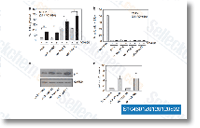
| Results | VX-680 on its own caused an increase in the number of senescent MCF7 cells andalso en hanced the effects of PKCι depletion on senescence induction (Figure a). VX-680, either alone or in combination with PKCι depletion, did not increase the numbers of gH2AX foci beyond those seen in controlc ells, suggesting that the two treatments promote senescence by similar mechanisms ( Figure b). VX-680 also increased the levels of p21 in MCF7 cells prior to the onset of the senescence phenotype (Figures c and d). |
Aurora kinases and protein phosphatase 1 mediate chromosome congression through regulation of CENP-E. [Kim Y, et al. Cell 2010;142(3):444-55]
Regulation of Embryonic and Induced Pluripotency by Aurora Kinase-p53 Signaling. [Lee DF, et al. Cell Stem Cell 2012;11(2):179-94]
A complex of Kif18b and MCAK promotes microtubule depolymerization and is negatively regulated by Aurora kinases. [Tanenbaum ME, et al. Curr Biol 2011;21(16):1356-65]
