
Antibodies


Vismodegib (GDC-0449) is a potent, novel and specific hedgehog inhibitor with IC50 of 3 nM and also inhibits P-gp with IC50 of 3.0 μM.
| Size | Price | Stock | Quantity | ||||||||||||||||||||
|---|---|---|---|---|---|---|---|---|---|---|---|---|---|---|---|---|---|---|---|---|---|---|---|
| |||||||||||||||||||||||
 Distributor Tel: +886-2-2827-1197jimmy@new.abscience.com.tw
| Description | Vismodegib (GDC-0449) is a potent, novel and specific hedgehog inhibitor with IC50 of 3 nM and also inhibits P-gp with IC50 of 3.0 μM. | |||||
|---|---|---|---|---|---|---|
| Targets | Hedgehog | |||||
| IC50 | 3 nM [1] | |||||
| In vitro | GDC-0449 targets the Hedgehog signaling pathway, blocking the activities of the Hedgehog-ligand cell surface receptors PTCH and/or SMO and suppressing Hedgehog signaling. GDC-0449 prevents multiple ATP-binding cassette (ABC) transporters. GDC-0449 also blocks ABCG2, Pgp, and MRP1-important ABC transporters associated with MDR. GDC-0449 is a potent inhibitor of ABC transporters, ABCG2/BCRP and ABCB1/Pgp, and is a mild inhibitor of ABCC1/MRP1. In ABCG2-overexpressing HEK293 cells, GDC-0449 increases retention of the fluorescent ABCG2 substrate BODIPY-prazosin and resensitizes these cells to mitoxantrone. In Madin-Darby canine kidney II cells engineered to overexpress Pgp or MRP1, GDC-0449 increases the retention of calcein-AM and resensitizes them to colchicine. GDC-0449 also resensitizes human non-small cell lung carcinoma cells NCI-H460/par and NCI-H460/MX20, which overexpress ABCG2 in response to mitoxantrone, to mitoxantrone, and to topotecan or SN-38. The IC50 values of GDC-0449 for prevention of ABCG2 and Pgp are about 1.4 μM and 3.0 μM, respectively. [2] GDC-0449 alters intracellular Ca2+ homeostasis and inhibits cell growth in cisplatin-resistant lung cancer cells. [3] | |||||
| In vivo | GDC-0449 has been used to treat medulloblastoma in animal models. [2] GDC-0449 prevents the growth of primary pancreatic xenografts without non-specifically inhibiting pancreatic cell proliferation. Oral dosing of GDC-0449 causes tumor regressions in the Ptch(+/-) allograft model of medulloblastoma at doses ≥25 mg/kg and tumor growth inhibition at doses up to 92 mg/kg dosed twice daily in two ligand-dependent colorectal cancer models, D5123, and 1040830. Analysis of Hh pathway activity and PK/PD modeling reveals that GDC-0449 inhibits Gli1 with a similar IC50 in both the medulloblastoma and D5123 models (0.165 μM and 0.267 μM, respectively). Pathway modulation is linked to efficacy using an integrated PK/PD model revealing a steep relationship where > 50% of the activity of GDC-0449 is associated with >80% repression of the Hh pathway. [4] | |||||
| Features | ||||||
| Cell lines | MDCKII cells |
|---|---|
| Concentrations | 20 μM |
| Incubation Time | 2 hours |
| Method | MDCKII cells are seeded into 24-well plates at a density of 3 × 10⁵ cells per well and are allowed to attach. Medium is then changed to that containing different drugs (50 μM VP, 50 μM indomethacin, or 20 μM GDC-0449 in DMSO or DMSO alone as control, and nonfluorescent calcein-AM is added to a final concentration of 1.0 μM and incubated at 37 °C for 2 hours. Cells are then washed twice with Ca2+, Mg2+-containing Hank’s balanced salt solution buffer and lysed by shaking in 0.01% Triton X-100 in PBS buffer for 1 hour at room temperature or overnight at 4 °C. The lysate is then transferred into 96-well plates, and the fluorescence signal caused by the cell-derived calcein is quantified spectrophotometrically with a SpectraMax M5 Multi-Detection Readerusing an excitation wavelength of 495 nm and an emission wavelength of 515 nm. All manipulations are performed in the dark. All readings are expressed as mean ?SEM normalized to the control. |
| Animal Models | Ptch(+/-) allograft model, D5123 and 1040830 |
|---|---|
| Dosages | ~ 100 mg/kg |
| Administration | Orally |
| Solubility | 0.5% methylcellulose/0.2% Tween 80, 30 mg/mL |
| NCT Number | Recruitment | Conditions | Sponsor /Collaborators | Start Date | Phases |
|---|---|---|---|---|---|
| NCT01835626 | Recruiting | Locally Advanced Basal Cell Carcinoma|Skin Cancer|Cutaneous Malignancy | University of California, San Francisco|Sue Yom|Genentech | 2013-05 | Phase 2 |
| NCT01898598 | Recruiting | Basal Cell Carcinoma | Hoffmann-La Roche | 2013-06 | Phase 2 |
| NCT01878617 | Recruiting | Medulloblastoma | St. Jude Children’s Research Hospital|Genentech | 2013-06 | Phase 2 |
| NCT01893892 | Not yet recruiting | Musculoskeletal Complications | Stanford University|National Cancer Institute (NCI) | 2013-07 | |
| NCT01880437 | Recruiting | Myelodysplastic Syndromes, Myelogenous Leukemia, Acute | Hoffmann-La Roche | 2013-10 | Phase 2 |
Download Vismodegib (GDC-0449) SDF
| Molecular Weight (MW) | 421.3 |
|---|---|
| Formula | C19H14Cl2N2O3S |
| CAS No. | 879085-55-9 |
| Storage | 3 years -20℃Powder |
|---|---|
| 6 months-80℃in DMSO | |
| Syonnyms | N/A |
| Solubility (25°C) * | In vitro | DMSO | 84 mg/mL (199 mM) |
|---|---|---|---|
| Water | <1 mg/mL (<1 mM) | ||
| Ethanol | <1 mg/mL (<1 mM) | ||
| In vivo | 0.5% methylcellulose/0.2% Tween 80, | 30 mg/mL | |
| * <1 mg/ml means slightly soluble or insoluble. * Please note that Selleck tests the solubility of all compounds in-house, and the actual solubility may differ slightly from published values. This is normal and is due to slight batch-to-batch variations. | |||
| Chemical Name | 2-chloro-N-(4-chloro-3-(pyridin-2-yl)phenyl)-4-(methylsulfonyl)benzamide |
|---|
| Stock Solution (1ml DMSO) | 1mM | 10mM | 20mM | 30mM |
|---|---|---|---|---|
| Mass(mg) | 0.4213 | 4.213 | 8.426 | 12.639 |
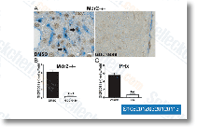 Click to enlarge | Rating | |
| Source | Gut, 2013, 62(2), 299-309. Vismodegib (GDC-0449) purchased from Selleck | |
| Method | Immunohistochemistry | |
| Cell Lines | Mdr2 -/- mice/hepatectomised mice | |
| Concentrations | ||
| Incubation Time | ||
| Results | Treatment of Mdr2 -/- mice with GDC-0449 (Hh signalling antagonist) significantly reduced the number of Gli2 and CD31 (a commonly used capillarisation marker in vivo) double-positive cells in the liver (figure A,B). Similar results were observed in partial hepatectomised mice treated with cyclopamine ( figure C). |
Hedgehog Controls Hepatic Stellate Cell Fate by Regulating Metabolism. [Chen Y, et al. Gastroenterology 2012;143(5):1319-29.e1-11]
Upâ€regulation of Hedgehog pathway is associated with cellular permissiveness for hepatitis C virus replication. [Choi SS, et al. Hepatology 2011;54(5):1580-90]
NKT-associated hedgehog and osteopontin drive fibrogenesis in non-alcoholic fatty liver disease. [Syn WK, et al. Gut 2012;61(9):1323-9]
