
Antibodies


Vemurafenib (PLX4032, RG7204) is a novel and potent inhibitor of B-RafV600E with IC50 of 31 nM.
| Size | Price | Stock | Quantity | ||||||||||||||||
|---|---|---|---|---|---|---|---|---|---|---|---|---|---|---|---|---|---|---|---|
| |||||||||||||||||||
 Distributor Tel: +886-2-2827-1197jimmy@new.abscience.com.tw
| Description | Vemurafenib (PLX4032, RG7204) is a novel and potent inhibitor of B-RafV600E with IC50 of 31 nM. | |||||
|---|---|---|---|---|---|---|
| Targets | B-RafV600E | C-Raf | MAP4K5 (KHS1) | SRMS | ACK1 | FGR |
| IC50 | 31 nM | 48 nM | 51 nM | 18 nM | 19 nM | 63 nM [1] |
| In vitro | PLX4032 inhibits B-RAFV600E, C-RAF, as well as wildtype B-RAF, with IC50 of 31 nM, 48 nM and 100 nM, respectively. PLX4032 also inhibits several non-RAF kinases, including ACK1, KHS1, and SRMS, with IC50 of 18 nM to 51 nM. [1] In melanoma cell lines, the inhibitory effect by PLX4032 depends on B-RAF mutational status, because PLX4032 potently inhibits those harboring B-RAF V600 mutants, including V600E, V600D, V600K, and V600R, but not wildtype or other mutants. The IC50 values of PLX4032 on these cells, including MALME-3M, Colo829, Colo38, A375, SK-MEL28, and A2058, ranges from 20 nM to 1 μM. In these cells, PLX4032 (0.1 μM to 30 μM) also inhibits the phosphorylation of both MEK1/2 and ERK1/2. [2] PLX4032 is highly effective in the treatment of melanoma, for its ability of inhibiting B-RAFV600E. However, PLX4032 displays limited effect in colon cancer patients that also carrying B-RAFV600E oncoprotein. The reason for this is that, in colon cancer cells, B-RAFV600E inhibition by PLX4032 results in a rapid feedback EGFR activation, which compensates for the PLX4032-inhibited cell proliferation. [3] | |||||
| In vivo | In B-RAFV600E-mutant mice xenograft models, PLX4032 (6 mg/kg–20 mg/kg) inhibits tumor growth. [1] In mice xenograft models of LOX, Colo829, and A375 cells, PLX4032 (12.5 mg/kg–100 mg/kg) inhibits tumor growth and prolongs mice survival. [2] | |||||
| Features | A novel and potent inhibitor of the B-RAFV600E oncoprotein. | |||||
| RAF kinase activity measurements | The kinase activities of wild-type RAF and mutants are determined by measuring phosphorylation of biotinylated-BAD protein. For each enzyme (0.01 ng), 20 μL reactions are carried out in 20 mM Hepes (pH 7.0), 10 mM MgCl2, 1 mM DTT, 0.01% (v/v) Tween-20, 50 nM biotin-BAD protein, and 1 mM ATP at room temperature. Reactions are stopped at 5 min with 5 μL of a solution containing 20 mM Hepes (pH 7.0), 200 mM NaCl, 80 mM EDTA, 0.3% (w/v) bovine serum albumin (BSA). The stop solution also includes phospho-BAD (Ser112) antibody, streptavidin-coated donor beads, and protein A acceptor beads. The antibody and beads are pre-incubated in stop solution in the dark at room temperature for 30 min. The final dilution of antibody is 1/2000 and the final concentration of each bead is 10 μg/mL. The assay plates are incubated at room temperature for one hour and then are read on a PerkinElmer AlphaQuest reader. Mutant activities are the average of two different batches of purified protein assayed in duplicate in three different experiments. |
|---|
| Cell lines | MALME-3M, Colo829, Colo38, A375, SK-MEL28, and A2058 cells |
|---|---|
| Concentrations | 0–10 μM , dissolved in DMSO |
| Incubation Time | 5 days |
| Method | Cellular proliferation is evaluated by MTT assay. Briefly, cells are plated in 96-well microtiter plates at a density of 1000 to 5000 cells per well in a volume of 180 μL. PLX4032 is prepared at 10 times the final assay concentration in media containing 1% DMSO. Twenty-four hours after cell plating, 20 μL of the appropriate dilution of PLX4032 are added to plates in duplicate. The plates are assayed for proliferation 6 days after the cells are plated. Percent inhibition is calculated and the IC50 is determined from the regression of a plot of the logarithm of the concentration versus percent inhibition. |
| Animal Models | Mice (athymic nude) xenograft models of LOX, Colo829, and A375 cells |
|---|---|
| Dosages | 12.5 mg/kg–100 mg/kg |
| Administration | Oral gavage twice daily |
| Solubility | 30% PEG400/0.5% Tween80/5% propylene glycol, 5 mg/mL |
| NCT Number | Recruitment | Conditions | Sponsor /Collaborators | Start Date | Phases |
|---|---|---|---|---|---|
| NCT01781026 | Recruiting | Melanoma [C04.557.465.625.650.510] | Yale University|Genentech | 2013-08 | Phase 2 |
| NCT01748149 | Not yet recruiting | Pediatric Recurrent/Refractory BRAFV600E-mutant Gliomas | University of California, San Francisco|Theodore Nicolaides MD|Genentech | 2013-10 | Phase 0 |
| NCT01942993 | Not yet recruiting | Melanoma | Mount Sinai School of Medicine|Philip Friedlander|Genentech | 2013-10 | Phase 2 |
| NCT01959633 | Not yet recruiting | Melanoma | Fondazione Melanoma Onlus | 2013-11 | Phase 1|Phase 2 |
| NCT01974258 | Recruiting | Neoplasms | Hoffmann-La Roche | 2013-11 | Phase 1 |
Download Vemurafenib (PLX4032, RG7204) SDF
| Molecular Weight (MW) | 489.92 |
|---|---|
| Formula | C23H18ClF2N3O3S |
| CAS No. | 918504-65-1 |
| Storage | 3 years -20℃Powder |
|---|---|
| 6 months-80℃in DMSO | |
| Syonnyms | RG7204 |
| Solubility (25°C) * | In vitro | DMSO | 98 mg/mL (200 mM) |
|---|---|---|---|
| Water | <1 mg/mL (<1 mM) | ||
| Ethanol | <1 mg/mL (<1 mM) | ||
| In vivo | 30% PEG400/0.5% Tween80/5% propylene glycol, | 5 mg/mL | |
| * <1 mg/ml means slightly soluble or insoluble. * Please note that Selleck tests the solubility of all compounds in-house, and the actual solubility may differ slightly from published values. This is normal and is due to slight batch-to-batch variations. | |||
| Chemical Name |
|---|
| Stock Solution (1ml DMSO) | 1mM | 10mM | 20mM | 30mM |
|---|---|---|---|---|
| Mass(mg) | 0.48992 | 4.8992 | 9.7984 | 14.6976 |
 Click to enlarge | Rating | |
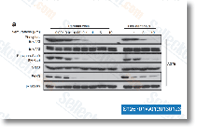
| Source | J Invest Dermatol, 2013, ahead of print. Vemurafenib (PLX4032, RG7204) purchased from Selleck | |
| Method | Western blot | |
| Cell Lines | A375 melanoma cells | |
| Concentrations | 0-10 μM | |
| Incubation Time | 6 h | |
| Results | The activation of Stat3 and the protein expression of PAX3 were both repressed in vemurafenib-sensitive (parental) A375 and UACC62 melanoma cells, but higher vemurafenib concentration were required in resistant A375 and UACC62 melanoma cells. Specifically, vemurafenib at 1 μM inhibited the expression of phospho-Stat3 in sensitive cells, but not in resistant cells. These results suggest that inhibition of Stat3 signaling represents a potential therapeutic strategy to overcome the acquired resistance to vemurafenib in melanoma cells. |
Unresponsiveness of colon cancer to BRAF(V600E) inhibition through feedback activation of EGFR. [Prahallad A, et al. Nature 2012;483(7387):100-3]
MED12 controls the response to multiple cancer drugs through regulation of TGF-β receptor signaling. [Huang S, et al. Cell 2012;151(5):937-50]
MDM4 is a key therapeutic target in cutaneous melanoma. [Gembarska A, et al. Nat Med 2012;18(8):1239-47]
