
Antibodies


Temsirolimus (CCI-779, NSC 683864)
| Size | Price | Stock | Quantity | ||||||||||||||||||||
|---|---|---|---|---|---|---|---|---|---|---|---|---|---|---|---|---|---|---|---|---|---|---|---|
| |||||||||||||||||||||||
 Distributor Tel: +886-2-2827-1197jimmy@new.abscience.com.tw
| Description | Temsirolimus (CCI-779) is a specific mTOR inhibitor with IC50 of 1.76 μM. | |||||
|---|---|---|---|---|---|---|
| Targets | mTOR | |||||
| IC50 | 1.76 μM [1] | |||||
| In vitro | In the absence of FKBP12, Temsirolimus potently inhibits mTOR kinase activity with IC50 of 1.76 μM, similar to that of rapamycin with IC50 of 1.74 μM. Temsirolimus treatment at nanomolar concentrations (10 nM to <5 μM) displays a modest and selective antiproliferative activity via FKBP12-dependent mechanism, but can completely inhibit the proliferation of a broad panel of tumor cells at low micromolar concentrations (5-15 μM), involving FKBP12-independent suppression of mTOR signaling. Temsirolimus treatment at micromolar but not nanomolar concentrations (20 μM) causes a marked decline in global protein synthesis and disassembly of polyribosomes, accompanied by rapid increase in the phosphorylation of translation elongation factor eEF2 and the translation initiation factor eIF2A. [1] Temsirolimus inhibits the phosphorylation of ribosomal protein S6, more potently in PTEN-positive DU145 cells than in PTEN-negative PC-3 cells, and inhibits cell growth and clonogenic survival of both cells in a concentration-dependent manner. [2] Temsirolimus (100 ng/mL) potently inhibits proliferation and induces apoptosis in primary human lymphoblastic leukemia (ALL) cells. [3] | |||||
| In vivo | In the NOD/SCID xenograft models with human ALL, Temsirolimus treatment at 10 mg/kg/day produces a decrease in peripheral blood blasts and in splenomegaly [3] Administration of Temsirolimus (20 mg/kg i.p. 5 days/week) significantly delays the growth of DAOY xenografts by 160% after 1 week and 240% after 2 weeks, compared with controls. Single high-dose of Temsirolimus (100 mg/kg i.p) treatment induces 37% regression of tumor volume within 1 week. Temsirolimus treatment for 2 weeks also delays the growth of rapamycin-resistant U251 xenografts by 148%. [4] Inhibition of mTOR by Temsirolimus improves performance on four different behavioral tasks and decreases aggregate formation in a mouse model of Huntington disease. [5]Administration of Temsirolimus induces significant dose-dependent, antitumor responses against subcutaneous growth of 8226, OPM-2, and U266 xenografts with ED50 of 20 mg/kg and 2 mg/kg for 8226 and OPM-2, respectively, which are associated with inhibited proliferation and angiogenesis, induction of apoptosis, and reduction in tumor cell size. [6] | |||||
| Features | ||||||
| In vitro assay of mTOR catalytic activity | The Flag-tagged wild-type human mTOR (Flag-mTOR) DNA constructs are transiently transfected into HEK293 cells. Protein extraction and purification of Flag-mTOR are carried out 48 hours later. In vitro kinase assays of purified Flag-mTOR in the presence of various concentrations of Temsirolimus without FKBP12 are performed in 96-well plate and detected by dissociation-enhanced lanthanide fluorescent immunoassay (DELFIA) using His6-S6K1 as the substrate. Enzymes is first diluted in kinase assay buffer (10 mM Hepes (pH 7.4), 50 mM NaCl, 50 mM β-glycerophosphate, 10 mM MnCl2, 0.5 mM DTT, 0.25 μM microcystin LR, and 100 μg/mL BSA). To each well, 12 μL of the diluted enzyme is mixed briefly with 0.5 μL Temsirolimus. The kinase reaction is initiated by adding 12.5 μL kinase assay buffer containing ATP and His6-S6K to give a final reaction volume of 25 μL containing 800 ng/mL FLAG-mTOR, 100 μM ATP, and 1.25 μM His6-S6K. The reaction plate is incubated for 2 hours (linear at 1-6 hours) at room temperature with gentle shaking and then terminated by adding 25 μL Stop buffer (20 mM Hepes (pH 7.4), 20 mM EDTA, and 20 mM EGTA). The DELFIA detection of the phosphorylated (Thr-389) His6-S6K is performed at room temperature using a monoclonal anti-P(T389)-p70S6K antibody labeled with Europium-N1-ITC (Eu) (10.4 Eu per antibody). 45 μL of the terminated kinase reaction mixture is transferred to a MaxiSorp plate containing 55 μL PBS. The His6-S6K is allowed to attach for 2 hours after which the wells are aspirated and washed once with PBS. 100 μL of DELFIA buffer with 40 ng/mL Eu-P(T389)-S6K antibody is added. The antibody binding is continued for 1 hour with gentle agitation. The wells are then aspirated and washed four times with PBS containing 0.05% Tween 20 (PBST). 100 μL of DELFIA Enhancement solution is added to each well and the plates are read in a PerkinElmer Victor model plate reader. |
|---|
| Cell lines | A549, H157, H460, H446, HCT116, HT29, SW480, DLD1, Caco2, LNCap, DU145, MDA468, MDA231, HEK293, and PC3-MM2 |
|---|---|
| Concentrations | Dissolved in DMSO, final concentrations ~20 μM |
| Incubation Time | 72 hours |
| Method | Cells are exposed to various concentrations of Temsirolimus for 72 hours. After treatment, viable cell densities are determined by MTS dye conversion using CellTiter AQ assay kit. |
| Animal Models | Female athymic nude mice injected s.c. with DAOY, or U251 cells |
|---|---|
| Dosages | 20 mg/kg |
| Administration | Injection daily 5 times per week |
| Solubility | 30% PEG400/0.5% Tween80/5% propylene glycol, 10 mg/mL |
| NCT Number | Recruitment | Conditions | Sponsor /Collaborators | Start Date | Phases |
|---|---|---|---|---|---|
| NCT00977574 | Active, not recruiting | Endometrial Adenocarcinoma|Endometrial Adenosquamous Cell Carcinoma|Endometrial Clear Cell Carcinoma|Recurrent Endometrial Carcinoma|Stage III Endometrial Carcinoma|Stage IV Endometrial Carcinoma | National Cancer Institute (NCI) | 2009-09 | Phase 2 |
| NCT01016015 | Active, not recruiting | Metastatic Osteosarcoma|Recurrent Adult Soft Tissue Sarcoma|Recurrent Osteosarcoma|Stage III Adult Soft Tissue Sarcoma|Stage IV Adult Soft Tissue Sarcoma | National Cancer Institute (NCI) | 2009-11 | Phase 2 |
| NCT01026792 | Active, not recruiting | Cervical Cancer | NCIC Clinical Trials Group|National Cancer Institute (NCI) | 2009-12 | Phase 2 |
| NCT01196429 | Recruiting | Ovarian Clear Cell Cystadenocarcinoma|Stage III Ovarian Epithelial Cancer|Stage IV Ovarian Epithelial Cancer | National Cancer Institute (NCI) | 2010-08 | Phase 2 |
| NCT01767194 | Suspended | Recurrent Neuroblastoma | National Cancer Institute (NCI) | 2013-02 | Phase 2 |
Download Temsirolimus (CCI-779, NSC 683864) SDF
| Molecular Weight (MW) | 1030.29 |
|---|---|
| Formula | C56H87NO16 |
| CAS No. | 162635-04-3 |
| Storage | 3 years -20℃Powder |
|---|---|
| 6 months-80℃in DMSO | |
| Syonnyms | CCI-779 |
| Solubility (25°C) * | In vitro | DMSO | 75 mg/mL (72 mM) |
|---|---|---|---|
| Water | <1 mg/mL (<1 mM) | ||
| Ethanol | 75 mg/mL (72 mM) | ||
| In vivo | 30% PEG400/0.5% Tween80/5% propylene glycol, | 10 mg/mL | |
| * <1 mg/ml means slightly soluble or insoluble. * Please note that Selleck tests the solubility of all compounds in-house, and the actual solubility may differ slightly from published values. This is normal and is due to slight batch-to-batch variations. | |||
| Chemical Name | Rapamycin, 42-[3-hydroxy-2-(hydroxymethyl)-2-methylpropanoate] |
|---|
| Stock Solution (1ml DMSO) | 1mM | 10mM | 20mM | 30mM |
|---|---|---|---|---|
| Mass(mg) | 1.03029 | 10.3029 | 20.6058 | 30.9087 |
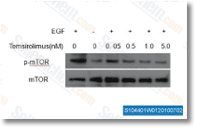 Click to enlarge | Rating | |
| Source | Dr. Zhang of Tianjin Medical University. Temsirolimus (CCI-779, NSC 683864) purchased from Selleck | |
| Method | Western blotting | |
| Cell Lines | Breast cancer cells | |
| Concentrations | 0-5 nM | |
| Incubation Time | 24 h | |
| Results | Temsirolimus treatment resulted in a reduction of mTOR phosphorylation in Breast cancer cells. |
Caffeine induces apoptosis by enhancement of autophagy via PI3K/Akt/mTOR/p70S6K inhibition. [Saiki S, et al. Autophagy 2011;7(2):176-87]
Current status and future perspectives of PI3K and mTOR inhibitor as anticancer drugs in breast cancer. [Zhang X, et al. Curr Cancer Drug Targets 2013;13(2):175-87]
mTOR Inhibitors Control the Growth of EGFR Mutant Lung Cancer Even after Acquiring Resistance by HGF. [Ishikawa D, et al. PLoS One 2013;8(5):e62104]
