
Antibodies


TAE684 (NVP-TAE684) is a potent and selective ALK inhibitor with IC50 of 3 nM, 100-fold more sensitive for ALK than InsR.
| Size | Price | Stock | Quantity | ||||||||||||||||||||
|---|---|---|---|---|---|---|---|---|---|---|---|---|---|---|---|---|---|---|---|---|---|---|---|
| |||||||||||||||||||||||
 Distributor Tel: +886-2-2827-1197jimmy@new.abscience.com.tw
| Description | TAE684 (NVP-TAE684) is a potent and selective ALK inhibitor with IC50 of 3 nM, 100-fold more sensitive for ALK than InsR. | |||||
|---|---|---|---|---|---|---|
| Targets | ALK | |||||
| IC50 | 3 nM [1] | |||||
| In vitro | TAE684 does not exhibit significant cross-reactivity against other kinases. TAE684 potently inhibits the proliferation of Ba/F3 NPM-ALK cells with IC50 of 3 nM, without affecting the survival of Ba/F3 cells even at 1 μM. TAE684 also inhibits proliferation of NPM-ALK-expressing human ALCL cell lines including Karpas-299 and SU-DHL-1 with IC50 of 2–5 nM. Molecular modeling reveals that L258 may be one of the major kinase-selectivity determinants for TAE684. TAE684 treatment results in a rapid and sustained inhibition of phosphorylation of NPM-ALK. TAE684 induces apoptosis and G1 phase arrest in NPM-ALK-expressing Ba/F3 cells and ALCL patient cell lines. [1] TAE684 markedly overcomes Crizotinib-resistance in H3122 CR cells, harboring the fusion oncogene EML4-ALK, decreasing cell growth, suppressing ALK phosphorylation and inducing apoptosis.[2] Neurite outgrowth induced by expression of the mALK R1279Q mutant could be completely inhibited by TAE684 at 30 nM. [3] | |||||
| In vivo | After 4 weeks of treatment with TAE684 at 3 and 10 mg/kg, there is a significant delay in lymphoma development and 100- to 1,000-fold reduction in luminescence signal, without any signs of compound- or disease-related toxicity in Karpas-299 lymphoma model. TAE684 treatment also induces disease regression in established Karpas-299 lymphomas and down-regulates CD30 expression. [1] TAE684 also shows impressive antitumor activity against H3122 CR xenograft tumors. [2] Furthermore, treatment with TAE684 improves the rough eye phenotype of both ALK mutants, especially that seen with ALKR1275Q, whereas Crizotinib has little effect on either phenotype. [3] | |||||
| Features | ||||||
| In vitro Enzyme Assays. | All in vitro enzyme assays are done at Upstate Biotechnology with the exception of InsR and IGF-1R. To determine the IC50 of TAE684 against InsR and IGF-1R a homogeneous time-resolved fluorescence assay is performed. ATP (10 mM) and 20 mg/ml biotinylated PolyEY (Glu, Tyr 4:1) are combined with 50 nL of serial dilutions of TAE684 (10-500 nM) and 4 ng of InsR enzyme in the presence of the kinase reaction buffer (20 mM TrisèŽCl, pH 7.5/10 mM MgCl2/3 mM MnCl2/1 mM DTT/10 mM NaVO4/0.1 mg/ml of BSA). Assays are incubated for 1 hour at ambient temperature. Reactions are terminated by adding 10 mL of the detection solution containing 50 mM EDTA, 500 mM KF, 0.5 mg/ml of BSA, 5 mg/mL Eu3+ cryptate-labeled anti-phosphotyrosine antibody Mab PT66-K, and 5 mg/mL Streptavidin-XLent. The reaction is incubated for half an hour, and fluorescence signals are read on Analyst GT. |
|---|
| Cell lines | Luciferase-expressing Karpas-299, SU-DHL-1, and Ba/F3 cells and transformed Ba/F3 stably expressing NPM-ALK, Bcr-Abl, or TEL-kinase fusion constructs. |
|---|---|
| Concentrations | 1 nM-10 μM |
| Incubation Time | 2–3 days |
| Method | Cells are seeded in 384-well plates (2.5×10⁴ cells per well) and incubated with serial dilutions of TAE684 or DMSO for 2–3 days. Luciferase expression is used as a measure of cell proliferation/survival and is evaluated with the Bright-Glo Luciferase Assay System. IC50 values are generated by using XLFit software. |
| Animal Models | Karpas-299 xenografts are established in 4- to 6-week old female Fox Chase SCIDBeige mice. |
|---|---|
| Dosages | 1, 3, and 10 mg/kg |
| Administration | Once daily by oral gavage for 3 weeks |
| Solubility | 30% PEG400/0.5% Tween80/5% propylene glycol, pH 4 10 mg/mL |
Download TAE684 (NVP-TAE684) SDF
| Molecular Weight (MW) | 614.2 |
|---|---|
| Formula | C30H40ClN7O3S |
| CAS No. | 761439-42-3 |
| Storage | 3 years -20℃Powder |
|---|---|
| 6 months-80℃in DMSO | |
| Syonnyms | N/A |
| Solubility (25°C) * | In vitro | DMSO | 3 mg/mL (4 mM) |
|---|---|---|---|
| Water | <1 mg/mL (<1 mM) | ||
| Ethanol | <1 mg/mL (<1 mM) | ||
| In vivo | 30% PEG400/0.5% Tween80/5% propylene glycol, pH 4 | 10 mg/mL | |
| * <1 mg/ml means slightly soluble or insoluble. * Please note that Selleck tests the solubility of all compounds in-house, and the actual solubility may differ slightly from published values. This is normal and is due to slight batch-to-batch variations. | |||
| Chemical Name | 5-chloro-N4-(2-(isopropylsulfonyl)phenyl)-N2-(2-methoxy-4-(4-(4-methylpiperazin-1-yl)piperidin-1-yl)phenyl)pyrimidine-2,4-diamine |
|---|
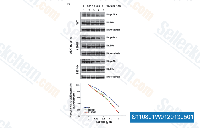 Click to enlarge | Rating | |
| Source | Neoplasia Vol. 13, No. 8, 2011. TAE684 (NVP-TAE684) purchased from Selleck | |
| Method | Western blot | |
| Cell Lines | H-1299 cells | |
| Concentrations | 0.03-1uM | |
| Incubation Time | ||
| Results | Treatment efficiently inhibited the cell proliferation and phospho-Y1604 ALK expression of H694R or E1384K mutant ALK, but also to a degree higher than that of wild-type ALK. |
Widespread potential for growth-factor-driven resistance to anticancer kinase inhibitors. [Wilson TR, et al. Nature 2012;487(7408):505-9]
MED12 controls the response to multiple cancer drugs through regulation of TGF-β receptor signaling. [Huang S, et al. Cell 2012;151(5):937-50]
Using tandem mass spectrometry in targeted mode to identify activators of class IA PI3K in cancer. [Yang X, et al. Cancer Res 2011;71(18):5965-75]
