
Antibodies


SP600125 is a broad-spectrum JNK inhibitor for JNK1, JNK2 and JNK3 with IC50 of 40 nM, 40 nM and 90 nM, respectively; 10-fold greater selectivity against MKK4, 25-fold greater selectivity against MKK3, MKK6, PKB, and PKCα, and 100-fold selectivity against ERK2, p38, Chk1, EGFR etc.
| Size | Price | Stock | Quantity | ||||||||||||||||
|---|---|---|---|---|---|---|---|---|---|---|---|---|---|---|---|---|---|---|---|
| |||||||||||||||||||
 Distributor Tel: +886-2-2827-1197jimmy@new.abscience.com.tw
| Description | SP600125 is a broad-spectrum JNK inhibitor for JNK1, JNK2 and JNK3 with IC50 of 40 nM, 40 nM and 90 nM, respectively; 10-fold greater selectivity against MKK4, 25-fold greater selectivity against MKK3, MKK6, PKB, and PKCα, and 100-fold selectivity against ERK2, p38, Chk1, EGFR etc. | |||||
|---|---|---|---|---|---|---|
| Targets | JNK1 | JNK2 | JNK3 | Aurora A | Flt3 | TRKA |
| IC50 | 40 nM | 40 nM | 90 nM [1] | 60 nM | 90 nM | 70 nM [4] |
| In vitro | SP600125 is originally characterized as a selective ATP-competitive inhibitor of c-Jun N-terminal kinase JNK. In Jurkat T cells, SP600125 inhibits the phosphorylation of c-Jun with IC50 of 5 μM to 10 μM. In CD4+ cells, such as Th0 cells isolated from either human cord or peripheral blood, SP600125 blocks cell activation and differentiation and inhibits the expression of inflammatory genes COX-2, IL-2, IL-10, IFN-γ, and TNF-α, with IC50 of 5 μM to 12 μM. [1] However, later studies reveal that SP600125 also suppresses aryl hydrocarbon receptor (AhR) [2], Mps1 [3], and a panel of other serine/threonine kinases, including Aurora kinase A, FLT3, MELK, and TRKA [4]. In a mouse beta cells MIN6, SP600125 (20 μM) induces the phosphorylation of p38 MAPK and its downstream CREB-dependent promoter activation. [5] In HCT116 cells, SP600125 (20 μM) blocks the G2 phase to mitosis transition and induces endoreplication. This ability of SP600125 is independent of JNK inhibition, but due to its inhibition of CDK1-cyclin B activation upstream of Aurora A and Polo-like kinase 1. [6] | |||||
| In vivo | In mice, SP600125 (15 mg/kg or 30 mg/kg) significantly inhibits lipopolysaccharide (LPS)-induced TNF-α expression and anti-CD3-induced apoptosis of CD4+ CD8+ thymocytes. [1] | |||||
| Features | ||||||
| In Vitro Kinase Assays | The potency of SP600125 towards kinases, including MPS1, JNK, and Aurora kinase A, is determined based on the specific measurement of radioactive phosphotransfer to the substrate. For each enzyme, the absolute Kmvalues for ATP and the specific substrate are initially determined and each assay is then run at optimized [ATP] (2·αKm) and [substrate] (5·Km) concentrations. MPS1 activity is measured using 5 nM of MPS1 recombinant protein in 50 mM HEPES pH 7.5, 2.5 mM MgCl2, 1 mM MnCl2, 1 mM DTT, 3 μM NaVO3, 2 mM β-glycerophosphate, 0.2 mg/mL BSA, 200 μM P38-βtide substrate-peptide (KRQADEEMTGYVATRWYRAE), and 8 μM ATP with 1.5 nM 33P-γ-ATP. Ten serial 1:3 dilutions (from 30 μM to 1.5 nM) of SP600125 are tested and IC50 determined. |
|---|
| Cell lines | HCT116, A2780, and U2OS cells |
|---|---|
| Concentrations | 0–5 μM, dissolved in 0.1% DMSO |
| Incubation Time | 72 hours |
| Method | Cells are seeded in 384 well-plates. One day after seeding, the cells are treated with SP600125 for 72 hours and the plates are then processed using a CellTiter-Glo assay. Inhibitory activity is evaluated comparing treated versus control data and IC50 value of proliferation is calculated. |
| Animal Models | Mouse LPS/TNF model (female CD-1) |
|---|---|
| Dosages | 15 or 30 mg/kg |
| Administration | Administered via intravenous injection or orally |
| Solubility | 30% PEG400/0.5% Tween80/5% propylene glycol, 30 mg/mL |
| Molecular Weight (MW) | 220.23 |
|---|---|
| Formula | C14H8N2O |
| CAS No. | 129-56-6 |
| Storage | 3 years -20℃Powder |
|---|---|
| 6 months-80℃in DMSO | |
| Syonnyms | N/A |
| Solubility (25°C) * | In vitro | DMSO | 44 mg/mL (199 mM) |
|---|---|---|---|
| Water | <1 mg/mL (<1 mM) | ||
| Ethanol | <1 mg/mL (<1 mM) | ||
| In vivo | 30% PEG400/0.5% Tween80/5% propylene glycol, | 30 mg/mL | |
| * <1 mg/ml means slightly soluble or insoluble. * Please note that Selleck tests the solubility of all compounds in-house, and the actual solubility may differ slightly from published values. This is normal and is due to slight batch-to-batch variations. | |||
| Chemical Name | 2H-Dibenzo[cd,g]indazol-6-one |
|---|
| Stock Solution (1ml DMSO) | 1mM | 10mM | 20mM | 30mM |
|---|---|---|---|---|
| Mass(mg) | 0.22023 | 2.2023 | 4.4046 | 6.6069 |
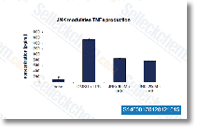 Click to enlarge | Rating | |
| Source | Lee lay hoon from National University of Singapore.SP600125 purchased from Selleck | |
| Method | ELISA | |
| Cell Lines | Bone marrow derived macrophages | |
| Concentrations | 10-20 μM | |
| Incubation Time | 24 h | |
| Results | SP600125 treatment resulted in a reduction of TNF-a production. |
ROS are required for mouse spermatogonial stem cell self-renewal. [Morimoto H, et al. Cell Stem Cell 2013;12(6):774-86]
Dynamic expression profiling of Type I and Type III Interferon-stimulated hepatocytes reveals a stable hierarchy of gene expression. [Bolen CR, et al. Hepatology 2013;10.1002/hep.26657]
Activation of MAPK pathways due to DUSP4 loss promotes cancer stem cell-like phenotypes in basal-like breast cancer. [Balko JM, et al. Cancer Res 2013;73(20):6346-58]
