
- 貨號 Cat. No.
- S1154
- 規格 Size
- 5~200mg
- 品牌 Brand
- Selleckchem
Description
SNS-314 Mesylate
SNS-314 Mesylate is a potent and selective inhibitor of Aurora A, Aurora B and Aurora C with IC50 of 9 nM, 31 nM, and 3 nM, respectively. It is less potent to Trk A/B, Flt4, Fms, Axl, c-Raf and DDR2. Phase 1.
Size |
Price |
Stock |
Quantity |
|
|---|
10mM/1mLIn DMSO |
USD 315 |
In stock |
0
1
2
3
4
5
6
7
8
9
10
|
5mg |
USD 151 |
In stock |
0
1
2
3
4
5
6
7
8
9
10
|
10mg |
USD 264 |
In stock |
0
1
2
3
4
5
6
7
8
9
10
|
50mg |
USD 844 |
In stock |
0
1
2
3
4
5
6
7
8
9
10
|
200mg |
USD 2356 |
In stock |
0
1
2
3
4
5
6
7
8
9
10
|
|
 Distributor Tel: +886-2-2827-1197jimmy@new.abscience.com.tw
Biological Activity
Description |
SNS-314 Mesylate is a potent and selective inhibitor of Aurora A, Aurora B and Aurora C with IC50 of 9 nM, 31 nM, and 3 nM, respectively. It is less potent to Trk A/B, Flt4, Fms, Axl, c-Raf and DDR2. Phase 1. |
|---|
Targets |
Aurora A |
Aurora B |
Aurora C |
|
|
|
|---|
IC50 |
9 nM |
31 nM |
3.4 nM [1] |
|
|
|
|---|
In vitro |
In HCT116 colorectal carcinoma cell line, with intact or depleted p53 protein levels, SNS-314 Mesylate shows enhanced efficacy when administered sequentially with other standard chemotherapeutic agents and the most profound synergies are identified for agents that activate the spindle assembly checkpoint, e.g., docetaxel and vincristine. [2] A recent study shows that SNS-314 Mesylate shows potent antiproliferative activity in HCT116 cells and inhibits soft agar colony formation. [3] |
|---|
In vivo |
The sequential treatment with SNS-314 Mesylate followed by docetaxel 24 hours later produces a significant 72.5% tumor growth inhibition of HCT116 xenografts, while docetaxel and SNS-314 Mesylate as single agents produce no significant inhibition of HCT116 tumor growth. [2] In the HCT116 human colon cancer xenograft model, administration of 50 and 100 mg/kg SNS-314 Mesylate results a dose-dependent inhibition of histone H3 phosphorylation, indicating effective Aurora-B inhibition in vivo. In addition, HCT116 tumors from animals treated with SNS-314 Mesylate exhibits potent and sustained responses including reduction of phosphorylated histone H3 levels, increased caspase-3 and appearance of increased nuclear size. [3] |
|---|
Features |
|
|---|
Protocol(Only for Reference)
Kinase Assay: [1]
Aurora-A Kinase Assay |
Humanized mouse Aurora A (amino acids 107-403) is expressed in E. coli as described previously. For IC50 assays, compounds are titrated three-fold in DMSO and diluted 12.5-fold into assay buffer (10 mM Tris HCl pH 7.2, 10 mM MgCl2, 0.05% NaN3, 0.01% Tween-20, and 0.1% BSA). Compounds are then diluted 4-fold into assay buffer containing Aurora A and FAM-PKAtide at final concentrations of 2 nM and 50 nM, respectively. The kinase reaction is initiated by adding ATP in assay buffer at a final concentration of 10 mM and incubated at 21 °C for 25 minutes. As a positive control, DMSO is added instead of compound and as a negative control assay buffer is added instead of Aurora A. Both control reactions are conducted in triplicate. To detect phosphorylated PKAtide, the kinase reaction is combined with Progressive Binding Solution (1:400 Progressive Binding Reagent, 1 × Buffer A, Molecular Devices) in a 1:3 ratio. The mixture is incubated for 30 minutes at 21 °C and the plate is scanned on an Analyst AD with excitation at 485 nm and emission at 530 nm. The percent relative enzymatic activity is calculated by normalizing the mP value for each well to the average positive control. Relative enzymatic activity values are plotted as a function of the logarithm of compound concentration and IC50 values are generated in GraphPad Prism software using a sigmoidal dose-response curve-fit. IC50’s are calculated as the concentration of compound at which enzymatic activity i |
|---|
Cell Assay: [2]
Cell lines |
HCT116 SCR and HCT116 p53 RNAi cells |
|---|
Concentrations |
~125 nM |
|---|
Incubation Time |
48 hours |
|---|
Method |
Viability is measured using the CellTiter-Blue cell viability assay. Cells are treated as described above, although with a 5-day incubation period. Cytotoxicity is determined by measuring intracellular ATP using the CellTiter-Glo Luminescence Cell Viability Assay. Cells are seeded in white 96-well tissue culture plates at a density of 1.5-2 × 10³ cells/well, and a serial dilution of SNS-314 is dosed in combination with fixed concentrations of either docetaxel or vincristine for a total of 72 hours. Viability is determined as the ratio between the ATP in treated cells versus control cells. Apoptosis is measured using the caspase-Glo 3/7 system. Cells are plated in white 96-well plates as described above and treated first with SNS-314 for 24 hours, washed with 200 μL of 1× PBS, and fresh medium is added with the second agent for 24 hours. |
|---|
Animal Study: [2]
Animal Models |
HCT116 cells are injected s.c. into the right flank of nu/nu mice. |
|---|
Dosages |
≤42.5 mg/kg |
|---|
Administration |
Administered via i.p. |
|---|
Solubility |
15% Captisol, 30 mg/mL |
|---|
1
References
Download SNS-314 Mesylate SDF
Molecular Weight (MW) |
527.04 |
|---|
Formula |
C18H15ClN6OS2.CH4O3S
|
|---|
CAS No. |
1146618-41-8 |
|---|
Storage |
3 years -20℃Powder |
|---|
6 months-80℃in DMSO |
Syonnyms |
N/A |
|---|
Solubility (25°C) * |
In vitro |
DMSO |
105 mg/mL (199 mM) |
|---|
Water |
6 mg/mL (11 mM) |
Ethanol |
<1 mg/mL (<1 mM) |
In vivo |
15% Captisol, |
30 mg/mL |
* <1 mg/ml means slightly soluble or insoluble.
* Please note that Selleck tests the solubility of all compounds in-house, and the actual solubility may differ slightly from published values. This is normal and is due to slight batch-to-batch variations. |
Chemical Name |
M1-(3-chlorophenyl)-3-(5-(2-(thieno[3,2-d]pyrimidin-4-ylamino)ethyl)thiazol-2-yl)urea Mesylate |
|---|
Stock Solution (1ml DMSO) |
1mM |
10mM |
20mM |
30mM |
|---|
Mass(mg) |
0.52704 |
5.2704 |
10.5408 |
15.8112 |
Customer Reviews (1)
Click to enlarge |
Rating |
|
Source |
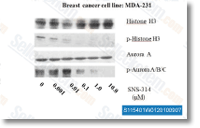
Dr. Zhang of Tianjin Medical University. SNS-314 Mesylate purchased from Selleck |
Method |
Western blot |
Cell Lines |
MDA-231 cells |
Concentrations |
0-10 μM |
Incubation Time |
|
Results |
SNS-314 treatment resulted in a reduction of Histone H3 and Aurora A/B/C phosphorylation. |
Product Citations (2)
詢價 / 洽詢此產品


