
Antibodies


Selumetinib (AZD6244) is a potent, highly selective MEK1 inhibitor with IC50 of 14 nM, also inhibits ERK1/2 phosphorylation with IC50 of 10 nM, no inhibition to p38α, MKK6, EGFR, ErbB2, ERK2, B-Raf, etc. Phase 1/2.
| Size | Price | Stock | Quantity | ||||||||||||||||||||
|---|---|---|---|---|---|---|---|---|---|---|---|---|---|---|---|---|---|---|---|---|---|---|---|
| |||||||||||||||||||||||
 Distributor Tel: +886-2-2827-1197jimmy@new.abscience.com.tw
| Description | Selumetinib (AZD6244) is a potent, highly selective MEK1 inhibitor with IC50 of 14 nM, also inhibits ERK1/2 phosphorylation with IC50 of 10 nM, no inhibition to p38α, MKK6, EGFR, ErbB2, ERK2, B-Raf, etc. Phase 1/2. | |||||
|---|---|---|---|---|---|---|
| Targets | MEK1 | |||||
| IC50 | 14 nM [1] | |||||
| In vitro | AZD6244 is not competitive with ATP and inactivates the ERK1/2 phosphorylation with IC50 concentrations below 40 nM. AZD6244 also inhibits the growth of primary HCC cells through inhibition of ERK1/2 and p90RSKphosphorylation, accompanied with elevation of the cleavage of caspase-3 and caspase-7, and cleaved poly(ADP)ribose polymerase. AZD6244 has little effects on the p38, c-Jun-NH2-kinase, phosphatidylinositol 3-kinase, and MEK5/ERK5 pathways. [1] AZD6244 is sensitive to Raf mutations in breast cancer cell lines and Ras mutations in NSCLC cell lines. [2] | |||||
| In vivo | AZD6244 significantly inhibits phosphorylation of ERK1/2 in 2-1318, 5-1318, 26-1004 and 4-1318 xenografts and induces apoptosis in primary 2-1318 cells by activating the caspase pathway. [1] AZD6244 could inhibit the tumor growth in HT-29 xenograft, which is a colorectal tumor model carrying a B-Raf mutation, at a dose of 100 mg/kg and the tumor growth inhibition of AZD6244 is better than it of Gemcitabine. [3] Otherwise AZD6244 could inhibit HCC xenografts tumor growth, which associated with increased apoptosis and down-regulation of cell cycle regulators, including cyclin D1, Cdc-2, CDK2 and 4, cyclin B1, and c-Myc. [4] | |||||
| Features | First MEK inhibitor being tested in Phase II clinical trials. | |||||
| Assay of MEK Kinase Activity | Anti-MEK1 antibody is used to immunoprecipitate MEK1 molecules. MEK kinase activity is measured as the ability of immuno-isolated MEK1 to activate recombinant ERK1 in a coupled assay using MBP as the end point of the assay. Phosphorylated MBP is resolved on a 14% SDS-PAGE gel and vacuum-dried before exposure to X-ray film. |
|---|
| Cell lines | Primary HCC cell lines including 2-1318, 4-1318 and 26-1004 cells |
|---|---|
| Concentrations | ~ 10 μM |
| Incubation Time | 24 or 48 hours |
| Method | Cells are seeded at a density of 2.0 × 10⁴. After 48 hours incubation, the cells are rinsed twice with culture media. Cells are treated with various concentrations of AZD6244 for 24 or 48 hours. Cell viability is determined by the 3-(4,5-dimethylthiazol-2y1)-2,5-diphenyltetrazolium bromide (MTT) assay. Cell proliferation is assayed using a bromodeoxyuridine kit. |
| Animal Models | HCC xenografts in mice homozygous for the SCID (severe combined immunodeficiency) mutation |
|---|---|
| Dosages | 50 or 100mg/kg |
| Administration | Administered via p.o. |
| Solubility | 0.5% methylcellulose/0.2% Tween 80 30 mg/mL |
| NCT Number | Recruitment | Conditions | Sponsor /Collaborators | Start Date | Phases |
|---|---|---|---|---|---|
| NCT01750281 | Recruiting | Locally Advanced or Metastatic Non Small Cell Lung Cancer Stage IIIb - IV | AstraZeneca | 2012-12 | Phase 2 |
| NCT01783197 | Recruiting | Non Small Cell Lung Cancer | NCIC Clinical Trials Group|AstraZeneca | 2013-01 | Phase 1 |
| NCT01859182 | Terminated | Adenocarcinoma of the Gallbladder|Adenocarcinoma With Squamous Metaplasia of the Gallbladder|Adult Primary Cholangiocellular Carcinoma|Advanced Adult Primary Liver Cancer etc. | National Cancer Institute (NCI) | 2013-01 | Phase 2 |
| NCT01809210 | Recruiting | Locally Advanced or Metastatic Non Small Cell Lung Cancer Stage IIIB -IV | AstraZeneca | 2013-04 | Phase 1 |
| NCT01843062 | Not yet recruiting | Differentiated Thyroid Cancer | AstraZeneca | 2013-06 | Phase 2 |
Download Selumetinib (AZD6244) SDF
| Molecular Weight (MW) | 457.68 |
|---|---|
| Formula | C17H15BrClFN4O3 |
| CAS No. | 606143-52-6 |
| Storage | 3 years -20℃Powder |
|---|---|
| 6 months-80℃in DMSO | |
| Syonnyms | ARRY-142886 |
| Solubility (25°C) * | In vitro | DMSO | 92 mg/mL (201 mM) |
|---|---|---|---|
| Water | <1 mg/mL (<1 mM) | ||
| Ethanol | <1 mg/mL (<1 mM) | ||
| In vivo | 0.5% methylcellulose/0.2% Tween 80 | 30 mg/mL | |
| * <1 mg/ml means slightly soluble or insoluble. * Please note that Selleck tests the solubility of all compounds in-house, and the actual solubility may differ slightly from published values. This is normal and is due to slight batch-to-batch variations. | |||
| Chemical Name | 6-(4-bromo-2-chlorophenylamino)-7-fluoro-N-(2-hydroxyethoxy)-3-methyl-3H-benzo[d]imidazole-5-carboxamide |
|---|
| Stock Solution (1ml DMSO) | 1mM | 10mM | 20mM | 30mM |
|---|---|---|---|---|
| Mass(mg) | 0.45768 | 4.5768 | 9.1536 | 13.7304 |
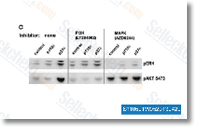 Click to enlarge | Rating | |
| Source | Oncogene, 2012, 31, 3277–3286. Selumetinib (AZD6244) purchased from Selleck | |
| Method | Western Blot | |
| Cell Lines | HEK-293 cells | |
| Concentrations | 1 uM | |
| Incubation Time | ||
| Results | We cultured HEK-293 cellsstably overexpressing p37d or p110d with the general PI3K –inhibitor, LY294002, or the MAPK-inhibitor, AZD6244. The inhibitors strongly affected the levels ofphosphorylated AKT S473 and ERK. |
Widespread potential for growth-factor-driven resistance to anticancer kinase inhibitors. [Wilson TR, et al. Nature 2012;487(7408):505-9]
Melanomas acquire resistance to B-RAF(V600E) inhibition by RTK or N-RAS upregulation. [Nazarian R, et al. Nature 2010;468(7326):973-7]
COT drives resistance to RAF inhibition through MAP kinase pathway reactivation. [Johannessen CM, et al. Nature 2010;468(7326):968-72]
