
Antibodies


Rucaparib (AG-014699, PF-01367338) is an inhibitor of PARP with Ki of 1.4 nM for PARP1, also showing binding affinity to eight other PARP domains. Phase 1/2.
| Size | Price | Stock | Quantity | ||||||||||||||||||||
|---|---|---|---|---|---|---|---|---|---|---|---|---|---|---|---|---|---|---|---|---|---|---|---|
| |||||||||||||||||||||||
 Distributor Tel: +886-2-2827-1197jimmy@new.abscience.com.tw
| Description | Rucaparib (AG-014699, PF-01367338) is an inhibitor of PARP with Ki of 1.4 nM for PARP1, also showing binding affinity to eight other PARP domains. Phase 1/2. | |||||
|---|---|---|---|---|---|---|
| Targets | PARP | |||||
| IC50 | 1.4 nM (Ki) [1] | |||||
| In vitro | Rucaparib is a potent inhibitor of purified full-length human PARP-1 and shows higher inhibition of cellular PARP in LoVo and SW620 cells. Besides, Rucaparib binds detectably to eight other PARP domains, including PARP2, 3, 4, 10, 15, 16, TNKS1 and TNKS2. [1] [2] The radio-sensitization by Rucaparib is due to downstream inhibition of activation of NF-κB, and is independent of SSB repair inhibition. Rucaparib could target NF-κB activated by DNA damage and overcome toxicity observed with classical NF-κB inhibitors without compromising other vital inflammatory functions. [3] Rucaparib inhibits PARP-1 activity by 97.1% at a concentration of 1 μM in permeabilised D283Med cells. [4] | |||||
| In vivo | Rucaparib is not toxic but significantly enhances temozolomide-induced TGD in the DNA repair protein-competent D384Med xenografts. Pharmacokinetics studies also show that Rucaparib is detected in the brain tissue, which indicates that Rucaparib has potential in intra-cranial malignancy therapy. [4] Rucaparib significantly potentiates the cytotoxicity of topotecan and temozolomide in NB-1691, SH-SY-5Y, and SKNBE (2c) cells. Rucaparib enhances the antitumor activity of temozolomide and indicates complete and sustained tumor regression in NB1691 and SHSY5Y xenografts. [5] | |||||
| Features | The first PARP inhibitor used in clinical trials combined with temozolomide. | |||||
| Ki Determination | Inhibition of human full-length recombinant PARP-1 by [32P]NAD+ incorporation is measured. The [32P]ADP-ribose incorporated into acid insoluble material is quantified using a PhosphorImager. Ki is calculated by nonlinear regression analysis. |
|---|---|
| Inhibition of PARP activity | Inhibition of PARP activity in 5 × 10³ D283Med cells is measured using various concentrations of Rucaparib (0-1 μM), compared with DMSO-only. Maximally stimulated PARP activity is measured in samples of permeabilised cells by immunological detection of the amount of poly(ADP-ribose) (PAR) formed, using the 10H anti-PAR antibody, during a 6-min incubation with NAD+ and oligonucleotide (substrate and activator). A PAR standard curve using a GCLP-validated assay is used as reference for the assay. [4] |
| Cell lines | D425Med, D283Med and D384Med cells |
|---|---|
| Concentrations | 0.4 μM |
| Incubation Time | 3 or 5 days |
| Method | Medulloblastoma cell lines are seeded in 96-well plates at a density of 1 × 10³, 3 × 10³ and 3 × 10³, respectively. At 24 hours (D384Med) or 48 hours (D283Med and D425Med) after seeding, the cells are exposed to various concentrations of temozolomide in the presence or absence of 0.4 μM Rucaparib. After 3 days (D425Med and D384Med) or 5 days (D283Med) of culture, cell viability is evaluated by a XTT cell proliferation kit assay. Cell growth is expressed as a percentage in relation to DMSO or 0.4 μM Rucaparib-alone controls. The concentration of temozolomide, alone or in combination with Rucaparib that inhibited growth by 50% (GI50) is calculated. The potentiation factor 50 (PF50) is defined as the ratio of the GI50 of temozolomide in the presence of Rucaparib to the GI50 of temozolomide alone. |
| Animal Models | CD-1 nude mice bearing established D283Med xenografts |
|---|---|
| Dosages | 1 mg/kg |
| Administration | One or four daily by i.p. |
| Solubility | 30% propylene glycol, 5% Tween 80, 65% D5W, 30 mg/mL |
| NCT Number | Recruitment | Conditions | Sponsor /Collaborators | Start Date | Phases |
|---|---|---|---|---|---|
| NCT00664781 | Recruiting | brca1 Mutation Carrier|brca2 Mutation Carrier|Breast Cancer|Ovarian Cancer | Cancer Research UK | 2007-12 | Phase 2 |
| NCT01009190 | Recruiting | Advanced Solid Tumors | Clovis Oncology, Inc. | 2010-02 | Phase 1 |
| NCT01482715 | Recruiting | Metastatic Solid Tumor|Breast Cancer|Ovarian Cancer | Clovis Oncology, Inc. | 2011-11 | Phase 1|Phase 2 |
Download Rucaparib (AG-014699,PF-01367338) SDF
| Molecular Weight (MW) | 421.36 |
|---|---|
| Formula | C19H18FN3O.H3PO4 |
| CAS No. | 459868-92-9 |
| Storage | 3 years -20℃Powder |
|---|---|
| 6 months-80℃in DMSO | |
| Syonnyms | AG-014447 |
| Solubility (25°C) * | In vitro | DMSO | 84 mg/mL (199 mM) |
|---|---|---|---|
| Water | <1 mg/mL (<1 mM) | ||
| Ethanol | <1 mg/mL (<1 mM) | ||
| In vivo | 30% propylene glycol, 5% Tween 80, 65% D5W, | 30 mg/mL | |
| * <1 mg/ml means slightly soluble or insoluble. * Please note that Selleck tests the solubility of all compounds in-house, and the actual solubility may differ slightly from published values. This is normal and is due to slight batch-to-batch variations. | |||
| Chemical Name | 8-fluoro-5-(4-((methylamino)methyl)phenyl)-3,4-dihydro-2H-azepino[5,4,3-cd]indol-1(6H)-one phosphoric acid |
|---|
| Stock Solution (1ml DMSO) | 1mM | 10mM | 20mM | 30mM |
|---|---|---|---|---|
| Mass(mg) | 0.42136 | 4.2136 | 8.4272 | 12.6408 |
 Click to enlarge | Rating | |
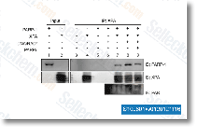
| Source | J Biol Chem, 2012, 287(47), 39824-33. Rucaparib (AG-014699,PF-01367338) purchased from Selleck | |
| Method | Western Blotting | |
| Cell Lines | HaCaT cells | |
| Concentrations | 1 μM | |
| Incubation Time | 30 min | |
| Results | preincubation of purified PARP-1 with AG-014699, a potent PARP inhibitor , prior to PARP-1 activation led to decreased associa-tion between PARP-1 and XPA. |
Embryonic lethal phenotype reveals a function of TDG in maintaining epigenetic stability. [Cortázar D, et al. Nature 2011;470(7334):419-23]
BMN 673, a novel and highly potent PARP1/2 inhibitor for the treatment of human cancers with DNA repair deficiency. [Shen Y, et al. Clin Cancer Res 2013;19(18):5003-15]
Co-targeting Deoxyribonucleic Acid-Dependent Protein Kinase and Poly(Adenosine Diphosphate-Ribose) Polymerase-1 Promotes Accelerated Senescence of Irradiated Cancer Cells. [Azad A, et al. Int J Radiat Oncol Biol Phys 2013;88(2):385-94]
