
Antibodies


Roscovitine (Seliciclib, CYC202) is a potent and selective CDK inhibitor for Cdc2, CDK2 and CDK5 with IC50 of 0.65 μM, 0.7 μM and 0.16 μM. It shows little effect on CDK4/6. Phase 2.
| Size | Price | Stock | Quantity | ||||||||||||||||
|---|---|---|---|---|---|---|---|---|---|---|---|---|---|---|---|---|---|---|---|
| |||||||||||||||||||
 Distributor Tel: +886-2-2827-1197jimmy@new.abscience.com.tw
| Description | Roscovitine (Seliciclib, CYC202) is a potent and selective CDK inhibitor for Cdc2, CDK2 and CDK5 with IC50 of 0.65 μM, 0.7 μM and 0.16 μM. It shows little effect on CDK4/6. Phase 2. | |||||
|---|---|---|---|---|---|---|
| Targets | Cdc2/cyclin B | CDK2/cyclin A | CDK2/cyclin E | CDK5/p35 | ||
| IC50 | 0.65 μM | 0.7 μM | 0.7 μM | 0.16 μM [1] | ||
| In vitro | Roscovitine displays high efficiency and high selectivity towards some cyclin-dependent kinases with IC50 of 0.65, 0.7, 0.7 and 0.16 μM for cdc2/cyclin B, cdk2/cyclin A, cdk2/cyclin E and cdk5/p53, respectively. [1]Roscovitine reversibly inhibits the prophaselmetaphase transition in the micromolar range of starfish oocytes and sea urchin embryos, inhibits in vitro M-phase-promoting factor activity and in vitro DNA synthesis in Xenopus egg extracts, and suppresses the proliferation of mammalian cell lines with an average IC50 of 16 μM. [1] In mesangial cells, Roscovitine results in a dose-dependent reduction of CDK2 activity that at concentrations of 7.5, 12.5 and 25 mM, Roscovitine causes a 25, 50% and 100% decrease in CDK2 activity, respectively. [2] A recent study shows that Roscovitine inhibits cdk5 kinase activity, cell proliferation, multicellular development, and cdk5 nuclear translocation in Dictyostelium discoideum, without affecting the expression of cdk5 protein during axenic growth. [3] | |||||
| In vivo | Roscovitine, at a dose of 50 mg/kg, significantly inhibits growth of The Ewing’s sarcoma family of tumors (ESFT) xenografts. [4] Roscovitine enhances the antitumor effect of doxorubicin without increased toxicity with a mechanism that involves cell cycle arrest rather than apoptosis in nude mice bearing established MCF7 xenografts. [5] | |||||
| Features | ||||||
| Enzymes | Kinases activities are assayed at 30 °C in buffer C. Blank values are subtracted from the data and activities calculated as molar amount of phosphate incorporated in protein acceptor during a 10-minute incubation. Controls are performed with appropriate dilutions of DMSO. In a few cases, phosphorylation of the substrate is assessed by autoradiography after SDS/PAGE. p34cdc2/cyclin B is purified from M-phase starfish (M. glacialis) oocytes by affinity chromatography. It is assayed with 1 mg histone Hl/mL, in the presence of 15 μM [γ-32P]ATP (3000 Ci/mmol; 1 mCi/mL) in a final volume of 30 μL. After a 10-minute incubation at 30 °C, 25-μL aliquots of supernatant are spotted onto pieces of Whatman P81 phosphocellulose paper, and, after 20 seconds, the filters are washed five times (for at least 5 minutes each time) in a solution of 10mL phosphoric acid/L water. The wet filters are transferred into 6-mL plastic scintillation vials, 5 mL ACS scintillation fluid is added and the radioactivity measured in a Packard counter. The kinase activity is expressed as molar amount of phosphate incorporated in histone H1 during a 10-minutes incubation or as a percentage of maximal activity. p33cdk2/cyclin A and p33cdk2/cyclinE are reconstituted from extracts of sf9 insect cells infected with various baculoviruses. Cyclins A and E are fusion proteins with glutathione S-transferase and the complexes are purified on glutathione-agarose beads. Kinase activities are assayed with 1 mg/mL histone H1, in the presence of 15 μM [γ-32P]ATP, during 10 minutes, in a final volume of 30 μL, as described for the p34cdc2/cyclin B kinase. p33cdk5/p35 is purified from bovine brain, excluding the Mono S-chromatographic step. The active fractions from the Superose 12 column are pooled and concentrated to a final concentration of approximately 25 μg enzyme/mL. The kinase is assayed with 1 mg/mL histone HI in the presence of 15 μM [γ-32P]ATP, during 10 minutes in a final volume of 30 μL, as described for the p34cdc2/cyclin B kinase. p33cdk5/cyclin D1 is obtained from insect cell lysates. Cdk4 is a fusion protein with glutathione-S-transferase and the active complex is purified on glutathione-agarose beads. Its kinase activity is assayed with purified retinoblastoma protein (complexed with glutathione-S-transferase) in the presence of 15 μM [γ-32P]ATP, in a final volume of 30 μL. After a 15-minute incubation, 30 μL Laemmli sample buffer is added. The phosphorylated substrate is resolved by 10 % SDS/PAGE and analysed by autoradiography by overnight exposure to Hyperfilm MP and densitometry. p33cdk4/cyclinD 2 is obtained from insect cell lysates. It is assayed with purified retinoblastoma protein (complexed with glutathione-S-transferase) in the presence of 15 μM [γ-32P]ATP in a final volume of 30 μL. After a 30-minute incubation, 30 μL Laemmli sample buffer is added. The phosphorylated substrate is resolved by 10% SDS/PAGE and analysed by autoradiography by overnight exposure to Hyperfilm MP and densitometry. MAP kinase erkl (tagged with glutathione-S-transferase), is expressed in bacteria, purified on glutathione-agarose beads and assayed with 1 mg myelin basic protein/ml in the presence of 15 μM [γ-32P]ATP as described above for the p34cdc2cyclin B kinase. His-tagged erkl and erk2 are activated in vitro by mitogen-activated protein kinase kinase, purified (Ni-affinity and Mono Q) and assayed as described above during 10 minutes in a final volume of 30 μL. Protein kinase C isoforms are purified from baculovirus infected sf9 insect cells and assayed with 1 mg/mL protamine sulfate in the presence of 15 μM [γ-32P]ATP, during 10 minutes at 30 °C, in a final volume of 30 μL. Phosphorylated protamine sulfate is recovered on Whatman P81 phosphocellulose paper as described for the cdc2 kinase. The catalytic subunit of cAMP-dependent protein kinase, purified from bovine heart, is assayed with 1 mg histone Hl/ml, in the presence of 15 μM [γ-32P]ATP as described for the p34cdc2/cyclin B kinase. cGMP-dependent protein kinase, purified to homogeneity from bovine tracheal smooth muscle, is assayed with 1 mg histone Hl/mL, in the presence of 15 μM [γ-32P]ATP as described for the p34cdc2/cyclin B kinase. Casein kinase 2 is isolated from rat liver cytosol and assayed with 1 mg casein/mL and 15 μM [γ-32P]ATP. The substrate is spotted on Whatmann 3MM filters and washed with 10% (mass/vol.) trichloroacetic acid. Myosin light chain kinase, purified from chicken gizzard is assayed in the presence of 100 nM calmodulin, 100 μM CaCl2, 50 mM Hepes, 5 mM MgCI,, 1 mM dithiothreitol and 0.1 mg BSA/ml at pH 7.5 using a synthetic peptide based on the smooth-muscle myosin light-chain phosphorylation site and in the presence of 15 μM [γ-32P]ATP, in a final volume of 50 μL. Incorporation of radioactive phosphate is monitored on phosphocellulose filters as described above. ASK-γ, a plant homologue of GSK-3, is expressed as a glutathione-S-transferase fusion protein in Escherichia coli and purified on glutathione-agarose. ASK-γ kinase is assayed, for 10 minutes at 30 °C, with 5 μg myelin basic protein, in the presence of 15 μM [γ-32P]ATP in a final volume of 30 μL. The phosphorylated myelin basic protein is recovered on Whatman P81 phosphocellulose paper as described for the p34cdc2/cyclin B kinase. Insulin receptor tyrosine kinase domain (CIRK-41) is overexpressed in a baculovirus system and purified to homogeneity. Its kinase activity is assayed, for 10 minutes at 30 °C, with 5 μg Raytide, in the presence of 15 μM [γ-32P]ATP, in a final volume of 30 μL. The phosphorylated Raytide is recovered on Whatman P81 phosphocellulose paper as described for the p34cdc2/cyclin B kinase. c-src kinase is purified from infected Sf9 cells. The v-abl kinase is expressed in E. coli and affinity purified on IgG Affigel 10. Both kinases are assayed for 10 minutes at 30 °C, with 5 μg Raytide, in the presence of 15 μM [γ-32P]ATP, in a final volume of 30 μL. The phosphorylated Raytide is recovered on Whatman P81 phosphocellulose paper as described for the p34cdc2/cyclin B kinase. |
|---|
| Cell lines | Leukemia, non-small cell lung cancer, colon cancer, central nervous system cancer, melanoma, ovarian cancer, renal cancer, prostate cancer, breast cancer |
|---|---|
| Concentrations | 0.01 - 100 μM |
| Incubation Time | 48 hours |
| Method | 60 human tumour cell lines comprising nine tumor types are cultured for 24 hours prior to a 48-hour continuous exposure to 0.01-100 μM roscovitine. A sulforhodaminine B protein assay is used to estimate the cytotoxicity. |
| Animal Models | A4573 cells are injected s.c. into the right posterior flank of CD1 nu/nu mice. |
|---|---|
| Dosages | ≤50 mg/kg |
| Administration | Administered via i.p. |
| Solubility | 1% DMSO/30% polyethylene glycol/1% Tween 80, 30 mg/mL |
| NCT Number | Recruitment | Conditions | Sponsor /Collaborators | Start Date | Phases |
|---|---|---|---|---|---|
| NCT00372073 | Terminated | Non-small Cell Lung Cancer | Cyclacel Pharmaceuticals, Inc. | 2006-07 | Phase 2 |
| NCT00999401 | Recruiting | Advanced Solid Tumors | Cyclacel Pharmaceuticals, Inc. | 2009-02 | Phase 1 |
| NCT01333423 | Withdrawn | Breast Cancer | M.D. Anderson Cancer Center|National Institutes of Health (NIH) | 2012-09 | Phase 1 |
Download Roscovitine (Seliciclib,CYC202) SDF
| Molecular Weight (MW) | 354.45 |
|---|---|
| Formula | C19H26N6O |
| CAS No. | 186692-46-6 |
| Storage | 3 years -20℃Powder |
|---|---|
| 6 months-80℃in DMSO | |
| Syonnyms | N/A |
| Solubility (25°C) * | In vitro | DMSO | 71 mg/mL (200 mM) |
|---|---|---|---|
| Water | <1 mg/mL (<1 mM) | ||
| Ethanol | 6 mg/mL (16 mM) | ||
| In vivo | 1% DMSO/30% polyethylene glycol/1% Tween 80, | 30 mg/mL | |
| * <1 mg/ml means slightly soluble or insoluble. * Please note that Selleck tests the solubility of all compounds in-house, and the actual solubility may differ slightly from published values. This is normal and is due to slight batch-to-batch variations. | |||
| Chemical Name | (R)-2-(6-(benzylamino)-9-isopropyl-9H-purin-2-ylamino)butan-1-ol |
|---|
| Stock Solution (1ml DMSO) | 1mM | 10mM | 20mM | 30mM |
|---|---|---|---|---|
| Mass(mg) | 0.35445 | 3.5445 | 7.089 | 10.6335 |
 Click to enlarge | Rating | |
| Source | PNAS 2011 108, 8417. Roscovitine (Seliciclib,CYC202) purchased from Selleck | |
| Method | Western blotting, Fluorescent Microscopy, Confocal Imaging | |
| Cell Lines | Tumor xenografts | |
| Concentrations | 150 mg/kg | |
| Incubation Time | 15 d | |
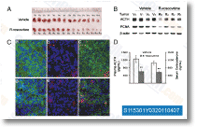
| Results | R-roscovitine caused approximately 50% weight reduction of dissected tumor xenografts(Fig. A). Consistent with the in vitro observations, Western blot and immunohistochemistry analysis of tumor specimens showed suppressed ACTH and PCNA protein expression by R-roscovitine (Fig. B and C). R-roscovitine-treated mice exhibited more than 50% reduction in plasma ACTH levels ), and approximately 50% reduction in serum corticosterone levels. |
MAPK phosphorylation of connexin 43 promotes binding of cyclin E and smooth muscle cell proliferation [Johnstone SR,et al. Circ Res 2012;111(2):201-11]
Targeting zebrafish and murine pituitary corticotroph tumors with a cyclin-dependent kinase (CDK) inhibitor. [Liu NA, et al. Proc Natl Acad Sci U S A 2011;108(20):8414-9]
Activation of Aurora-A Is Essential for Neuronal Migration via Modulation of Microtubule Organization. [Takitoh T, et al. J Neurosci 2012;32(32):11050-66]
