
Antibodies


Ridaforolimus (Deforolimus) is a selective mTOR inhibitor with IC50 of 0.2 nM; while not classified as a prodrug, mTOR inhibition and FKBP12 binding is similar to rapamycin.
| Size | Price | Stock | Quantity | ||||||||||||||||||||
|---|---|---|---|---|---|---|---|---|---|---|---|---|---|---|---|---|---|---|---|---|---|---|---|
| |||||||||||||||||||||||
 Distributor Tel: +886-2-2827-1197jimmy@new.abscience.com.tw
| Description | Ridaforolimus (Deforolimus) is a selective mTOR inhibitor with IC50 of 0.2 nM; while not classified as a prodrug, mTOR inhibition and FKBP12 binding is similar to rapamycin. | |||||
|---|---|---|---|---|---|---|
| Targets | mTOR | |||||
| IC50 | 0.2 nM [1] | |||||
| In vitro | Treatment of HT-1080 cells with Deforolimus induces a dose-dependent inhibition of phosphorylation of both S6 and 4E-BP1, with IC50 of 0.2 nM and 5.6 nM, respectively, and leads to a decrease in cell size, an increase in the proportion of cells in the G1 phase of the cell cycle, and inhibition of glucose uptake. Deforolimus displays significant antiproliferative activity a broad panel of cell lines with EC50 of 0.2-2.3 nM. Deforolimus potently and selectively inhibits VEGF production in a dose-dependent manner. [1] Deforolimus treatment significantly induces growth suppression in human NSCLC cell lines with IC30 values of 2.45-8.83 nM, with the exception of H157 with IC30 of >20 nM. Deforolimus treatment (2.8-5.9 nM) significantly dephosphorylates p70S6KThr389 in A549, H1703 and H157 cells, except H1666 that may express a resistant variant of mTORC1, and causes increased phosphorylation of pAKTser473 and pAKTThr308 in A549 and H1703 cells. Deforolimus in combination with the MEK inhibitors, CI-1040 or PD0325901 exhibits dose-dependent synergism in lung cancer cell lines, which is associated with the suppression of proliferation rather than enhancement of cell death, involving the inhibition of ribosomal biogenesis by 40% within 24 hours and a decreased polysome/monosome ratio. [2] | |||||
| In vivo | Administration of Deforolimus exerts significant antitumor effects in mice bearing PC-3 (prostate), HCT-116 (colon), MCF7 (breast), PANC-1 (pancreas) or A549 (lung) xenografts in a dose-dependent manner, and inhibits mTOR signaling in in SK-LMS-1 xenograft model associated with inhibition of tumor growth. [1] | |||||
| Features | ||||||
| Cell based target inhibition | HT-1080 cells are treated with increasing concentrations of Deforolimus (0-100 nM) for 2 hours, prior to harvest. Cellular lysates are extracted in denaturing lysis buffer, resolved on SDS-PAGE and transferred to PVDF membranes. After blocking, membranes are incubated with primary antibodies for 1 hour, followed by appropriate HRPconjugated secondary antibodies for 1 hour at room temperature. Immunoreactive proteins are detected using enhanced chemiluminescence and autoradiography performed by exposure to X-ray film. IC50 is determined from the inhibition of levels of phosphorylated ribosomal protein S6 (p-S6) and 4E-BP1 (p-4E-BP1). |
|---|
| Cell lines | Colo205, H1755, H1395, H1666, A549, H157, and H1703 cells |
|---|---|
| Concentrations | Dissolved in ethanol, final concentrations ~ 1 μM |
| Incubation Time | 72-120 hours |
| Method | Cells are seeded at 2-3 × 10⁴/mL, and serial dilutions of Deforolimus are added after 2 hours, for at least three cell doublings (72-120 hours). Deforolimus effects are measured using the CellTiter 96 Aqueous nonradioactive cell proliferation assay and Sulforhodamine B assays. For Deforolimus, growth effects are described as IC30 because rapamycin and its derivatives do not significantly impede cell proliferation. |
| Animal Models | Male and female athymic NCr-nu mice with xenografts established by subcutaneous implantation of PC-3, A549, HCT-116, MCF7, PANC-1 and SK-LMS-1 tumors |
|---|---|
| Dosages | ~10 mg/kg |
| Administration | Intraperitoneally |
| Solubility | 30% PEG400/0.5% Tween80/5% propylene glycol, 20 mg/mL |
| NCT Number | Recruitment | Conditions | Sponsor /Collaborators | Start Date | Phases |
|---|---|---|---|---|---|
| NCT01256268 | Recruiting | Endometrial Cancer|Ovarian Cancer | H. Lee Moffitt Cancer Center and Research Institute|Merck | 2011-06 | Phase 1 |
| NCT01380184 | Completed | Cancer, Advanced | Merck | 2011-07 | Phase 1 |
| NCT01431534 | Active, not recruiting | Solid Tumors | Merck | 2012-01 | Phase 1 |
| NCT01431547 | Active, not recruiting | Solid Tumors | Merck | 2012-02 | Phase 1 |
| NCT01605396 | Active, not recruiting | Breast Neoplasms | Merck | 2012-07 | Phase 2 |
Download Ridaforolimus (Deforolimus, MK-8669) SDF
| Molecular Weight (MW) | 990.21 |
|---|---|
| Formula | C53H84NO14P |
| CAS No. | 572924-54-0 |
| Storage | 3 years -20℃Powder |
|---|---|
| 6 months-80℃in DMSO | |
| Syonnyms | AP23573 |
| Solubility (25°C) * | In vitro | DMSO | 198 mg/mL (199 mM) |
|---|---|---|---|
| Water | <1 mg/mL (<1 mM) | ||
| Ethanol | <1 mg/mL (<1 mM) | ||
| In vivo | 30% PEG400/0.5% Tween80/5% propylene glycol, | 20 mg/mL | |
| * <1 mg/ml means slightly soluble or insoluble. * Please note that Selleck tests the solubility of all compounds in-house, and the actual solubility may differ slightly from published values. This is normal and is due to slight batch-to-batch variations. | |||
| Chemical Name |
|---|
| Stock Solution (1ml DMSO) | 1mM | 10mM | 20mM | 30mM |
|---|---|---|---|---|
| Mass(mg) | 0.99021 | 9.9021 | 19.8042 | 29.7063 |
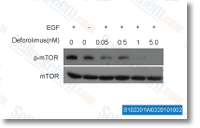 Click to enlarge | Rating | |
| Source | Dr. Zhang of Tianjin Medical University. Ridaforolimus (Deforolimus, MK-8669) purchased from Selleck | |
| Method | Western blotting | |
| Cell Lines | Breast cancer cells | |
| Concentrations | 0-5 nM | |
| Incubation Time | 24 h | |
| Results | Deforolimus treatment resulted in a reduction of mTOR phosphorylation in Breast cancer cells. |
Inhibition of glycogen biosynthesis via mTORC1 suppression as an adjunct therapy for Pompe disease. [Ashe KM, et al. Mol Genet Meta 2010;100(4):309-15]
Activation of mammalian target of rapamycin contributes to pain nociception induced in rats by BmK I, a sodium channel-specific modulator. [Jiang F, et al. Neurosci Bull 2013;10.1007/s12264-013-1377-0]
