
- 貨號 Cat. No.
- S1096
- 規格 Size
- 5~200mg
- 品牌 Brand
- Selleckchem
Description
Quisinostat (JNJ-26481585)
JNJ-26481585 is a novel second-generation HDAC inhibitor with highest potency for HDAC1 with IC50 of 0.11 nM, modest potent to HDACs 2, 4, 10, and 11; greater than 30-fold selectivity against HDACs 3, 5, 8, and 9 and lowest potency to HDACs 6 and 7. Phase 2.
Size |
Price |
Stock |
Quantity |
|
|---|
10mM/1mLIn DMSO |
USD 415 |
In stock |
0
1
2
3
4
5
6
7
8
9
10
|
5mg |
USD 264 |
In stock |
0
1
2
3
4
5
6
7
8
9
10
|
10mg |
USD 466 |
In stock |
0
1
2
3
4
5
6
7
8
9
10
|
50mg |
USD 1222 |
In stock |
0
1
2
3
4
5
6
7
8
9
10
|
200mg |
USD 3112 |
In stock |
0
1
2
3
4
5
6
7
8
9
10
|
|
 Distributor Tel: +886-2-2827-1197jimmy@new.abscience.com.tw
Biological Activity
Description |
JNJ-26481585 is a novel second-generation HDAC inhibitor with highest potency for HDAC1 with IC50 of 0.11 nM, modest potent to HDACs 2, 4, 10, and 11; greater than 30-fold selectivity against HDACs 3, 5, 8, and 9 and lowest potency to HDACs 6 and 7. Phase 2. |
|---|
Targets |
HDAC1 |
HDAC2 |
HDAC4 |
HDAC10 |
HDAC11 |
|
|---|
IC50 |
0.11 nM |
0.33 nM |
0.64 nM |
0.46 nM |
0.37 nM [1] |
|
|---|
In vitro |
JNJ-26481585 exhibits broad spectrum antiproliferative activity in solid and hematologic cancer cell lines, such as all lung, breast, colon, prostate, brain, and ovarian tumor cell lines, with IC50 ranging from 3.1-246 nM, which is more potent than vorinostat, R306465, panobinostat, CRA-24781, or mocetinostat in various human cancer cell lines tested. [1] A recent study shows that JNJ-26481585 promotes myeloma cell death at low nanomolar concentrations by resulting in Mcl-1 depletion and Hsp72 induction. [2] |
|---|
In vivo |
In an HDAC1-responsive A2780 ovarian tumor screening model, JNJ-26481585 dosing at its maximal tolerated dose (10 mg/kg i.p. and 40 mg/kg p.o.) for 3 days leads to an HDAC1-regulated fluorescence , which predicts tumor growth inhibition. Furthermore, JNJ-26481585 also shows more potent inhibitory effects on the growth of C170HM2 colorectal liver metastases than 5-fluorouracil/Leucovorin. [1] |
|---|
Features |
An orally bioavailable, second-generation, hydroxamic acid-based HDAC inhibitor. |
|---|
Protocol(Only for Reference)
Kinase Assay: [1]
HDAC activity assays |
In all cases, full-length HDAC proteins are expressed using baculovirus-infected Sf9 cells. In addition, HDAC3 is coexpressed as a complex with human NCOR2. For assessing activity of HDAC1-containing cellular complexes, immunoprecipitated HDAC1 complexes are incubated with an [3H]acetyl- labeled fragment of histone H4 peptide [biotin-(6-aminohexanoic)Gly-Ala-(acetyl[3H])Lys-Arg-His-Arg-Lys-Val-NH2] in a total volume of 50μL enzyme assay buffer (25mM HEPES (pH 7.4), 1 M sucrose, 0.1 mg/mL BSA and 0.01% (v/v) Triton X-100). Incubation is performed for 45 minutes at 37 °C (immunoprecipitates) or 30 min at room temperature. Before addition of substrate, HDAC inhibitors are added at increasing concentrations and preincubated for 10 minutes at room temperature. After incubation, the reaction is quenched with 35μL stop buffer (1 M HCl and 0.4 M acetic acid). Released [3H]acetic acid is extracted with 800μL ethyl acetate and quantified by scintillation counting. Equal amounts of HDAC1 are immunoprecipitated as indicated by Western blot analysis. HDAC1 activity results are presented as mean ± SD of three independent experiments on a single lysate. |
|---|
Cell Assay: Cell proliferation assays
Cell lines |
NCL-H2106, Colo699 and LNCAP cells |
|---|
Concentrations |
0-300 nM |
|---|
Incubation Time |
24 hours |
|---|
Method |
All cell lines are obtained from American Type Culture Collection and cultured according to instructions. The effect of HDAC inhibitors on cell proliferation is measured using an MTT. Proliferation of non–small cell lung carcinoma (NSCLC) cell lines is assessed using an Alamar Blue–based assay. For proliferation of hematologic cell lines, cells are incubated for 72 hours and the cytotoxic activity is evaluated by MTS assay. Data are presented as mean IC50 or IC40 ± SD of at least three independent experiments. |
|---|
Animal Study: [1]
Animal Models |
HCT116 human colon carcinoma cells are injected s.c. into the inguinal region of athymic male NMRI nu/nu mice, C170HM2 cell suspensions are injected into the peritoneal cavity of male MFI nude mice. |
|---|
Dosages |
≤10 mg/kg |
|---|
Administration |
Administered via both p.o. and i.p. |
|---|
Solubility |
15% Captisol, 30 mg/mL |
|---|
1
References
Clinical Trial Information( data from http://clinicaltrials.gov)
NCT Number |
Recruitment |
Conditions |
Sponsor
/Collaborators |
Start Date |
Phases |
|---|
NCT00677105 |
Completed |
Lymphoma|Neoplasms |
Johnson & Johnson Pharmaceutical Research & Development, L.L.C.|Janssen Pharmaceutica N.V., Belgium |
2007-08 |
Phase 1 |
NCT00676728 |
Terminated |
Advanced or Refractory Leukemia|Myelodysplastic Syndromes |
Johnson & Johnson Pharmaceutical Research & Development, L.L.C. |
2008-12 |
Phase 1 |
NCT01464112 |
Recruiting |
Multiple Myeloma |
Janssen Research & Development, LLC |
2011-09 |
Phase 1 |
NCT01486277 |
Active, not recruiting |
Cutaneous T-cell Lymphoma; Histone Deacetylase Inhibitor; Lymphoma; Oncology |
Janssen Research & Development, LLC |
2011-11 |
Phase 2 |
Download Quisinostat (JNJ-26481585) SDF
Molecular Weight (MW) |
394.476 |
|---|
Formula |
C21H26N6O2
|
|---|
CAS No. |
875320-29-9 |
|---|
Storage |
3 years -20℃Powder |
|---|
6 months-80℃in DMSO |
Syonnyms |
N/A |
|---|
Solubility (25°C) * |
In vitro |
DMSO |
79 mg/mL (200 mM) |
|---|
Water |
<1 mg/mL (<1 mM) |
Ethanol |
<1 mg/mL (<1 mM) |
In vivo |
15% Captisol, |
30 mg/mL |
* <1 mg/ml means slightly soluble or insoluble.
* Please note that Selleck tests the solubility of all compounds in-house, and the actual solubility may differ slightly from published values. This is normal and is due to slight batch-to-batch variations. |
Chemical Name |
N-hydroxy-2-(4-(((1-methyl-1H-indol-3-yl)methylamino)methyl)piperidin-1-yl)pyrimidine-5-carboxamide |
|---|
Stock Solution (1ml DMSO) |
1mM |
10mM |
20mM |
30mM |
|---|
Mass(mg) |
0.394476 |
3.94476 |
7.88952 |
11.83428 |
Customer Reviews (1)
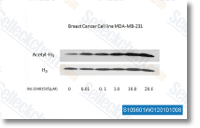
Click to enlarge |
Rating |
|
Source |
Dr. Zhang of Tianjin Medical University. Quisinostat (JNJ-26481585) purchased from Selleck |
Method |
Western blot |
Cell Lines |
MDA-MB-231 cells |
Concentrations |
0-20 μM |
Incubation Time |
|
Results |
Increased Histone H3 acetylation in MDA-MB-231 cells treated with JNJ-26481585 was observed. |
Product Citations (1)
詢價 / 洽詢此產品


