
Antibodies


Ponatinib (AP24534) is a novel, potent multi-target inhibitor of Abl, PDGFRα, VEGFR2, FGFR1 and Src with IC50 of 0.37 nM, 1.1 nM, 1.5 nM, 2.2 nM and 5.4 nM, respectively.
| Size | Price | Stock | Quantity | ||||||||||||||||
|---|---|---|---|---|---|---|---|---|---|---|---|---|---|---|---|---|---|---|---|
| |||||||||||||||||||
 Distributor Tel: +886-2-2827-1197jimmy@new.abscience.com.tw
| Description | Ponatinib (AP24534) is a novel, potent multi-target inhibitor of Abl, PDGFRα, VEGFR2, FGFR1 and Src with IC50of 0.37 nM, 1.1 nM, 1.5 nM, 2.2 nM and 5.4 nM, respectively. | |||||
|---|---|---|---|---|---|---|
| Targets | Abl | PDGFRα | VEGFR2 | FGFR1 | Src | |
| IC50 | 0.37 nM | 1.1 nM | 1.5 nM | 2.2 nM | 5.4 nM [1] | |
| In vitro | AP24534 potently inhibits native Abl, AblT315I, and other clinically important Abl kinase domain mutants with IC50 of 0.30 nM–2 nM. AP24534 doesnot inhibit Aurora kinase family members, nor does it inhibit insulin receptor or CDK2/cyclin E. AP24534 inhibits proliferation of Ba/F3 cells expressing Bcr-Abl with IC50 of 0.5 nM, as well as Ba/F3 cells expressing a range of Bcr-Abl mutants with IC50 of 0.5 nM–36 nM. The inhibition of proliferation by AP24534 is correlated with induction of apoptosis. [1-2] In leukemic cell lines containing activated forms of FLT3, KIT, FGFR1, and PDGFRα receptors, AP24534 potently inhibits receptor phosphorylation and cellular proliferation with IC50 of 0.3 nM to 20 nM. In MV4-11 (FLT3-ITD(+/+)) but not RS4;11 (FLT3-ITD(–/–)) AML cells, AP24534 inhibits FLT3 signaling and induced apoptosis at less than 10 nM. AP24534 inhibits viability of primary leukemic blasts from a FLT3-ITD positive AML patient with IC50 of 4 nM but not those from patients with AML expressing native FLT3. [3] In Ba/F3 cells engineered to express activated FGFR1-4, AP24534 potently inhibits FGFR-mediated signaling and viability with IC50 lower than 40 nM. In cell lines representing multiple tumor types (endometrial, bladder, gastric, breast, lung, and colon), and containing FGFRs dysregulated by a variety of mechanisms, AP24534 inhibits FGFR-mediated signaling with IC50 less than 40 nM and inhibits cell growth with IC50 of 7 nM–181 nM. [4] | |||||
| In vivo | In a mouse xenograft model of Ba/F3 cells expressing native Bcr-Abl, AP24534 (2.5 mg/kg and 5 mg/kg) prolongs mice median survival. In the xenograft model of Ba/F3 Bcr-AblT315I, AP24534 (10 mg/kg–50 mg/kg) significantly suppresses tumor growth. AP24534 (30 mg/kg) decreases the phosphorylated Bcr-Abl and phosphorylated CrkL levels in the tumors. [2] | |||||
| Features | ||||||
| Peptide substrate phosphorylation assays with GST-Abl kinase domains | The effect of AP24534 (0-320 nM) on GST-Abl kinase activity is assessed by using a synthetic peptide substrate (Abltide: EAIYAAPFAKKK). Assays are carried out at 30 °C for 15 min in 25 μL reaction mixture: 8 mM MOPS (pH 7), 0.2 mM EDTA, 50 μM Abltide, 30 mM MgCl2, 10 mM β-glycerol phosphate, 1 mM EGTA, 0.002% Brij-35, 0.4 mM DTT, 0.2 mg/mL BSA, 0.4 mM sodium orthovanadate, 10 nM WT or mutant GST-Abl kinase, and 100 µM ATP/γ-32[P]ATP (5000 cpm/pmol). Reactions are terminated by transferring a portion of the reaction mixture onto a p81 phosphocellulose filter and immersing in 0.75% phosphoric acid. Filters are washed 3 times in 0.75% phosphoric acid, rinsed in acetone, and air dried; phosphate incorporation is determined by scintillation counting. All results are corrected for background binding to the filters, as determined by omitting peptide substrate from the kinase reaction. Time course experiments to establish the linear range of enzymatic activity precedes kinase assays. |
|---|
| Cell lines | Ba/F3 cells expressing Bcr-Abl or a range of single mutations in the kinase domain of Bcr-Abl |
|---|---|
| Concentrations | 0-625 nM |
| Incubation Time | 72 hours |
| Method | Ba/F3 cell lines are distributed in 96-well plates (4 × 10³ cells/well) and incubated with AP24534 for 72 hours. Proliferation is measured using a methanethiosulfonate (MTS)-based viability assay (CellTiter96 Aqueous One Solution). All values are normalized to the control wells with no drug. IC50 values are reported as the mean of three independent experiments performed in quadruplicat |
| Animal Models | Mouse xenograft models of Ba/F3 cells expressing Bcr-Abl or Bcr-AblT315I |
|---|---|
| Dosages | 2.5 mg/kg and 5 mg/kg for Ba/F3 Bcr-Abl; 2.5 mg/kg–50 mg/kg for Ba/F3 Bcr-AblT315I |
| Administration | Oral gavage once daily |
| Solubility | 30% PEG400/0.5% Tween80/5% propylene glycol, 10 mg/mL |
| NCT Number | Recruitment | Conditions | Sponsor /Collaborators | Start Date | Phases |
|---|---|---|---|---|---|
| NCT01838642 | Recruiting | Thyroid Neoplasms | National Institutes of Health Clinical Center (CC)|National Cancer Institute (NCI) | 2013-03 | Phase 2 |
| NCT01874665 | Suspended | GIST | Ariad Pharmaceuticals | 2013-05 | Phase 2 |
| NCT01888562 | Not yet recruiting | Endometrial Neoplasms | Washington University School of Medicine | 2013-09 | |
| NCT01935336 | Recruiting | Adenocarcinoma of the Lung|Extensive Stage Small Cell Lung Cancer|Limited Stage Small Cell Lung Cancer|Recurrent Non-small Cell Lung Cancer|Recurrent Small Cell Lung Cancer|Stage IIIA Non-small Cell L | University of Colorado, Denver|Ariad Pharmaceuticals|University of Colorado Hospital | 2013-09 | Phase 2 |
| NCT01813734 | Suspended | Non Small Cell Lung Cancer | Massachusetts General Hospital | 2013-09 | Phase 2 |
Download Ponatinib (AP24534) SDF
| Molecular Weight (MW) | 532.56 |
|---|---|
| Formula | C29H27F3N6O |
| CAS No. | 943319-70-8 |
| Storage | 3 years -20℃Powder |
|---|---|
| 6 months-80℃in DMSO | |
| Syonnyms | N/A |
| Solubility (25°C) * | In vitro | DMSO | 30 mg/mL (56 mM) |
|---|---|---|---|
| Water | <1 mg/mL (<1 mM) | ||
| Ethanol | <1 mg/mL (<1 mM) | ||
| In vivo | 30% PEG400/0.5% Tween80/5% propylene glycol, | 10 mg/mL | |
| * <1 mg/ml means slightly soluble or insoluble. * Please note that Selleck tests the solubility of all compounds in-house, and the actual solubility may differ slightly from published values. This is normal and is due to slight batch-to-batch variations. | |||
| Chemical Name | 3-(2-(imidazo[1,2-b]pyridazin-3-yl)ethynyl)-4-methyl-N-(4-((4-methylpiperazin-1-yl)methyl)-3-(trifluoromethyl)phenyl)benzamide |
|---|
| Stock Solution (1ml DMSO) | 1mM | 10mM | 20mM | 30mM |
|---|---|---|---|---|
| Mass(mg) | 0.53256 | 5.3256 | 10.6512 | 15.9768 |
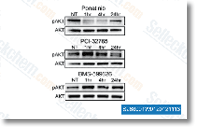 Click to enlarge | Rating | |
| Source | Cancer Cell, 2012, 22(5), 656-667 . Ponatinib (AP24534) purchased from Selleck | |
| Method | Western blot | |
| Cell Lines | RCH-ACV cells | |
| Concentrations | 50 nM | |
| Incubation Time | 1-24 h | |
| Results | Treatment of these cells with a CSK inhibitor (BMS-599626) or a BTK inhibitor (PCI-32765) did not recapitulate the dasatinib/ponatinib phenotype. |
Crosstalk between ROR1 and the Pre-B Cell Receptor Promotes Survival of t (1; 19) Acute Lymphoblastic Leukemia. [Bicocca VT, et al. Cancer Cell 2012;22(5):656-67]
Molecular dynamics reveal BCR-ABL1 polymutants as a unique mechanism of resistance to PAN-BCR-ABL1 kinase inhibitor therapy [Gibbons DL Proc Natl Acad Sci U S A 2014;10.1073/pnas.1321173111]
The N550K/H mutations in FGFR2 confer differential resistance to PD173074, dovitinib and ponatinib ATP-competitive inhibitors. [Byron SA, et al. Neoplasia 2013;15(8):975-88]
