
Antibodies


PIK-90 is a PI3Kα/γ/δ inhibitor with IC50 of 11 nM/18 nM/58 nM, respectively, less potent to PI3Kβ.
| Size | Price | Stock | Quantity | ||||||||||||
|---|---|---|---|---|---|---|---|---|---|---|---|---|---|---|---|
| |||||||||||||||
 Distributor Tel: +886-2-2827-1197jimmy@new.abscience.com.tw
| Description | PIK-90 is a PI3Kα/γ/δ inhibitor with IC50 of 11 nM/18 nM/58 nM, respectively, less potent to PI3Kβ. | |||||
|---|---|---|---|---|---|---|
| Targets | PI3Kα | PI3Kβ | PI3Kδ | PI3Kγ | ||
| IC50 | 11 nM | 350 nM | 58 nM | 18 nM [1] | ||
| In vitro | PIK-90 shows distinct patterns of isoform selectivity to inhibit different subsets of four class I PI3K isoforms. In addition, PIK-90 completely inhibits the fMLP-stimulated phosphorylation of Akt and impairs polarity and chemotaxis in dHL60 cells. [1] PIK-90 exhibits significantly antiproliferative activity by effectively blocking phosphorylation of Akt in six glioma cell lines varying in mutational status at PTEN or p53, including U87 MG, SF188, SF763, LN229, A1207 and LN-Z30 cells. Moreover, PIK-90 induces a modest G0G1 arrest at a concentration (0.5 μM) sufficient to inhibit phosphorylation of Akt substantially. [2] In chronic lymphocytic leukemia (CLL) cells, PIK-90 inhibits chemotaxis to levels that are 57.8% of controls at 1 μM and 56.8% of controls at 10 μM. Consistently, PIK-90 inhibits pseudoemperipolesis to levels that are 74.2% PIK-90 of controls at 1 μM and 57.9% of controls at 10 μM. In addition, PIK-90 also leads to a significant reduction of CLL cell migration into the stromal cell layer and decreases CXCL12-induced actin polymerization. [3] | |||||
| In vivo | Immediately following insulin treatment, PIK-90 (10 mg/kg) completely protects animals from this insulin-stimulated decline in blood glucose. [4] | |||||
| Features | ||||||
| Expression and Assay of p110α/p85α, p110β/p85α, p110δ/p85α, and p110γ | IC50 values are measured using either a standard TLC assay for lipid kinase activity or a high-throughput membrane capture assay. Kinase reactions are performed by preparing a reaction mixture containing kinase, inhibitor (2% DMSO final concentration), buffer (25 mM HEPES, pH 7.4, 10 mM MgCl2), and freshly sonicated phosphatidylinositol (100 μg/mL). Reactions are initiated by the addition of ATP containing 10 μCi of γ-32P-ATP to a final concentration 10 μM or 100 μM, and allowed to proceed for 20 minutes at room temperature. For TLC analysis, reactions are then terminated by the addition of 105 μL 1N HCl followed by 160 μL CHCl3:MeOH (1:1). The biphasic mixture is vortexed, briefly centrifuged, and the organic phase transferred to a new tube using a gel loading pipette tip precoated with CHCl3. This extract is spotted on TLC plates and developed for 3-4 hours in a 65:35 solution of n-propanol:1M acetic acid. The TLC plates are then dried, exposed to a phosphorimager screen, and quantitated. For each compound, kinase activity is typically measured at 10-12 inhibitor concentrations representing two-fold dilutions from the highest concentration tested (100 μM). For compounds showing significant activity, IC50 determinations are repeated two to four times, and the reported value is the average of these independent measurements. |
|---|
| Cell lines | U87 MG, SF188, SF763, LN229, A1207 and LN-Z3 cells |
|---|---|
| Concentrations | 0 to 1 μM |
| Incubation Time | 72 hours |
| Method | For viabilty, cells are seeded in 12-well plates in the presence of PIK-90 for 3 days. Cell viability is determined using a WST-1 assay. |
| Animal Models | FVB/N female mice are fasted at 9:00 a.m. and then given human insulin or vehicle (PBS) intravenously at 12:00 p.m. |
|---|---|
| Dosages | ≤10 mg/kg |
| Administration | Administered via i.p. |
| Solubility | 1% DMSO/30% polyethylene glycol/1% Tween 80, pH 4 15 mg/mL |
| Molecular Weight (MW) | 351.36 |
|---|---|
| Formula | C18H17N5O3 |
| CAS No. | 677338-12-4 |
| Storage | 3 years -20℃Powder |
|---|---|
| 6 months-80℃in DMSO | |
| Syonnyms | N/A |
| Solubility (25°C) * | In vitro | DMSO | 0.28 mg/mL (<1 mM) |
|---|---|---|---|
| Water | <1 mg/mL (<1 mM) | ||
| Ethanol | <1 mg/mL (<1 mM) | ||
| In vivo | 1% DMSO/30% polyethylene glycol/1% Tween 80, pH 4 | 15 mg/mL | |
| * <1 mg/ml means slightly soluble or insoluble. * Please note that Selleck tests the solubility of all compounds in-house, and the actual solubility may differ slightly from published values. This is normal and is due to slight batch-to-batch variations. | |||
| Chemical Name |
|---|
 Click to enlarge | Rating | |
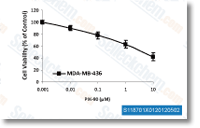
| Source | Dr. Yong-Weon Yi from Georgetown University Medical Center.PIK-90 purchased from Selleck | |
| Method | MTT assays | |
| Cell Lines | MDB-MA-436 cells | |
| Concentrations | 0.001-10 μM | |
| Incubation Time | 72 h | |
| Results | PIK-90 potently inhibited the survival of MDA-MB-436 cells in a dose-dependent manner. |
K-Ras and B-Raf oncogenes inhibit colon epithelial polarity establishment through up-regulation of c-myc. [Magudia K, et al. J Cell Biol 2012;198(2):185-94]
