
Antibodies


PIK-75 is a p110α inhibitor with IC50 of 5.8 nM (200-fold more potently than p110β), isoform-specific mutants at Ser773, and also potently inhibits DNA-PK with IC50 of 2 nM.
| Size | Price | Stock | Quantity | ||||||||||||
|---|---|---|---|---|---|---|---|---|---|---|---|---|---|---|---|
| |||||||||||||||
 Distributor Tel: +886-2-2827-1197jimmy@new.abscience.com.tw
| Description | PIK-75 is a p110α inhibitor with IC50 of 5.8 nM (200-fold more potently than p110β), isoform-specific mutants at Ser773, and also potently inhibits DNA-PK with IC50 of 2 nM. | |||||
|---|---|---|---|---|---|---|
| Targets | p110α | DNA-PK | ||||
| IC50 | 5.8 nM [1] | 2 nM [2] | ||||
| In vitro | PIK-75 shows the impressive potency and isoform selectivity at p110α while the corresponding IC50 values are 1300 nM, 76 nM and 510 nM for other PI3K isoforms, p110β, -γ, and -δ, respectively. Furthermore, when binding to purified p110α, PIK-75 is a noncompetitive inhibitor with respect to ATP with Ki of 36 nM and competitive with respect to the substrate PI with Ki of 2.3 nM. [1] PIK-75 also shows potent inhibition of DNA-PK. [2] PIK-75 (1 μM) reduces cell survival by significantly decreasing mitochondrial activity in unstimulated nonasthmatic airway smooth muscle (ASM) cells, asthmatic ASM cells, and lung fibroblasts. While in TGFβ-stimulated ASM cells, PIK75 only decreases mitochondrial activity in asthmatic cells without effects in nonasthmatic cells. [3] A recent study shows that PIK-75 (10 nM) inhibits TNF-α-induced CD38 mRNA expression and significantly attenuates of TNF-α-induced ADP-ribosyl cyclase activity in human airway smooth muscle cells. [4] | |||||
| In vivo | In the ErbB3WT tumor model, PIK-75 reduces in vitro chemotactic response to HRGβ1 and lowers pAkt levels by 40%. Besides, PIK-75 significantly reduces tumor cell motility and in vivo invasion in ErbB3WT primary tumors. [5] In the CD1 male mice, PIK-75 leads to serious impairments in the insulin tolerance test (ITT) and glucose tolerance test (GTT), and an increase in glucose production during a pyruvate tolerance test (PTT). [6] | |||||
| Features | PI3K and DNA-PK inhibitor. | |||||
| Inhibition Assays | The PI3K inhibitor PIK-75 is dissolved at 10 mM in dimethyl sulfoxide and stored at −20°C until use. PI3K enzyme activity is determined in 50 μL of 20 mM HEPES, pH 7.5, and 5 mM MgCl2 containing 180 μM phosphatidyl inositol, with the reaction started by the addition of 100 μM ATP (containing 2.5 μCi of [γ-32P]ATP). After a 30-minute incubation at room temperature, the enzyme reaction is stopped by the addition of 50 μL of 1 M HCl. Phospholipids are then extracted with 100 μL of chloroform/methanol [1:1 (v/v)] and 250 μL of 2 M KCl followed by liquid scintillation counting. Inhibitors are diluted in 20% (v/v) dimethyl sulfoxide to generate a concentration versus inhibition of enzyme activity curve, which is then analyzed with the use of Prism version 5.00 for Windows to calculate the IC50. For kinetic analysis, a luminescent assay measuring ATP consumption is used. PI3K enzyme activity is determined in 50 μL of 20 mM HEPES, pH 7.5, and 5 mM MgCl2 with PI and ATP at various concentrations. After a 60-minute incubation at room temperature, the reaction is stopped by the addition of 50 μL of Kinase-Glo followed by a further 15-minute incubation. Luminescence is then read using a Fluostar plate reader. Results are analyzed using Prism. |
|---|
| Cell lines | A2780, A2780/cp70, 2780AD, HCT116, HT29, WIL, CALU-3, MCF7, PC3 and HS852 cells |
|---|---|
| Concentrations | 0-10 μM |
| Incubation Time | 48 hours |
| Method | Mitochondrial activity is assessed after stimulation with TGFβ with or without inhibitors for 48 hours using the 3-(4,5-dimethylthiazol-2-yl)-2,5-diphenyltetrazolium (MTT) assay. Harvested washed cells are resuspended in DMEM-lO% FCS and aliquoted (500 μL) into 24-well cluster plates prior to serial dilution (1:2) in duplicates. To each well, 100 μL of an appropriate MTT concentration (dissolved in PBS and filtered through a 0.2 μm filter before use to remove any blue formazan product) is added immediately after diluting the cells, which are then incubated for 3.5 hours at 37 °C. The resulting blue formazan product is solubilized overnight (16 hours) at 37 °C by the addition of 500 μL of 10% sodium dodecyl sulfate (SDS) in 0.01 M HCl to each well. A sample (150 μL) from each duplicate well is transferred to a 96-well microplate, and the optical density determinedby automated spectrophotometry against a reagent blank (no cells). Absorbance is measured at a test wavelength of 570 nm and a reference wavelength of 690 nm. For each primary cell culture, results from three to six wells from each treatment are averaged, and data are expressed as absorbance 570 to 690 nm. |
| Animal Models | MTLn3 cells are injected into the right fourth mammary fat pad from the head of female severe-combined immunodeficient/NCr mice. |
|---|---|
| Dosages | ≤1 μM |
| Administration | Administered via i.p. |
| Molecular Weight (MW) | 488.74 |
|---|---|
| Formula | C16H14BrN5O4S.HCl |
| CAS No. | 372196-77-5 |
| Storage | 3 years -20℃Powder |
|---|---|
| 6 months-80℃in DMSO | |
| Syonnyms | N/A |
| Solubility (25°C) * | In vitro | DMSO | 3 mg/mL (6 mM) |
|---|---|---|---|
| Water | <1 mg/mL (<1 mM) | ||
| Ethanol | <1 mg/mL (<1 mM) | ||
| * <1 mg/ml means slightly soluble or insoluble. * Please note that Selleck tests the solubility of all compounds in-house, and the actual solubility may differ slightly from published values. This is normal and is due to slight batch-to-batch variations. | |||
| Chemical Name | (E)-N-((6-bromoH-imidazo[1,2-a]pyridin-3-yl)methylene)-N,2-dimethyl-5-nitrobenzenesulfonohydrazide hydrochloride |
|---|
| Stock Solution (1ml DMSO) | 1mM | 10mM | 20mM | 30mM |
|---|---|---|---|---|
| Mass(mg) | 0.48874 | 4.8874 | 9.7748 | 14.6622 |
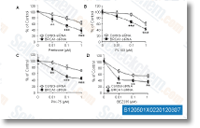 Click to enlarge | Rating | |
| Source | Mol Carcinog 2012.April PIK-75 purchased from Selleck | |
| Method | MTT assay | |
| Cell Lines | MCF7 cells | |
| Concentrations | 0.01-1 μM | |
| Incubation Time | 48 h | |
| Results | Knockdown of BRCA1 can sensitize the MCF7 cells to Perifosine in a dose-dependent manner (Figure A). BRCA1-KD also sensitizes the MCF7 cells to dual PI3K/mTOR inhibitors, such as PI-103 or BEZ235 (Figure B, D). Another inhibitor, PIK-75 which specifically inhibits PI3Ka and PI3Kg, but not mTOR, also showed similar effects on proliferation of BRCA1-KD MCF7 cells (Figure C). |
Inhibition of constitutively activated phosphoinositide 3-kinase/AKT pathway enhances antitumor activity of chemotherapeutic agents in breast cancer susceptibility gene 1-defective breast cancer cells. [Yi YW, et al. Mol Carcinog 2012;52(9):667-75]
DW09849, a Selective Phosphatidylinositol 3-Kinase (PI3K) Inhibitor, Prevents PI3K Signaling and Preferentially Inhibits Proliferation of Cells Containing the Oncogenic Mutation p110α (H1047R). [Liu JL, et al. J Pharmacol Exp Ther 2014;348(3):432-41]
RSK Activation of Translation Factor eIF4B Drives Abnormal Increases of Laminin γ2 and MYC Protein during Neoplastic Progression to Squamous Cell Carcinoma. [Degen M, et al. PLoS One 2013;8(10):e78979]
