
Antibodies


PHT-427 is a dual Akt and PDPK1 inhibitor (high affinity binding for the PH domains of Akt and PDPK1) with Ki of 2.7 μM and 5.2 μM, respectively.
| Size | Price | Stock | Quantity | ||||||||||||||||
|---|---|---|---|---|---|---|---|---|---|---|---|---|---|---|---|---|---|---|---|
| |||||||||||||||||||
 Distributor Tel: +886-2-2827-1197jimmy@new.abscience.com.tw
| Description | PHT-427 is a dual Akt and PDPK1 inhibitor (high affinity binding for the PH domains of Akt and PDPK1) with Kiof 2.7 μM and 5.2 μM, respectively. | |||||
|---|---|---|---|---|---|---|
| Targets | Akt | PDPK1 | ||||
| IC50 | 2.7 μM | 5.2 μM [1] | ||||
| In vitro | PH-427 is a pleckstrin homology domain inhibitor to Akt/PDPK1. PH-427 significantly reduces phospho-Ser241-PDPK1 phospho-Thr308-Akt in PC-3 prostate cancer cells at 10 μM, which shows that PHT-427 could inhibit both Akt and PDKP1. PHT-427 also inhibits translocation of the Akt and PDKP1 PH domains in plasma membrane. [1] PHT-427 induces apoptosis and inhibits AKT phosphorylation with IC50 of 8.6 μM (in BxPC-3 cells), which mainly on its Ser473 residue and less strongly on Thr308 residue without affecting total Akt protein expression. PHT-427 also shows antiproliferation in Panc-1 cells with IC50 of 65 μM. [2] | |||||
| In vivo | PHT-427 shows great antitumor activity in BxPC-3 pancreatic, MCF-7 breast and A-549 NSCL cancer xenografts. PHT-427 gives up to an 80% inhibition of tumor growth in BxPC-3 at doses of 125 to 250 mg/kg. [1] | |||||
| Features | ||||||
| Surface plasmon resonance (SPR) spectroscopy binding assays | All interaction analyses are performed with a Biacore 2000, Biacore 2000 Control Software v3.2, and BIAevaluation v4.1 analysis software. The PH domain GST-fusion proteins (Akt1, IRS1, and PDK1) are immobilized on a CM5 Sensorchip using Biacores Amine Coupling Kit to a level of 10,000 Response units (RUs). Small molecule analytes at concentrations ranging from 0.1 to 10 × the predicted KD are injected at a high flow rate (30μL/min). DMSO concentrations in all samples and running buffer are 1% (v/v) or less. |
|---|
| Cell lines | Panc-1 cells |
|---|---|
| Concentrations | 1-50 μM |
| Incubation Time | |
| Method | Cell growth inhibition is determined using a micro-cytoxicity assay. Cells are plated in 96-well micro-cytoxicity at 5-10 × 103 cells per well (depending on cell doubling time) and grown for 7 days. PHT-427 dissolved in DMSO is added directly to the media, at various concentrations ranging from 1 to 50 μM. The endpoint is spectrophotometric determination of the protein content of each well using 3-(4,5-dimethylthiazol-2-yl)-2,5-diphenyltetrazolium bromide. A concentration-response relationship at two or more concentration levels is used to obtain an IC50 for PHT-427. |
| Animal Models | BxPC-3, Panc-1, MiaPaCa-2, PC-3, SKOV-3, A-549 or MCF-7 cells are injected subcutaneously into the flanks of female scid mice. |
|---|---|
| Dosages | 125-250 mg/kg |
| Administration | Oral administration |
| Solubility | 5% DMSO/95% Corn oil, 5 mg/mL |
| Molecular Weight (MW) | 409.61 |
|---|---|
| Formula | C20H31N3O2S2 |
| CAS No. | 1191951-57-1 |
| Storage | 3 years -20℃Powder |
|---|---|
| 6 months-80℃in DMSO | |
| Syonnyms | N/A |
| Solubility (25°C) * | In vitro | DMSO | 82 mg/mL (200 mM) |
|---|---|---|---|
| Water | <1 mg/mL (<1 mM) | ||
| Ethanol | 60 mg/mL (146 mM) | ||
| In vivo | 5% DMSO/95% Corn oil, | 5 mg/mL | |
| * <1 mg/ml means slightly soluble or insoluble. * Please note that Selleck tests the solubility of all compounds in-house, and the actual solubility may differ slightly from published values. This is normal and is due to slight batch-to-batch variations. | |||
| Chemical Name | 4-dodecyl-N-(1,3,4-thiadiazol-2-yl)benzenesulfonamide |
|---|
| Stock Solution (1ml DMSO) | 1mM | 10mM | 20mM | 30mM |
|---|---|---|---|---|
| Mass(mg) | 0.40961 | 4.0961 | 8.1922 | 12.2883 |
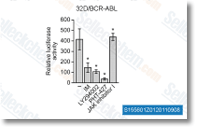 Click to enlarge | Rating | |
| Source | BLOOD 2011 118, 2840-2848. PHT-427 purchased from Selleck | |
| Method | Luciferase reporter assays | |
| Cell Lines | 32D cells, BCR-ABL cells | |
| Concentrations | 20 μM | |
| Incubation Time | 24 h | |
| Results | Treatment of 32D/BCR-ABL cells withthe AKT/PDPK1 inhibitor PHT-427, the PI3K inhibitor LY294002 or the BCR-ABL inhibitor imatinib substantially reduced Atf5 promoter-directed luciferase activity. |
BCR-ABL suppresses autophagy through ATF5-mediated regulation of mTOR transcription. [Sheng Z, et al. Blood 2011;118(10):2840-8]
