
Antibodies


PHA-665752 is a potent, selective and ATP-competitive c-Met inhibitor with IC50 of 9 nM, >50-fold selectivity for c-Met than RTKs or STKs.
| Size | Price | Stock | Quantity | ||||||||||||||||||||
|---|---|---|---|---|---|---|---|---|---|---|---|---|---|---|---|---|---|---|---|---|---|---|---|
| |||||||||||||||||||||||
 Distributor Tel: +886-2-2827-1197jimmy@new.abscience.com.tw
| Description | PHA-665752 is a potent, selective and ATP-competitive c-Met inhibitor with IC50 of 9 nM, >50-fold selectivity for c-Met than RTKs or STKs. | |||||
|---|---|---|---|---|---|---|
| Targets | c-Met | |||||
| IC50 | 9 nM [1] | |||||
| In vitro | PHA-665752 significantly inhibits c-Met kinase activity with Ki of 4 nM, and exhibits >50-fold selectivity for c-Met compared with various tyrosine and serine-threonine kinases. PHA-665752 potently inhibits the HGF-stimulated c-Met autophosphorylation with IC50 of 25-50 nM. PHA-665752 also significantly blocks HGF- and c-Met-dependent functions such as cell motility and cell proliferation with IC50 of 40-50 nM and 18-42 nM, respectively. In addition, PHA-665752 potently inhibits HGF-stimulated or constitutive phosphorylation of mediators of downstream of c-Met such as Gab-1, ERK, Akt, STAT3, PLC-γ, and FAK in multiple tumor cell lines.[1] PHA-665752 inhibits cell growth in TPR-MET-transformed BaF3 cells with IC50 of <60 nM, and inhibits constitutive cell motility and migration by 92.5% at 0.2 μM. Inhibition of c-Met by PHA665752 (0.2 μM) also induces cell apoptosis of 33.1% and G1 cell cycle arrest with cells in G1 phase increasing from 42.4% to 77.0%. PHA665752 can cooperate with rapamycin to inhibit cell growth of TPR-MET-transformed BaF3 cells and non-small cell lung cancer H441 cells. [2] | |||||
| In vivo | Administration of PHA-665752 induces a dose-dependent tumor growth inhibition of S114 xenografts by 20 %, 39% and 68%, at dose of 7.5, 15, and 30 mg/kg/day, respectively. [1] PHA665752 treatment significantly reduces the tumor growth of NCI-H69, NCI-H441 and A549 in mouse xenografts by 99%, 75%, and 59%, respectively. PHA665752 also significantly inhibits angiogenesis by >85%, due to decreasing the production of vascular endothelial growth factor and increasing the production of the angiogenesis inhibitor thrombospondin-1. [3] | |||||
| Features | ||||||
| In vitro enzyme assay | The c-Met kinase domain GST-fusion protein is used for the c-Met assay. The IC50 value of PHA-665752 for the inhibition of c-Met is based on phosphorylation of kinase peptide substrates or poly-glu-tyr in the presence of ATP and divalent cation (MgCl2 or MnCl2 10-20 mM). The linear range (i.e., the time period over which the rate remains equivalent to the initial rate) is determined for c-Met, and the kinetic measurement and IC50 determination are performed within this range. |
|---|
| Cell lines | S114, GTL-16, NCI-H441, and BxPC-3 |
|---|---|
| Concentrations | Dissolved in DMSO, final concentrations ~10 μM |
| Incubation Time | 18, or 72 hours |
| Method | For proliferation assays, cells are grown in medium with 0.1% FBS for 48 hours after which they are treated with various concentrations of PHA-665752 in HGF (50 ng/mL) in a medium containing 2% FBS. After 18 hours, cells are incubated with BrdUrd for 1 hour, fixed, and stained with anti-BrdUrd peroxidase-conjugated antibody, and plates are read at 630 nm. For apoptosis assays, cells are grown in medium with 2% FBS in presence and absence of HGF (50 ng/mL) and various concentrations of PHA-665752 for 72 hours. After 72 hours, a mixture containing ethidium bromide and acridine orange is added, and apoptotic cells (bright orange cells or cell fragments) are counted by fluorescence microscopy. |
| Animal Models | Female athymic mice (nu/nu) bearing S114 or GTL-16 tumor xenografts |
|---|---|
| Dosages | ~30 mg/kg/day |
| Administration | Injection via bolus i.v. |
| Solubility | 30% PEG400/0.5% Tween80/5% propylene glycol, 30 mg/mL |
| Molecular Weight (MW) | 641.61 |
|---|---|
| Formula | C32H34Cl2N4O4S |
| CAS No. | 477575-56-7 |
| Storage | 3 years -20℃Powder |
|---|---|
| 6 months-80℃in DMSO | |
| Syonnyms | N/A |
| Solubility (25°C) * | In vitro | DMSO | 128 mg/mL (199 mM) |
|---|---|---|---|
| Water | <1 mg/mL (<1 mM) | ||
| Ethanol | <1 mg/mL (<1 mM) | ||
| In vivo | 30% PEG400/0.5% Tween80/5% propylene glycol, | 30 mg/mL | |
| * <1 mg/ml means slightly soluble or insoluble. * Please note that Selleck tests the solubility of all compounds in-house, and the actual solubility may differ slightly from published values. This is normal and is due to slight batch-to-batch variations. | |||
| Chemical Name | (R,Z)-5-(2,6-dichlorobenzylsulfonyl)-3-((3,5-dimethyl-4-(2-(pyrrolidin-1-ylmethyl)pyrrolidine-1-carbonyl)-1H-pyrrol-2-yl)methylene)indolin-2-one |
|---|
| Stock Solution (1ml DMSO) | 1mM | 10mM | 20mM | 30mM |
|---|---|---|---|---|
| Mass(mg) | 0.64161 | 6.4161 | 12.8322 | 19.2483 |
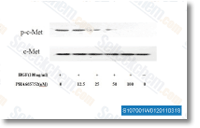 Click to enlarge | Rating | |
| Source | Dr. Zhang of Tianjin Medical University. PHA-665752 purchased from Selleck | |
| Method | Western blot | |
| Cell Lines | ||
| Concentrations | 0-100 μM | |
| Incubation Time | ||
| Results | PHA-665752 treatment resulted in a reduction of c-Met phosphorylation in a concentration-dependent manner. |
Activation of the AXL kinase causes resistance to EGFR-targeted therapy in lung cancer. [Zhang Z, et al. Nat Genet 2012;44(8):852-60]
Discovery of a mutant-selective covalent inhibitor of EGFR that overcomes T790M-mediated resistance in NSCLC. [Walter AO, et al. Cancer-Discov 2013;3(12):1404-15]
Proliferation State and Poloâ€Like Kinase1 Dependence of Tumorigenic Colon Cancer Cells. [Francescangeli F, et al. Stem Cells 2012;30(9):1819-30]
