
Antibodies


PH-797804 is a novel pyridinone inhibitor of p38α with IC50 of 26 nM; 4-fold more selective versus p38β and does not inhibit JNK2. Phase 2.
| Size | Price | Stock | Quantity | ||||||||||||||||||||
|---|---|---|---|---|---|---|---|---|---|---|---|---|---|---|---|---|---|---|---|---|---|---|---|
| |||||||||||||||||||||||
 Distributor Tel: +886-2-2827-1197jimmy@new.abscience.com.tw
| Description | PH-797804 is a novel pyridinone inhibitor of p38α with IC50 of 26 nM; 4-fold more selective versus p38β and does not inhibit JNK2. Phase 2. | |||||
|---|---|---|---|---|---|---|
| Targets | p38α | |||||
| IC50 | 26 nM [1] | |||||
| In vitro | PH-797804 blocks LPS-induced TNF-α production and p38 kinase activity in the human monocytic U937 cell line, with comparable IC50 of 5.9 nM and 1.1 nM. PH-797804 has no inhibitory effect on either the JNK pathway (c-Jun phosphorylation) or ERK pathway (ERK phosphorylation) in U937 cells at concentrations up to 1 μM. PH-797804 inhibits RANKL- and M-CSF-induced osteoclast formation in a concentration-dependent manner, with IC50 of 3 nM in primary rat bone marrow cells. [1] IC50 values for PH-797804 against the following targets have been determined to be greater than 200 μM (unless specified): CDK2, ERK2, IKK1, IKK2, IKKi, MAPKAP2, MAPKAP3, MKK7 (>100 μM), MNK, MSK (>164 μM), PRAK, RSK2, and TBK1, which means the activity of PH-797804 is specific. [2] | |||||
| In vivo | Orally dosing of PH-797804 effectively inhibits acute inflammatory responses induced by systemically administered endotoxin in both rat and cynomolgus monkeys. PH-797804 treatment for 10 days demonstrates robust anti-inflammatory activity in chronic disease models, significantly reducing both joint inflammation and associated bone loss in streptococcal cell wall-induced arthritis in rats and mouse collagen-induced arthritis. Dose-response analysis resulted in ED50 values of 0.07 mg/kg and 0.095 mg/kg in rat and cynomolgus monkeys, respectively. PH-797804 inhibits LPS-induced TNF-α, IL-6, and MK-2 activity in a dose- and concentration-dependent manner in a human endotoxin challenge model. [1] | |||||
| Features | ||||||
| P38 kinase assay | A resin capture assay method is used to determine the phosphorylation of epidermal growth factor receptor peptide (EGFRP) or GST-c-Jun by p38 kinases. Reactions mixtures contain 25 mM HEPES, pH 7.5, 10 mM magnesium acetate, ATP (at the indicated concentration), 0.05 to 0.3 μCi of [γ-33P]ATP, 0.8 mM dithiothreitol, and either 200 μM EGFRP or 10 μM GST-c-Jun for p38α kinase reactions. The reaction is initiated by the addition of 25 nM p38α kinase to give a final volume of 50 μl. The p38αkinase reactions are incubated at 25 °C for 30 minutes. Under these conditions, the formation of product for both p38αkinase is linear with time. The reaction is stopped, and the unreacted [γ-33P]ATP is removed by the addition of 150 μl of AG 1 × 8 ion exchange resin in 900 mM sodium formate, pH 3.0. Once thoroughly mixed, solutions are allowed to stand for 5 minutes. A 50-μl aliquot of head volume containing the phosphorylated substrate is removed from the mixture and transferred to a 96-well plate. MicroScint-40 scintillation cocktail (150 μL) is added to each well and the radioactivity quantities using a TopCount NXT microplate scintillation and luminescence counter. |
|---|
| Cell lines | Rheumatoid arthritis synovial fibroblast(s) |
|---|---|
| Concentrations | |
| Incubation Time | |
| Method | Cell viability is evaluated using the 3-(4,5-dimethylthiazol-2-yl)-) diphenyl tetrazolium bromide assay. Absorbance is measured on an ELISA plate reader with a test wavelength of 570 nm and a reference of 630 nm. |
| Animal Models | LPS-induced chronic inflammation rat model |
|---|---|
| Dosages | 0.001-1 mg/kg |
| Administration | Oral gavage 4 hours before LPS administration |
| Solubility | 0.5% methylcellulose/0.2% Tween 80, 30 mg/mL |
| NCT Number | Recruitment | Conditions | Sponsor /Collaborators | Start Date | Phases |
|---|---|---|---|---|---|
| NCT01321463 | Completed | Pulmonary Disease, Chronic Obstructive | Pfizer | 2011-05 | Phase 2 |
| NCT01479647 | Completed | Healthy Volunteers | Pfizer | 2011-12 | Phase 1 |
| NCT01543919 | Recruiting | Pulmonary Disease, Chronic Obstructive | Pfizer | 2012-04 | Phase 2 |
| NCT01589614 | Completed | Healthy | Pfizer | 2012-06 | Phase 1 |
| NCT01862887 | Recruiting | Healthy | Pfizer | 2013-04 | Phase 1 |
| Molecular Weight (MW) | 477.3 |
|---|---|
| Formula | C22H19BrF2N2O3 |
| CAS No. | 586379-66-0 |
| Storage | 3 years -20℃Powder |
|---|---|
| 6 months-80℃in DMSO | |
| Syonnyms | N/A |
| Solubility (25°C) * | In vitro | DMSO | 96 mg/mL (201 mM) |
|---|---|---|---|
| Water | <1 mg/mL (<1 mM) | ||
| Ethanol | 7 mg/mL (14 mM) | ||
| In vivo | 0.5% methylcellulose/0.2% Tween 80, | 30 mg/mL | |
| * <1 mg/ml means slightly soluble or insoluble. * Please note that Selleck tests the solubility of all compounds in-house, and the actual solubility may differ slightly from published values. This is normal and is due to slight batch-to-batch variations. | |||
| Chemical Name | 3-(4-(2,4-difluorobenzyloxy)-3-bromo-6-methyl-2-oxopyridin-1(2H)-yl)-N,4-dimethylbenzamide |
|---|
| Stock Solution (1ml DMSO) | 1mM | 10mM | 20mM | 30mM |
|---|---|---|---|---|
| Mass(mg) | 0.4773 | 4.773 | 9.546 | 14.319 |
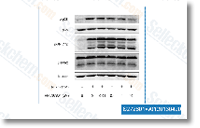 Click to enlarge | Rating | |
| Source | PH-797804 purchased from Selleck | |
| Method | Western blot | |
| Cell Lines | HEK293 cells | |
| Concentrations | 10 -1000 nM | |
| Incubation Time | 1 h | |
| Results | PH797804 treatment resulted in a reduction of p38 phosphorylation in HEK293 cells. |
