
Antibodies


PKI-587 is a highly potent dual inhibitor of PI3Kα, PI3Kγ and mTOR with IC50 of 0.4 nM, 5.4 nM and 1.6 nM, respectively. Phase 2.
| Size | Price | Stock | Quantity | ||||||||||||||||
|---|---|---|---|---|---|---|---|---|---|---|---|---|---|---|---|---|---|---|---|
| |||||||||||||||||||
 Distributor Tel: +886-2-2827-1197jimmy@new.abscience.com.tw
| Description | PKI-587 is a highly potent dual inhibitor of PI3Kα, PI3Kγ and mTOR with IC50 of 0.4 nM, 5.4 nM and 1.6 nM, respectively. Phase 2. | |||||
|---|---|---|---|---|---|---|
| Targets | PI3K-α | PI3K-γ | mTOR | |||
| IC50 | 0.4 nM | 5.4 nM | 1.6 nM [1] | |||
| In vitro | PKI-587 shows potent inhibitory activity against PI3K-α, PI3K-γ and mTOR with IC50 of 0.4 nM, 5.4 nM and 1.6 nM, respectively. Furthermore, PKI-587 also exhibits its potency against the most frequently occurring mutant forms of PI3Kα, notably the H1047R and E545K with IC50 of 0.6 nM and 0.6 nM, respectively. [1] Correlated with suppression of phosphorylation of PI3K/mTOR signaling pathway proteins, PKI-587 causes tumor cell growth inhibition in MDA-361 and PC3-MM2 cell lines with IC50 of 4 nM and 13.1 nM, respectively. [1] | |||||
| In vivo | In nude mice, PKI-587 treatment at 25 mg/kg iv leads to low plasma clearance (7 (mL/min)/kg), high volume of distribution (7.2 L/kg), and long half-life, (14.4 hours). In the MDA-361 xenograft model, PKI-587 produces potent antitumor efficacy with the minimum efficacious dose (MED) of 3 mg/kg against MDA-361 tumors and maximum tolerated single dose (MTD) of 30 mg/kg. While in the H1975 (non-small-cell lung carcinoma, mutant EGFR [L858R, T790M]) xenograft model, PKI-587 at 25 mg/kg for 7 weeks results in 90% survival of the group treated.[1] | |||||
| Features | ||||||
| PI3K and mTOR kinase assay | Enzyme assays are done in fluorescent polarization (FP) format, adapted from the Echelon K-1100 PI3K FP assay kit protocol. Human class I PI3Ks and PI3K-α mutants (E545K and H1047R) are produced in Sf9 or purchased from Upstate Biotech. GST-GRP1 (murine) is produced in Escherichia coli and isolated by GST-Sepharose. Assay buffers are reaction buffer [20 mM HEPES (pH 7.1), 2 mM MgCl2, 0.05% CHAPS, and 0.01% β-mercaptoethanol] and stop/detection buffer [100 mM HEPES (pH 7.5), 4 mM EDTA, 0.05% CHAPS]. FP reaction is run for 30 minutes at room temperature in 20 μL of reaction buffer containing 20 μM phosphatidylinositol 4,5-bisphosphate (PIP2), 25 μM ATP, and <4% DMSO. FP reaction is stopped with 20 μL of stop/detection buffer (10 nM probe and 40 nM GST-GRP), and after 2 hours, data are collected using an Envision plate reader. The routine assays with purified FLAG-TOR (FL and 3.5) are performed in 96-well plates as follows. Enzymes are first diluted in kinase assay buffer (10 mM Hepes (pH 7.4), 50 mM NaCl, 50 mM β-glycerophosphate, 10 mM MnCl2, 0.5 mM DTT, 0.25 μM microcystin LR, and 100 μg/mL BSA). To each well, 12 μL of the diluted enzyme is mixed briefly with 0.5 μL test inhibitor or control vehicle dimethyl sulfoxide (DMSO). The kinase reaction is initiated by adding 12.5 μL kinase assay buffer containing ATP and His6-S6K to give a final reaction volume of 25 μL containing 800 ng/mL FLAG-TOR, 100 μM ATP, and 1.25 μM His6-S6K. The reaction plate is incubated for 2 hours (linear at 1–6 hours) at room temperature with gentle shaking and then terminated by adding 25 μL Stop buffer (20 mM Hepes (pH 7.4), 20 mM EDTA, and 20 mM EGTA). |
|---|
| Cell lines | MDA-361 and PC3-MM2 |
|---|---|
| Concentrations | 0-10 μM |
| Incubation Time | 72 hours |
| Method | Cells are plated in 96-well culture plates at about 3000 cells per well. One day following plating, PKI-587 is added to cells. Three days after PKI-587 treatment, viable cell densities are determined by measuring metabolic conversion (by viable cells) of the dye MTS, a previously established cell proliferation assay. For each assay, MTS and PMS stocks are freshly thawed and mixed (MTS/PMS, 20:1). The MTS/PMS mixture is then added to 96-well cell plates at 20 μL/well, and plates are incubated for 1 hour–2 hours in cell culture incubator. MTS assay results are read in a 96-well format plate reader by measuring absorbance at 490 nm. The effect of each PKI-587 treatment is calculated as a percentage of control cell growth obtained from vehicle-treated cells grown in the same culture plate. |
| Animal Models | MDA-361 and H1975 cells are injected subcutaneously into the nude mice. |
|---|---|
| Dosages | ≤30 mg/kg |
| Administration | Administered via i.v. |
| Solubility | 30% propylene glycol, 5% Tween 80, 65% D5W, 30 mg/mL |
| NCT Number | Recruitment | Conditions | Sponsor /Collaborators | Start Date | Phases |
|---|---|---|---|---|---|
| NCT00940498 | Completed | Neoplasms | Pfizer | 2010-01 | Phase 1 |
| NCT01420081 | Recruiting | Endometrial Neoplasms | Pfizer | 2012-01 | Phase 2 |
Download PF-05212384 (PKI-587) SDF
| Molecular Weight (MW) | 615.73 |
|---|---|
| Formula | C32H41N9O4 |
| CAS No. | 1197160-78-3 |
| Storage | 3 years -20℃Powder |
|---|---|
| 6 months-80℃in DMSO | |
| Syonnyms | N/A |
| Solubility (25°C) * | In vitro | DMSO | 2 mg/mL (3 mM) |
|---|---|---|---|
| Water | <1 mg/mL (<1 mM) | ||
| Ethanol | <1 mg/mL (<1 mM) | ||
| In vivo | 30% propylene glycol, 5% Tween 80, 65% D5W, | 30 mg/mL | |
| * <1 mg/ml means slightly soluble or insoluble. * Please note that Selleck tests the solubility of all compounds in-house, and the actual solubility may differ slightly from published values. This is normal and is due to slight batch-to-batch variations. | |||
| Chemical Name | 1-(4-(4-(dimethylamino)piperidine-1-carbonyl)phenyl)-3-(4-(4,6-dimorpholino-1,3,5-triazin-2-yl)phenyl)urea |
|---|
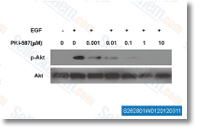 Click to enlarge | Rating | |
| Source | Dr. Zhang of Tianjin Medical University. PF-05212384 (PKI-587) purchased from Selleck | |
| Method | Western Blot | |
| Cell Lines | A549 cells | |
| Concentrations | 0-10 μM | |
| Incubation Time | 3 h | |
| Results | PKI-587 treatment resulted in a reduction of AKT phosphorylation. |
