
Antibodies


Pemetrexed is a novel antifolate and antimetabolite for TS, DHFR and GARFT with Ki of 1.3 nM, 7.2 nM and 65 nM, respectively.
| Size | Price | Stock | Quantity | ||||||||||||
|---|---|---|---|---|---|---|---|---|---|---|---|---|---|---|---|
| |||||||||||||||
 Distributor Tel: +886-2-2827-1197jimmy@new.abscience.com.tw
| Description | Pemetrexed is a novel antifolate and antimetabolite for TS, DHFR and GARFT with Ki of 1.3 nM, 7.2 nM and 65 nM, respectively. | |||||
|---|---|---|---|---|---|---|
| Targets | TS | DHFR | GARFT | |||
| IC50 | 1.3 nM (Ki) | 7.2 nM (Ki) | 65 nM (Ki) [1] | |||
| In vitro | Pemetrexed disodium shows the antiproliferative activity in CCRF-CEM leukemia, GC3/C1 colon carcinoma, and HCT-8 ileocecal carcinoma cells with IC50 of 25 nM, 34 nM and 220 nM, respectively. [1] A recent study shows that cisplatin plus Pemetrexed combined with SOCS-1 gene delivery shows the antitumor effect by inhibition of cell proliferation, invasiveness, and induction of apoptosis in MPM cells infected with adenovirus-expressing SOCS-1 vector. [2] | |||||
| In vivo | In the human H460 non-small cell lung carcinoma xenograft, Pemetrexed disodium produces a duration-dependent tumor growth delay (TGD). [3] | |||||
| Features | ||||||
| Enzyme Assays and Methods. | TS activity is assayed using a spectrophotometric method, which involved monitoring the increase in absorbance at 340 nm resulting from formation of the product, 7,8-dihydrofolate. The assay buffer contains 50 mM N-tris[hydroxymethyljmethyl-2-aminoethanesulfonic acid, 25 mM MgC12, 6.5 mM formaldehyde, 1 mM EDTA, and 75 mM 2-mercaptoethanol, pH 7.4. The concentrations of deoxyuridylate monophosphate, 6R-MTHF, and hIS are 100 μM, 30μM and 30 nM (1.7 milliunits/mL), respectively. At the 6R-MTHF concentration, an uninhibited reaction and six concentrations of inhibitor are assayed. Ki app values are determined by fitting the data to the Morrison equation using nonlinear regression analysis with the aid of the program ENZFITTER. Kivalues are calculated using the equation: Ki app= Ki(1 + [S]/Km), where [S] is equal to 30 μM and Km is equal to 3 μM. DHFR activity is assayed spectrophotometrically by monitoring the dis appearance of the substrates NADPH and 7,8-dihydrofolate at 340 nm. The reaction takes place at 25°C in 0.5 mL of 50 mM potassium phosphate buffer, which contains 150 mM KC1 and 10 nM 2-mercaptoethanol, pH 7.5, and 14 nM (0.34 milliunitlmL) DHFR. The NADPH concentration is 10 μM and 7,8-dihydrofolate is varied at 5, 10, or 15 μM. At each 7,8-dihydrofolate concentration, an uninhibited reaction and seven concentrations of inhibitor are assayed. The ENZFITI’ER microcomputer program is used to obtain Ki app values by fitting the data to the Morrison equation by nonlinear regression analysis. Ki app= Ki(1 + [S]/Km), where [S] is equal to the concentration of 7,8-dihydrofolate used and Km of 7,8-dihydrofolate is equal to 0.15 μM. GARFT activity is assayed spectrophotometrically by monitoring the increase of absorbance resulting from formation of the product 5,8-dideazafolate at 295 nm. The reaction solvent contains 75 mM HEPES, 20% glycerol, and 50 mM a-thioglygerol, pH 7.5, at 25°C. The concentrations of substrates and enzyme used are 10 μM α,β-glycinamide ribonucleotide, 0-10 μM 10-formyl-5,8-dideazafolic acid, and 10 nM (1.9 milliunits/mL) GARFT. Ki values are calculated using the Enzyme Mechanism program of the Beckman DU640 spectrophotometer, which uses nonlinear regression analysis to fit data to the Michaelis-Menten equation for competitive inhibition. |
|---|
| Cell lines | CCRF-CEM leukemia, GC3/C1 colon carcinoma, and HCT-8 ileocecal carcinoma cells. |
|---|---|
| Concentrations | 0-30 μM |
| Incubation Time | 72 hours |
| Method | Dose-response curves are generated to determine the concentration required for 50% inhibition of growth (IC50). Pemetrexed disodium is dissolved initially in DMSO at a concentration of 4 mg/mL and further diluted with cell culture medium to the desired concentration. CCRF-CEM leukemia cells in complete medium are added to 24-well Cluster plates in a total volume of 2.0 mL. Pemetrexed disodium at various concentrations are added to duplicate wells so that the final volume of DMSO is 0.5%. The plates are incubated for 72 hour at 37 °C in an atmosphere of 5% CO2 in air. At the end of the incubation, cell numbers are determined on a ZBI Coulter counter. For several studies, IC50s are determined for each compound in the presence of either 300 μM AICA, 5 μM thymidine, 100 μM hypoxanthine, or combination of 5 μM hymidine plus 100 μM hypoxanthine. For adherent tumor cells, a modification of the original MTT colorimetric assay is used to measure cell cytotoxicity. The human tumor cells are seeded in 100 μL assay medium/well in 96-well flat-bottomed tissue culture plates. The assay medium contains folic acid-free RPMI 1640 supplemented with 10% FCS and either 2 nM folinic acid or 2.3 μM folic acid as the sole folate source. Well 1A is left blank. Stock solutions of antifolates are prepared in Dulbecco’s PBS at 1 mg/mL, and a series of 2-fold dilutions are subsequently made in PBS. Ten-μL aliquots of each concentration are added to triplicate wells. Plates are incubated for 72 hours at 37 °C in a humidified atmosphere of 5% CO2-in-air. MTT is dissolved in PBS at 5 mg/mL, 10 μL of stock MTF solution are added to each well of an assay, and the plates are incubated at 37 °C for 2 additional hours. Following incubation, 100 μL of DMSO are added to each well. After thorough formazan solubilization, the plates are read on a Dynatech MR600 reader, using a test wavelength of 570 nm and a reference wavelength of 630 nm. The IC50 is determined as the concentration of drug required to inhibit cell growth by 50% compared to an untreated controls. |
| Animal Models | EMT-6 mammary carcinoma, the human HCT 116 colon carcinoma, and the human H460 non-small cell lung carcinoma are injected s.c. into the nude mice. |
|---|---|
| Dosages | 100 mg/kg or 150 mg/kg |
| Administration | Administered via i.p. |
| Solubility | Saline, 30 mg/mL |
| NCT Number | Recruitment | Conditions | Sponsor /Collaborators | Start Date | Phases |
|---|---|---|---|---|---|
| NCT01837329 | Not yet recruiting | Non-Squamous Non-Small Cell Lung Cancer | University of Rochester | 2013-11 | Phase 1 |
| NCT02004184 | Not yet recruiting | Carcinoma, Non-small-cell Lung | Norwegian University of Science and Technology|St. Olavs Hospital | 2013-12 | Phase 3 |
| NCT01982955 | Not yet recruiting | Non-small Cell Lung Cancer | Merck KGaA | 2013-12 | Phase 1|Phase 2 |
| NCT02013453 | Not yet recruiting | Cancer of Head and Neck | University of Michigan Cancer Center | 2013-12 | Phase 2 |
| NCT01784640 | Not yet recruiting | Recurrent Non-small Cell Lung Cancer|Squamous Cell Lung Cancer|Stage IV Non-small Cell Lung Cancer | Jonsson Comprehensive Cancer Center|National Cancer Institute (NCI) | 2014-01 | Phase 1 |
| Molecular Weight (MW) | 471.37 |
|---|---|
| Formula | C20H19N5Na2O6 |
| CAS No. | 150399-23-8 |
| Storage | 3 years -20℃Powder |
|---|---|
| 6 months-80℃in DMSO | |
| Syonnyms | LY-231514 |
| Solubility (25°C) * | In vitro | DMSO | <1 mg/mL (<1 mM) |
|---|---|---|---|
| Water | 94 mg/mL (199 mM) | ||
| Ethanol | <1 mg/mL (<1 mM) | ||
| In vivo | Saline, | 30 mg/mL | |
| * <1 mg/ml means slightly soluble or insoluble. * Please note that Selleck tests the solubility of all compounds in-house, and the actual solubility may differ slightly from published values. This is normal and is due to slight batch-to-batch variations. | |||
| Chemical Name | sodium (S)-2-(4-(2-(2-amino-4-oxo-4,7-dihydro-1H-pyrrolo[2,3-d]pyrimidin-5-yl)ethyl)benzamido)pentanedioate |
|---|
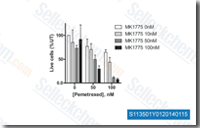 Click to enlarge | Rating | |
| Source | Mol Cancer Ther. 2013, 12(12):2675-84 . Pemetrexed purchased from Selleck | |
| Method | propidium iodide exclusion and flow cytometry | |
| Cell Lines | A549 cells | |
| Concentrations | 0, 50,100 uM | |
| Incubation Time | 72 h | |
| Results | We next tested a more clinically relevant antimetabolite used for lung cancer treatment, pemetrexed, in combination with MK1775 and again found synergistic inhibition of proliferation. |
