
Antibodies


Pelitinib (EKB-569) is a potent irreversible EGFR inhibitor with IC50 of 38.5 nM. Phase2.
| Size | Price | Stock | Quantity | ||||||||||||||||
|---|---|---|---|---|---|---|---|---|---|---|---|---|---|---|---|---|---|---|---|
| |||||||||||||||||||
 Distributor Tel: +886-2-2827-1197jimmy@new.abscience.com.tw
| Description | Pelitinib (EKB-569) is a potent irreversible EGFR inhibitor with IC50 of 38.5 nM. Phase2. | |||||
|---|---|---|---|---|---|---|
| Targets | EGFR | |||||
| IC50 | 38.5 nM [1] | |||||
| In vitro | Pelitinib displays much higher inhibitory activity against EGFR, compared with the closely related c-erbB-2, as well as other kinases such as Src, Cdk4, c-Met, Raf, and MEK/ERK, with IC50 ranging from 282 nM for Src to >20 μM for Cdk4. Consistently, Pelitinib treatment significantly inhibits the autophosphorylation of EGFR but not c-Met in A431 cells. [1] Pelitinib potently inhibits the proliferation of normal human keratinocytes (NHEK), as well as A431 and MDA-468 tumor cells with IC50 of 61 nM, 125 nM, and 260 nM, respectively, while displaying little activity against MCF-7 cells with IC50 of 3.6 μM. Pelitinib inhibits EGF-induced phosphorylation of EGFR in A431 and NHEK cells with IC50 of 20-80 nM, as well as the phosphorylation of STAT3 with IC50 of 30-70 nM. Pelitinib at 75-500 nM also specifically inhibits the activation of AKT and ERK1/2, without affecting NF-κB pathway. In NHEK cells, Pelitinib also potently inhibits TGF-α mediated EGFR activation with IC50 of 56 nM, as well as activation of STAT3 and ERK1/2 with IC50 of 60 nM and 62 nM, respectively. [2] | |||||
| In vivo | A single oral dose of 10 mg/kg Pelitinib potently inhibits the EGFR phosphorylation in A431 xenografts with over-expressed EGFR, by 90% within 1 hour, and by >50% after 24 hours. Administration of Pelitinib at 20 mg/kg/day inhibits tumorigenesis in APCMin/+ mice by 87%, equivalent to the effect of used with 2 times doses of EKI-785 (40 mg/kg/day), consistent with greater in vivo potency. [1] Pelitinib selectively inhibits EGFR signaling in airway epithelial cells in vivo. In the mouse model of airway epithelial remodeling that is inducible by viral infection and features a delayed but permanent switch to goblet cell metaplasia, Pelitinib treatment at 20 mg/kg/day corrects all 3 aspects of epithelial remodeling, by completely blocking the increase of ciliated cells and decrease of Clara cells, and significantly inhibiting the metaplasia of goblet cells. [3] | |||||
| Features | An improved version of EKI-785. | |||||
| Autophosphorylation of EGFR in cells | For experiments using cells in culture, A431 cells are treated with various concentrations of Pelitinib for 2.75 hours before co-incubation with 100 ng/mL EGF for 0.25 hour. Cells are washed twice with cold phosphate-buffered saline (PBS) before adding to lysis buffer (10 mM Tris, pH 7.5, 5 mM ethylenediamine tetra-acetic acid (EDTA), 150 mM NaCl, 1% Triton X-100, 1% Sodium deoxycolate, 0.1 % SDS, 1 mM PMSF, 10 mg/mL pepstatin A, 10 mg/mL leupeptin, 20 KIU/mL aprotinin, 2 mM sodium orthovanadate, and 100 mM sodium fluoride) for 20 minutes on ice, before immunoprecipitation and SDS-PAGE-immunoblotting. For immunoprecipitation, cultured cells are placed in cold lysis buffer and immediately homogenized on ice with a polytron with several pulses. The homogenate is first centrifuged at 2500 rpm (20 minutes, 4 °C) and then again at 14,000 rpm in a microcentrifuge (10 minutes, 4 °C). Supernatants (1000 μg protein) are incubated for 2 hours at 4 °C with 15 mL of EGFR polyclonal antibody. After 2 hours, 50 μL of protein G plus/protein A agarose beads is added and incubated with constant rotation for 2 hours at 4 °C. After washing with lysis buffer, beads are boiled for 2 minutes in Laemmli sample buffer. Proteins are then resolved by SDS-PAGE, transferred to immobilon membrane and probed overnight with an anti-phosphotyrosine antibody conjugated with horseradish peroxidase (HRP). Membranes are developed using the ECL reagent. Total EGFR protein is determined by stripping membranes and re-probing with receptor-specific antibodies. Quantitation of bands is done by densitometry, using ImageQuant software with a Molecular Dynamics laser transmittance scanner. |
|---|
| Cell lines | NHEK, A431, MCF-7, and MDA-468 |
|---|---|
| Concentrations | Dissolved in DMSO, final concentrations ~10 μM |
| Incubation Time | 5 days |
| Method | Cells are seeded in 96-well dishes, and after 2 hours, Pelitinib is added and incubated for 5 days. After incubation, the medium is removed from each well and fresh medium (150 μL) + 1 mg/mL MTT solution (50 μL) is added. After incubation for 2 hours at 37 °C, the medium is replaced with 150 μL DMSO, and absorbance at 540 nm in each well is determined. The IC50 is calculated by linear regression of the data. |
| Animal Models | Athymic nu/nu female mice bearing subcutaneous A431 tumors, or APCMin/+ male mice, a murine model of human familial adenomatous polyposis (FAP) |
|---|---|
| Dosages | 10, or 20 mg/kg/day |
| Administration | Oral gavage |
| Solubility | 30% PEG400/0.5% Tween80/5% propylene glycol, 30 mg/mL |
| NCT Number | Recruitment | Conditions | Sponsor /Collaborators | Start Date | Phases |
|---|---|---|---|---|---|
| NCT00067548 | Completed | Non-Small-Cell Lung Carcinoma|Carcinoma, Non-Small Cell Lung|Lung Neoplasms | Wyeth is now a wholly owned subsidiary of Pfizer | Phase 2 | |
| NCT00072748 | Completed | Colorectal Neoplasms|Colonic Neoplasms|Rectal Neoplasms | Wyeth is now a wholly owned subsidiary of Pfizer | Phase 2 | |
| NCT00098501 | Completed | Unspecified Adult Solid Tumor, Protocol Specific | National Cancer Institute (NCI) | 2004-10 | Phase 1 |
Download Pelitinib (EKB-569) SDF
| Molecular Weight (MW) | 467.92 |
|---|---|
| Formula | C24H23ClFN5O2 |
| CAS No. | 257933-82-7 |
| Storage | 3 years -20℃Powder |
|---|---|
| 6 months-80℃in DMSO | |
| Syonnyms | WAY-EKB 569 |
| Solubility (25°C) * | In vitro | DMSO | 13 mg/mL (27 mM) |
|---|---|---|---|
| Water | <1 mg/mL (<1 mM) | ||
| Ethanol | <1 mg/mL (<1 mM) | ||
| In vivo | 30% PEG400/0.5% Tween80/5% propylene glycol, | 30 mg/mL | |
| * <1 mg/ml means slightly soluble or insoluble. * Please note that Selleck tests the solubility of all compounds in-house, and the actual solubility may differ slightly from published values. This is normal and is due to slight batch-to-batch variations. | |||
| Chemical Name | (E)-N-(4-(3-chloro-4-fluorophenylamino)-3-cyano-7-ethoxyquinolin-6-yl)-4-(dimethylamino)but-2-enamide |
|---|
| Stock Solution (1ml DMSO) | 1mM | 10mM | 20mM | 30mM |
|---|---|---|---|---|
| Mass(mg) | 0.46792 | 4.6792 | 9.3584 | - |
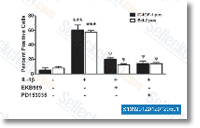 Click to enlarge | Rating | |
| Source | J Immunol, 2012, 188(9), 4581-4589. Pelitinib (EKB-569) purchased from Selleck | |
| Method | Western blot | |
| Cell Lines | RCH-ACV cell | |
| Concentrations | 1 μM | |
| Incubation Time | ||
| Results | Pretreatment with EGFR kinase inhibitors, PD153035 and EKB-569, a potent irreversible inhibitor, abolished the IGF-1- and IL-1β-mediated increase in Bcl-2mRNA levels. |
Intracellular Insulin-like Growth Factor-1 Induces Bcl-2 Expression in Airway Epithelial Cells. [Chand HS, et al. J Immunol 2012;188(9):4581-9]
