
Antibodies


PD173074
PD173074 is a potent FGFR1 inhibitor with IC50 of ~25 nM and also inhibits VEGFR2 with IC50 of 100-200 nM, ~1000-fold selective for FGFR1 than PDGFR and c-Src.
| Size | Price | Stock | Quantity | ||||||||||||||||
|---|---|---|---|---|---|---|---|---|---|---|---|---|---|---|---|---|---|---|---|
| |||||||||||||||||||
 Distributor Tel: +886-2-2827-1197jimmy@new.abscience.com.tw
| Description | PD173074 is a potent FGFR1 inhibitor with IC50 of ~25 nM and also inhibits VEGFR2 with IC50 of 100-200 nM, ~1000-fold selective for FGFR1 than PDGFR and c-Src. | |||||
|---|---|---|---|---|---|---|
| Targets | FGFR1 | VEGFR2 | ||||
| IC50 | ~25 nM | 100-200 nM [1] | ||||
| In vitro | PD173074 is an ATP-competitive inhibitor of FGFR1 with Ki of ~40 nM. PD173074 is also an effective inhibitor of VEGFR2. Compared to FGFR1, PD173074 weakly inhibits the activities of Src, InsR, EGFR, PDGFR, MEK, and PKC with 1000-fold or greater IC50 values. PD173074 inhibits autophosphorylation of FGFR1 and VEGFR2 in a dose-dependent manner with IC50 of 1-5 nM and 100-200 nM, respectively. [1] PD173074 inhibits FGF-2 promotion of granule neuron survival in a dose-dependent manner with IC50 of 12 nM, exhibiting 1,000-fold greater potency than that of SU 5402. [2] PD173074 specifically inhibits FGF-2-mediated effects on proliferation, differentiation, and MAPK activation in oligodendrocyte (OL) lineage cells. [3] PD173074 is active against the WT receptor and FGFR3 mutations in multiple myeloma (MM) cell lines. PD173074 also potently inhibits autophosphorylation of FGFR3 in a dose-dependent manner with IC50 of ~5 nM. PD173074 treatment potently reduces viability of FGFR3-expressing KMS11 and KMS18 cells with IC50 of <20 nM. Inhibition of aFGF-stimulated MM cell growth by PD173074 is highly correlated with the expression of FGFR3. PD173074 treatment completely abolishes NIH 3T3 transformation mediated by Y373C FGFR3 but not by Ras V12, demonstrating that PD173074 specifically targets FGFR3-mediated cell transformation and lacks nonspecific cytotoxic effect. PD173074 also induces functional maturation of KMS11 and KMS18 cells. [4] | |||||
| In vivo | Administration of PD173074 at 1 mg/kg/day or 2 mg/ka/day in mice can effectively block angiogenesis induced by either FGF or VEGF in a dose-dependent manner with no apparent toxicity. [1] PD173074 inhibits in vivo growth of mutant FGFR3-transfected NIH 3T3 cells in nude mice. Inhibition of FGFR3 by PD173074 delays tumor growth and increases survival of mice in a KMS11 xenograft myeloma model. [4] In the H-510 xenograft, oral aministration of PD173074 blocks tumor growth similar to that seen with single-agent cisplatin administration, increasing median survival compared with control sham-treated animals. In H-69 xenografts, PD173074 induces complete responses lasting >6 months in 50% of mice. These effects are correlated with increased apoptosis in excised tumors, but not a consequence of disrupted tumor vasculature. [5] | |||||
| Features | ||||||
| In vitro kinase inhibition assays | Assays using the full-length FGFR-1 kinase are performed in a total volume of 100 μL containing 25 mM HEPES buffer (pH 7.4), 150 mM NaCl, 10 mM MnCl2, 0.2 mM sodium orthovanadate, 750 μg/mL concentration of a random copolymer of glutamic acid and tyrosine (4:1), various concentrations of PD173074 and 60 to 75 ng of enzyme. The reaction is initiated by the addition of [γ-32P]ATP (5 μM ATP containing 0.4 μCi of [γ-32P]ATP per incubation), and samples are incubated at 25°C for 10 minutes. The reaction is terminated by the addition of 30% trichloroacetic acid and the precipitation of material onto glass-fiber filter mats. Filters are washed three times with 15% trichloroacetic acid, and the incorporation of [32P] into the glutamate tyrosine polymer substrate is determined by counting the radioactivity retained on the filters in a Wallac 1250 betaplate reader. Nonspecific activity is defined as radioactivity retained on the filters following incubation of samples without enzyme. Specific activity is determined as total activity (enzyme plus buffer) minus nonspecific activity. The concentration of PD173074 that inhibits FGFR-1 enzymatic activity by 50% (IC50) is determined graphically. |
|---|
| Cell lines | KMS11 and KMS18 |
|---|---|
| Concentrations | Dissolved in DMSO, final concentrations ~100 nM |
| Incubation Time | 48 hours |
| Method | Cells are incubated with increasing concentrations of PD173074 in the presence of aFGF/heparin for 48 hours. The percentage of viable cells is determined by MTT. |
| Animal Models | Swiss Webster mice with induced corneal angiogenesis |
|---|---|
| Dosages | ~2 mg/kg/day |
| Administration | Administered intraperitoneally |
| Molecular Weight (MW) | 523.67 |
|---|---|
| Formula | C28H41N7O3 |
| CAS No. | 219580-11-7 |
| Storage | 3 years -20℃Powder |
|---|---|
| 6 months-80℃in DMSO | |
| Syonnyms | N/A |
| Solubility (25°C) * | In vitro | DMSO | 100 mg/mL (190 mM) |
|---|---|---|---|
| Water | <1 mg/mL (<1 mM) | ||
| Ethanol | 100 mg/mL (190 mM) | ||
| * <1 mg/ml means slightly soluble or insoluble. * Please note that Selleck tests the solubility of all compounds in-house, and the actual solubility may differ slightly from published values. This is normal and is due to slight batch-to-batch variations. | |||
| Chemical Name | 1-tert-butyl-3-(2-(4-(diethylamino)butylamino)-6-(3,5-dimethoxyphenyl)pyrido[2,3-d]pyrimidin-7-yl)urea |
|---|
| Stock Solution (1ml DMSO) | 1mM | 10mM | 20mM | 30mM |
|---|---|---|---|---|
| Mass(mg) | 0.52367 | 5.2367 | 10.4734 | 15.7101 |
 Click to enlarge | Rating | |
| Source | SCIENCE 2011 331, 912-916. PD173074 purchased from Selleck | |
| Method | Immunohistochemistry | |
| Cell Lines | uterine horn | |
| Concentrations | ||
| Incubation Time | ||
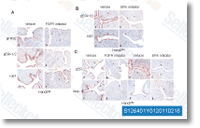
| Results | The epithelia of vehicle-treated horn showed prominent expression of p-FRS2 and p-ERK1/2 (Fig. A, a and c). However, the levels of both p-FRS2 and p-ERK1/2 were reduced in the epithelia of PD173074-treated horn on day 4 of pregnancy (Fig. A, b and d). We also observed a marked decline in the proliferative activity of Hand2-null uterine epithelia, as indicated by decreased Ki-67 staining (Fig. A, e and f). Administration of either PD173074 (Fig. C, a to d) or PD184352 (Fig. C, e to h) to Hand2-null uterine horns blocked the phosphorylation of epithelial ER a at Ser118 and the expression of Muc-1. |
The antiproliferative action of progesterone in uterine epithelium is mediated by Hand2. [Li Q, et al. Science 2011;331(6019):912-6]
Identification of Targetable FGFR Gene Fusions in Diverse Cancers. [Wu YM, et al. Cancer Discov 2013;3(6):636-47]
Ponatinib overcomes FGF2-mediated resistance in CML patients without kinase domain mutations. [Traer E, et al. Blood 2013;10.1182/blood-2013-07-518381 ]
