
Antibodies


Pazopanib (GW786034) is a novel multi-target inhibitor of VEGFR1, VEGFR2, VEGFR3, PDGFR, FGFR, c-Kit and c-Fms with IC50 of 10 nM, 30 nM, 47 nM, 84 nM, 74 nM, 140 nM and 146 nM, respectively.
| Size | Price | Stock | Quantity | ||||||||||||||||
|---|---|---|---|---|---|---|---|---|---|---|---|---|---|---|---|---|---|---|---|
| |||||||||||||||||||
 Distributor Tel: +886-2-2827-1197jimmy@new.abscience.com.tw
| Description | Pazopanib (GW786034) is a novel multi-target inhibitor of VEGFR1, VEGFR2, VEGFR3, PDGFR, FGFR, c-Kit and c-Fms with IC50 of 10 nM, 30 nM, 47 nM, 84 nM, 74 nM, 140 nM and 146 nM, respectively. | |||||
|---|---|---|---|---|---|---|
| Targets | VEGFR1 | VEGFR2 | VEGFR3 | PDGFR | FGFR | |
| IC50 | 10 nM | 30 nM | 47 nM | 84 nM | 74 nM [1] | |
| In vitro | Pazopanib potently inhibits VEGF-induced phosphorylation of VEGFR2 in HUVEC cells with IC50 of 8 nM. [1]PPazopanib shows dose-dependent growth inhibition in all synovial sarcoma cell lines including SYO-1 and HS-SY-II cells. Proliferation of SYO-1 and HS-SY-II cells is inhibited even at 1 µg/mL of Pazopanib and is completely abolished at 5 µg/mL. Pazopanib induces G1 arrest, and thereby suppresses the growth of synovial sarcoma cells. Phosphorylation of Akts, GSK-3β, JNKs, p70 S6 Kinase, and mTOR is suppressed in Pazopanib-treated SYO-1 cells compared with that in the vehicle-treated cells. [2] Pazopanib between 20 m g/mL and 22.5 m g/mL shows an increasing reduction of RPE cell viability. [3] | |||||
| In vivo | The mice treated with 30 mg/kg or 100 mg/kg Pazopanib reveals a significant decrease in tumor burden compared with the mice treated with vehicle or 10 mg/kg Pazopanib. Treatment with Pazopanib is well-tolerated and there is no significant difference in the body weight among the mice in each group. [2] | |||||
| Features | A multi-kinase inhibitor. | |||||
| Kinase enzyme assays | VEGFR enzyme assays for VEGGR1, VEGFR2, and VEGFR3 are run in homogeneous time-resolved fluorescence (HTRF) format in 384-well microtiter plates using a purified, baculovirus-expressed glutathione-S-transferase (GST) fusion protein encoding the catalytic c-terminus of human VEGFR receptor kinases 1, 2, or 3. Reactions are initiated by the addition of 10 μL of activated VEGFR2 kinase solution [final concentration, 1 nM enzyme in 0.1 M HEPES, pH 7.5, containing 0.1 mg/mL bovine serum albumin (BSA), 300 μM dithiothreitol (DTT)] to 10 μL substrate solution [final concentration, 360 nM peptide, (biotin-aminohexyl-EEEEYFELVAKKKK-NH2), 75 μM ATP, 10 μM MgCl2], and 1 μL of titrated Pazopanib in DMSO. Plates are incubated at room temperature for 60 min, and then the reaction is quenched by the addition of 20 μL of 100 mM ethylene diamine tetraacetic acid (EDTA). After quenching, 20 μL HTRF reagents (final concentration, 15 nM Streptavidin-linked allophycocyanin, 1 nM Europium-labeled antiphosphotyrosine antibody diluted in 0.1 mg/mL BSA, 0.1 M HEPES, pH 7.5) is added and the plates incubated for a minimum of 10 min. The fluorescence at 665 nM is measured with a Wallac Victor plate reader using a time delay of 50 μs. |
|---|
| Cell lines | HUVEC cells |
|---|---|
| Concentrations | 0-10 μM |
| Incubation Time | 1 hour |
| Method | Phosphorylation of VEGFR2 is assessed in HUVEC stimulated with VEGF. HUVEC are plated in type-I collagen-coated 10 cm plates in Clonetics EGM-MV medium at 1.0-1.5 × 10⁶ cells/plate. After 24 hours, the confluent cells are serum starved overnight by replacing the growth medium with Clonetics EBM medium containing 0.1% BSA, 500 μg/mL hydrocortisone. Cells are treated with Pazopanib at various concentrations for 1 hour, followed by addition of 10 ng/mL VEGF or vehicle for 10 min. Cells are solubilized in lysis buffer. VEGFR2 is immunoprecipitated using antiflk-1 antibody and analyzed by sodium dodecyl sulfate polyacrylamide gel electrophoresis (SDS-PAGE) followed by Western blotting and detection with antiflk-1 or with antiphosphotyrosine (anti-P-tyr-biotin) antibody. The VEGFR2 phosphorylation level is quantified by densitometry and normalized to the total VEGFR2 level. |
| Animal Models | Immunodeficient mice bearing SYO-1 cells |
|---|---|
| Dosages | 0 mg/kg, 10 mg/kg, 30 mg/kg, or 100 mg/kg |
| Administration | Oral administration |
| Solubility | 30% PEG400/0.5% Tween80/5% propylene glycol, 30 mg/mL |
| NCT Number | Recruitment | Conditions | Sponsor /Collaborators | Start Date | Phases |
|---|---|---|---|---|---|
| NCT01684397 | Recruiting | Clear Cell Renal Cell Carcinoma|Stage IV Renal Cell Cancer | Roswell Park Cancer Institute|National Cancer Institute (NCI)|GlaxoSmithKline | 2012-10 | Phase 1|Phase 2 |
| NCT01713972 | Recruiting | Unspecified Adult Solid Tumor, Protocol Specific | Ohio State University Comprehensive Cancer Center|Manisha Shah|National Comprehensive Cancer Network | 2012-11 | Phase 1 |
| NCT01767636 | Recruiting | Recurrent Renal Cell Cancer|Stage IV Renal Cell Cancer|Type 1 Papillary Renal Cell Carcinoma|Type 2 Papillary Renal Cell Carcinoma | Mayo Clinic | 2013-05 | Phase 2 |
| NCT01716416 | Recruiting | Squamous Cell Carcinoma of the Head and Neck | Washington University School of Medicine | 2013-05 | Phase 1 |
| NCT01841736 | Recruiting | Metastatic Gastrointestinal Carcinoid Tumor|Pulmonary Carcinoid Tumor|Recurrent Gastrointestinal Carcinoid Tumor|Recurrent Neuroendocrine Carcinoma of the Skin|Regional Gastrointestinal Carcinoid Tumo | National Cancer Institute (NCI) | 2013-06 | Phase 2 |
Download Pazopanib HCl (GW786034 HCl) SDF
| Molecular Weight (MW) | 473.98 |
|---|---|
| Formula | C21H23N7O2S.HCl |
| CAS No. | 635702-64-6 |
| Storage | 3 years -20℃Powder |
|---|---|
| 6 months-80℃in DMSO | |
| Syonnyms | GW786034 |
| Solubility (25°C) * | In vitro | DMSO | 17 mg/mL (35 mM) |
|---|---|---|---|
| Water | <1 mg/mL (<1 mM) | ||
| Ethanol | <1 mg/mL (<1 mM) | ||
| In vivo | 30% PEG400/0.5% Tween80/5% propylene glycol, | 30 mg/mL | |
| * <1 mg/ml means slightly soluble or insoluble. * Please note that Selleck tests the solubility of all compounds in-house, and the actual solubility may differ slightly from published values. This is normal and is due to slight batch-to-batch variations. | |||
| Chemical Name | 5-(4-((2,3-dimethyl-2H-indazol-6-yl)(methyl)amino)pyrimidin-2-ylamino)-2-methylbenzenesulfonamide hydrochloride |
|---|
| Stock Solution (1ml DMSO) | 1mM | 10mM | 20mM | 30mM |
|---|---|---|---|---|
| Mass(mg) | 0.47398 | 4.7398 | 9.4796 | 14.2194 |
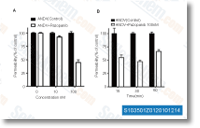 Click to enlarge | Rating | |
| Source | J Virol 2011 85, 2296–2303. Pazopanib HCl (GW786034 HCl) purchased from Selleck | |
| Method | Endothelial cell permeability assay | |
| Cell Lines | Endothelial cell | |
| Concentrations | 0-100 nM | |
| Incubation Time | 15-60 min | |
| Results | Figure A defines concentrations of kinase inhibitors which block ANDV-induced EC permeability approximately 50% (IC50s).The IC50s of pazopanib is 100 nM. we assessed the abilities of VEGFR2 and SFK inhibitors to block ANDV-induced permeability at their IC50s from 15 to 60 min after VEGF addition. The VEGFR2 kinase inhibitor pazopanib inhibited ANDV-induced permeability by 40 to 60% at nanomolar IC50 levels (Figure B). |
Identification of Targetable FGFR Gene Fusions in Diverse Cancers. [Wu YM, et al. Cancer Discov 2013;3(6):636-47]
