
Antibodies


Panobinostat (LBH589) is a novel broad-spectrum HDAC inhibitor with IC50 of 5 nM. Phase 3.
| Size | Price | Stock | Quantity | ||||||||||||||||
|---|---|---|---|---|---|---|---|---|---|---|---|---|---|---|---|---|---|---|---|
| |||||||||||||||||||
 Distributor Tel: +886-2-2827-1197jimmy@new.abscience.com.tw
| Description | Panobinostat (LBH589) is a novel broad-spectrum HDAC inhibitor with IC50 of 5 nM. Phase 3. | |||||
|---|---|---|---|---|---|---|
| Targets | HDAC (MOLT-4 cells) | HDAC (Reh cells) | ||||
| IC50 | 5 nM | 20 nM [1] | ||||
| In vitro | LBH589 induces apoptosis among MOLT-4 and Reh cells in a time- and dose-dependent manner. Moreover, LBH589 is more potent in MOLT-4 than in Reh cells. LBH589 markedly prevents the growth of both MOLT-4 and Reh cells in a dose-dependent manner at 48 hours. LBH589 treatment causes a 2- to 3-fold increase in the number of cells in the G2/M phase of the cell cycle compared with the control cells. LBH589 is associated with induction of histone H3K9 and histone H4K8 acetylation as well as decreasing levels of c-Myc expression in a dose-dependent manner. LBH589 treatment also increases the levels of p21 expression. LBH589 treatment also decreases the levels of c-Myc after an initial increase at the lowest dose (10 nM) in Reh cells. In addition, LBH589 gives rise to substantial increases in mRNA levels of proapoptosis and DNA repair genes. LBH589 induces increased levels of acetylated histone H3 and H4 at the GADD45G promoter. [1] Besides, LBH589 inhibits growth of non small cell lung cancer cell lines (such as human H1299, L55 and A549 with IC50 of 5 nM, 11 nM and 30 nM, respectively), mesothelioma (such as human OK-6 and Ok-5 with IC50 of 5 nM and 7 nM, respectively) and small cell lung cancer cell lines (such as human RG-1 and LD-T with IC50 of 4 nM and 5 nM, respectively). [2] | |||||
| In vivo | In lung cancer and mesothelioma animal models, LBH589 markedly decreases tumor growth by 62%. LBH589 is equally effective in immunocompetent and severe combined immunodeficien-cymice, suggesting that the inhibition of tumor growth by LBH589 is not due to direct immunologic effects. Daily LBH589, given i.p. at 20 mg/kg for 5 days per week, leading to an average decrease in growth of 70%. Compared with the corresponding control tumors, LBH589 leads to a 53% decrease for H526-derived tumors, an 81% decrease for BK-T-derived tumors, a 76% decrease for RG-1- derived tumors, and a 70% decrease for H69-derived tumors. In contrast to the lack of tumor regression notes in NSCLC and Meso-derived xenografted tumors that are treated under identical conditions and doses, LBH589 results in dramatic tumor regression in SCLC-derived tumors and RG-1-derived tumor. [2] | |||||
| Features | ||||||
| Cell lines | MOLT-4 cell lines and Reh (pre-B cells) |
|---|---|
| Concentrations | 50 nM |
| Incubation Time | 48 hours |
| Method | Untreated and LBH589-treated cells [human Ph- acute lymphoblastic leukemia MOLT-4 (T cells) and Reh (pre-B cells)] are stained with annexin V and propidium iodide using annexin V-FITC apoptosis detection kit I. The percentage of apoptotic and nonviable cells is determined by flow cytometry. At least 5 × 10⁴ cells are collected with a CyAn ADP Violet cytometer. Percentage apoptosis is calculated considering all the annexin V-positive plus the annexin V/PI-positive cells; percentage loss of cell viability is calculated considering all the annexin V-positive plus the PI-positive and the annexinV/PI-positive cells. |
| Animal Models | Severe combined immunodeficiency (SCID) mice with M30 (107 cells) or A549 (5 × 10⁶ cells), H69 (2.5 × 10⁶cells), BK-T (6.5 × 10⁶), H526 (10 × 106), and RG1 (10 × 106) cells |
|---|---|
| Dosages | 10 mg/kg, 20 mg/kg |
| Administration | Administered via i.p. injection |
| NCT Number | Recruitment | Conditions | Sponsor /Collaborators | Start Date | Phases |
|---|---|---|---|---|---|
| NCT01613976 | Recruiting | Myelodysplastic Syndromes (MDS)|Chronic Myelomonocytic Leukemia (CMML)|Acute Myeloid Leukemia (AML) | Novartis|Novartis Pharmaceuticals | 2012-08 | Phase 1 |
| NCT01680094 | Active, not recruiting | HIV Infection | University of Aarhus|Massachusetts General Hospital|Monash University|Karolinska Institutet|Novartis|Aarhus University Hospital | 2012-09 | Phase 1|Phase 2 |
| NCT01693601 | Recruiting | Myelofibrosis | Mount Sinai School of Medicine|John Mascarenhas | 2013-01 | Phase 1|Phase 2 |
| NCT01440582 | Recruiting | Myeloma | M.D. Anderson Cancer Center|Novartis | 2013-02 | Phase 1|Phase 2 |
| NCT01802879 | Not yet recruiting | Hematologic Neoplasms | Novartis|Novartis Pharmaceuticals | 2013-04 | Phase 2 |
| NCT01083602 | Active, not recruiting | Relapsed and Bortezomib Refractory Multiple Myeloma|Refractory Multiple Myeloma|Relapsed Multiple Myeloma | Novartis|Novartis Pharmaceuticals | 2013-06 | Phase 4 |
Download Panobinostat (LBH589) SDF
| Molecular Weight (MW) | 349.43 |
|---|---|
| Formula | C21H23N3O2 |
| CAS No. | 404950-80-7 |
| Storage | 3 years -20℃Powder |
|---|---|
| 6 months-80℃in DMSO | |
| Syonnyms | N/A |
| Solubility (25°C) * | In vitro | DMSO | 70 mg/mL (200 mM) |
|---|---|---|---|
| Water | <1 mg/mL (<1 mM) | ||
| Ethanol | <1 mg/mL (<1 mM) | ||
| * <1 mg/ml means slightly soluble or insoluble. * Please note that Selleck tests the solubility of all compounds in-house, and the actual solubility may differ slightly from published values. This is normal and is due to slight batch-to-batch variations. | |||
| Chemical Name | (E)-N-hydroxy-3-(4-((2-(2-methyl-1H-indol-3-yl)ethylamino)methyl)phenyl)acrylamide |
|---|
| Stock Solution (1ml DMSO) | 1mM | 10mM | 20mM | 30mM |
|---|---|---|---|---|
| Mass(mg) | 0.34943 | 3.4943 | 6.9886 | 10.4829 |
 Click to enlarge | Rating | |
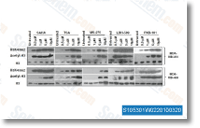
| Source | Breast Cancer Res Treat 2010 124(3), 667-675.Panobinostat (LBH589) purchased from Selleck | |
| Method | Western blot | |
| Cell Lines | MDA-MB-231 cells, MDA-MB-468 cells | |
| Concentrations | 0.5-10 μM | |
| Incubation Time | 24 h | |
| Results | In both MDA-MB-231 and MDA-MB-468 cell lines, exposure to LBH589 and other compounds produced significant global increase of nuclear H3K4me2, which is the specific substrate of LSD1. The enhanced level of histone methylation by HDAC inhibitors parallels the increase of acetylation of histone 3. |
Chemoproteomics profiling of HDAC inhibitors reveals selective targeting of HDAC complexes. [Bantscheff M, et al. Nat Biotechnol 2011;29(3):255-65]
Selective cancer targeting with prodrugs activated by histone deacetylases and a tumour-associated protease. [Ueki N, et al. Nat Commun 2013;4:2735]
A novel human high-risk ependymoma stem cell model reveals the differentiation-inducing potential of the histone deacetylase inhibitor Vorinostat. [Milde T, et al. Acta Neuropathol 2011;122(5):637-50]
