
Antibodies


Palomid 529 inhibits both the mTORC1 and mTORC2 complexes, reduces phosphorylation of pAktS473, pGSK3βS9, and pS6 but no effect observed on pMAPK or pAktT308. Phase 1.
| Size | Price | Stock | Quantity | ||||||||||||||||
|---|---|---|---|---|---|---|---|---|---|---|---|---|---|---|---|---|---|---|---|
| |||||||||||||||||||
 Distributor Tel: +886-2-2827-1197jimmy@new.abscience.com.tw
| Description | Palomid 529 inhibits both the mTORC1 and mTORC2 complexes, reduces phosphorylation of pAktS473, pGSK3βS9, and pS6 but no effect observed on pMAPK or pAktT308. Phase 1. | |||||
|---|---|---|---|---|---|---|
| Targets | ||||||
| IC50 | ||||||
| In vitro | Palomid 529 inhibits proliferation and increases apoptosis of endothelial cells. Palomid 529 inhibits both VEGF-driven and bFGF-driven endothelial cell proliferation with IC50 of 20 nM and 30 nM, respectively. Palomid 529 retains the ability to induce endothelial cell apoptosis. Palomid 529 decreases VEGF-A–driven phosphorylation of pAktS473, pGSK3βS9, and pS6. However, Palomid 529 prevents neither phosphorylated mitogen-activated protein kinase (pMAPK) nor pAktT308 as potently as pAktS473. Palomid 529 not only reduces the proliferative response in the ischemic retina but also improves the organization and structure of the vessels that form. [1] Palomid 529 shows a potent antiproliferative activity in the NCI-60 cell lines panel, with growth inhibitory 50 (GI50) <35 μM. In addition, Palomid 529 significantly enhances the antiproliferative effect of radiation in prostate cancer cells (PC-3). Palomid 529 gives rise to a concentration dependent growth inhibition on PC-3 cells. Doses of 2 and 7μM resulted in 30 and 60% growth inhibition, respectively. Palomid 529 inhibits the radiation-induced p-Akt activation and decreases Bcl-2/Bax ratio in PC-3. Palomid 529 not only inhibits radiation-induced overexpression of Id-1 and VEGF but also down-regulates radiation-induced MMP-2 and MMP-9. [2] | |||||
| In vivo | Palomid 529 shows a dose-dependent inhibition of the Ad-VEGF-A–driven angiogenesis following Palomid 529 treatment. Palomid 529 inhibits C6V10 glioma tumor growth in nude mice following i.p. dosing. Palomid 529 decreases AktS473 but not AktT308 signaling. Palomid 529 inhibits C6V10 glioma tumor growth in nude mice following i.p. dosing. Palomid 529 decreases AktS473 but not AktT308 signaling. Palomid 529 inhibits tumor growth, angiogenesis, and vascular permeability. [1] Treatment of PC-3 tumour-bearing mice with Palomid 529 reduced tumour growth to 57.1% compared with controls. [2] Palomid 529 is an effective suppressor of Müller cell proliferation, glial scar formation, and photoreceptor cell death in a rabbit model of retinal detachment (RD).[3] Palomid 529 significantly suppresses Brca1-deficient tumor growth in mice through inhibition of both Akt and mTOR signaling. [4] | |||||
| Features | ||||||
| Estrogen receptor binding assays | The proteins are produced with rabbit reticulocyte lysates. The amount of template used in each reaction is determined empirically and expression is monitored in parallel reactions where [35S]methionine is incorporated into the receptor followed by gel electrophoresis and exposure to film. Binding reactions of the estrogen receptors (ER) and Palomid 529 are carried out in 100 mL final volumes in TEG buffer [10 mM Tris (pH 7.5), 1.5 mM EDTA, 10% glycerol]. In vitro transcribed-translated receptor (5 μL) is used in each binding reaction in the presence of 0.5 nM [3H]estradiol (E2). Palomid 529 is routinely tested from 10−11 to 10−6 M and diluted in ethanol. The reactions are incubated at 4 °C overnight and bound E2 is quantified by adding 200 mL dextran-coated charcoal. After a 15-minutes rotation at 4 °C, the tubes are centrifuged for 10 minutes and 150 mL of the supernatant are added to 5 mL scintillation mixture for determination of cpm by liquid scintillation counting. The maximum binding is determined by competing bound E2 with only the ethanol vehicle. Controls for background are included in each experiment using 5 mL unprogrammed rabbit reticulocyte lysate. This value, typically 10% to 15% of the maximal counts, is subtracted from all values. The data are plotted and Kivalues are calculated. Experiments are conducted at least thrice in duplicate. |
|---|
| Cell lines | Human umbilical vascular endothelial cells (HUVEC) |
|---|---|
| Concentrations | ~20 μM |
| Incubation Time | 48 hours |
| Method | Human umbilical vascular endothelial cells (HUVEC) are used. The proliferation assay is carried out by seeding the HUVECs in 96-well plates at a density of 1,000 per well in complete medium. Following a 24-hour plating period, the cells are starved for 24 hours in 0.5% serum before being treated with Palomid 529 in the presence of 10 ng/mL basic fibroblast growth factor (bFGF) or VEGF in complete medium. After 48 hours, cell number is determined using a colorimetric method. The results are expressed as the percentage of the maximal bFGF or VEGF response in the absence of Palomid 529. Nonproliferating endothelial cells are assayed by growing HUVECs to quiescence in 96-well plates and treating with Palomid 529 for 48 hours. Initially, 5,000 cells per well are seeded and confluence is achieved the next day. The plates are incubated for another 24 hours to ensure growth arrest before treatment with Palomid 529. |
| Animal Models | Female nude mice with C6V10 rat glioma cells or U87 cells |
|---|---|
| Dosages | 50 mg/kg/2 d, 25 mg/kg/2 d and 200 mg/kg/2 d |
| Administration | Administered via i.p. |
| NCT Number | Recruitment | Conditions | Sponsor /Collaborators | Start Date | Phases |
|---|---|---|---|---|---|
| NCT01033721 | Completed | Age-Related Macular Degeneration | Paloma Pharmaceuticals, Inc. | 2010-06 | Phase 1 |
| NCT01271270 | Completed | Age-Related Macular Degeneration | National Institutes of Health Clinical Center (CC)|National Eye Institute (NEI) | 2010-12 | Phase 1 |
Download Palomid 529 (P529) SDF
| Molecular Weight (MW) | 406.43 |
|---|---|
| Formula | C24H22O6 |
| CAS No. | 914913-88-5 |
| Storage | 3 years -20℃Powder |
|---|---|
| 6 months-80℃in DMSO | |
| Syonnyms | P529 |
| Solubility (25°C) * | In vitro | DMSO | 81 mg/mL (199 mM) |
|---|---|---|---|
| Water | <1 mg/mL (<1 mM) | ||
| Ethanol | <1 mg/mL (<1 mM) | ||
| * <1 mg/ml means slightly soluble or insoluble. * Please note that Selleck tests the solubility of all compounds in-house, and the actual solubility may differ slightly from published values. This is normal and is due to slight batch-to-batch variations. | |||
| Chemical Name | 3-(4-methoxybenzyloxy)-8-(1-hydroxyethyl)-2-methoxy-6H-benzo[c]chromen-6-one |
|---|
| Stock Solution (1ml DMSO) | 1mM | 10mM | 20mM | 30mM |
|---|---|---|---|---|
| Mass(mg) | 0.40643 | 4.0643 | 8.1286 | 12.1929 |
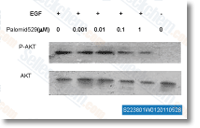 Click to enlarge | Rating | |
| Source | Dr. Zhang of Tianjin Medical University. Palomid 529 (P529) purchased from Selleck | |
| Method | Western blot | |
| Cell Lines | A549 cells | |
| Concentrations | 0-1 μM | |
| Incubation Time | 3 h | |
| Results | Palomid529 treatment resulted in a reduction of Akt phosphorylation in A549 cells. |
Pharmacological profiling of phosphoinositide-3-kinase inhibitors as mitigators of ionizing radiation-induced cell death. [Lazo JS, et al. J Pharmacol Exp Ther 2013;347(3):669-80]
