
Antibodies


OSU-03012 is a potent inhibitor of recombinant PDK-1 with IC50 of 5 μM and 2-fold increase in potency over OSU-02067.
| Size | Price | Stock | Quantity | ||||||||||||||||
|---|---|---|---|---|---|---|---|---|---|---|---|---|---|---|---|---|---|---|---|
| |||||||||||||||||||
 Distributor Tel: +886-2-2827-1197jimmy@new.abscience.com.tw
| Description | OSU-03012 is a potent inhibitor of recombinant PDK-1 with IC50 of 5 μM and 2-fold increase in potency over OSU-02067. | |||||
|---|---|---|---|---|---|---|
| Targets | PDK-1 | |||||
| IC50 | 5 μM [1] | |||||
| In vitro | OSU-03012 induces apoptotic death in PC-3 cells with IC50 of 5 µM and reduces the activity of immunoprecipitated p70S6K. OSU-03012 completely suppress cell growth in a diverse range of tumor cell lines at concentrations of 3–5 μm, as compared with the concentration of at least 50 μm required for celecoxib.[1] OSU-03012 promotes cell killing to a greater extent in glioma cells than in nontransformed astrocytes. OSU-03012 causes a dose-dependent induction of cell death that is not altered by p53 mutation, expression of ERBB1 VIII, or loss of phosphatase and tensin function due to a homolog deletion on chromosome 10. OSU-03012 and ionizing radiation cause an additive, caspase-independent elevation in cell killing. OSU-03012 lethality as a single agent or when combined with signaling modulators is not modified in cells lacking expression of BIM or of BAX/BAK. OSU-03012 promotes the release of cathepsin B from the lysosomal compartment and that of AIF from mitochondria. The lethality of OSU-03012 is attenuated in protein kinase R-like endoplasmic reticulum kinase-/- cells, which correlated with the reduced cleavage of BID and suppression of cathepsin B and AIF release into the cytosol. [2] OSU-03012 inhibits thyroid cancer cell (NPA, WRO, and ARO cells) proliferation, migration and induces apoptosis, which results in an increase of cells in the S phase without an increase of cells in G2. OSU-03012 is an ATP-competitive inhibitor of PAK activity and suppresses the phosphorylation of AKT in thyroid cancer cells. [3] OSU-03012 inhibits cell growth of hepatocellular carcinoma cell lines including Huh7, Hep3B and HepG2 cells with IC50 values below 1 μM. OSU-03012 does not suppress PDK1 or AKT activity or induce cellular apoptosis but induces autophagy in Huh7 cells. Moreover, accumulation of reactive oxygen species (ROS) is detected after OSU-03012 treatment. [4] A recent study shows that OSU-03012 could enhance the susceptibility of (Bcr)-Abl mutant cell lines to imatinib-induced apoptosis. [5] | |||||
| In vivo | OSU-03012 suppresses tumor growth by 57.59% and increases cleaved LC3 in Huh7 tumor xenografts at 200 mg/kg. [4] OSU-03012 remarkably decreases expression of EGFR protein in the tumors by 48% compared with vehicle controls and also prevents YB-1 from binding to the EGFR promoter in MDA-MB-435/LCC6 xenografts.[6] OSU-03012 is well tolerated and inhibits the growth of HMS-97 schwannoma xenografts by 55% after oral administration. [7] | |||||
| Features | A derivative of celecoxib with 10-fold greater antitumor activity, but lacks celecoxibs COX-2 inhibitory activity. | |||||
| PDK-1 Kinase Assay | This in vitro assay is performed using a PDK-1 kinase assay kit. This cell-free assay is based on the ability of recombinant PDK-1, in the presence of DMSO vehicle or OSU-03012, to activate its downstream serum- and glucocorticoid-regulated kinase which, in turn, phosphorylates the Akt/serum- and glucocorticoid-regulated kinase-specific peptide substrate RPRAATF with [γ-32P]ATP. The 32P-phosphorylated peptide substrate is then separated from the residual [γ-32P]-ATP by using P81 phosphocellulose paper and quantitated in a scintillation counter after three washes with 0.75% phosphoric acid. |
|---|
| Cell lines | PC-3 cells |
|---|---|
| Concentrations | 0-10 μM |
| Incubation Time | ~72 hours |
| Method | The effect of OSU-03012 on PC-3 cell viability is assessed by using the 3-(4,5-dimethylthiazol-2-yl)-2,5-diphenyl-2H-tetrazolium bromide assay in six replicates. Cells are grown in 10% FBS- supplemented RPMI 1640 in 96-well, flat-bottomed plates for 24 hours. They are exposed to various concentrations of OSU-03012 (0-10 μM) dissolved in DMSO (final concentration ≤0.1%) in 1% serum-containing RPMI 1640 for different time intervals (~72 hours). Controls receive DMSO vehicle at a concentration equal to that in OSU-03012-treated cells. The medium is removed and replaced by 200 μL of 0.5 mg/mL 3-(4,5-dimethylthiazol-2-yl)-2,5-diphenyl-2H-tetrazolium bromide in 10% FBS-containing RPMI 1640. The cells are incubated in the CO2 incubator at 37 °C for 2 hours. Supernatants are removed from the wells, and the reduced 3-(4,5-dimethylthiazol-2-yl)-2,5-diphenyl-2H-tetrazolium bromide dye is solubilized in 200 μL DMSO per well. Absorbance at 570 nm is determined by using a plate reader. |
| Animal Models | Huh7 tumor xenografts in male BALB/c nude mice |
|---|---|
| Dosages | 100-200 mg/kg |
| Administration | Daily by gavage |
| Solubility | 0.5% methylcellulose/0.2% Tween 80, 30 mg/mL |
Download OSU-03012 (AR-12) SDF
| Molecular Weight (MW) | 460.45 |
|---|---|
| Formula | C26H19F3N4O |
| CAS No. | 742112-33-0 |
| Storage | 3 years -20℃Powder |
|---|---|
| 6 months-80℃in DMSO | |
| Syonnyms | N/AAR-12 |
| Solubility (25°C) * | In vitro | DMSO | 11 mg/mL (23 mM) |
|---|---|---|---|
| Water | <1 mg/mL (<1 mM) | ||
| Ethanol | <1 mg/mL (<1 mM) | ||
| In vivo | 0.5% methylcellulose/0.2% Tween 80, | 30 mg/mL | |
| * <1 mg/ml means slightly soluble or insoluble. * Please note that Selleck tests the solubility of all compounds in-house, and the actual solubility may differ slightly from published values. This is normal and is due to slight batch-to-batch variations. | |||
| Chemical Name | 2-amino-N-(4-(5-(phenanthren-2-yl)-3-(trifluoromethyl)-1H-pyrazol-1-yl)phenyl)acetamide |
|---|
| Stock Solution (1ml DMSO) | 1mM | 10mM | 20mM | 30mM |
|---|---|---|---|---|
| Mass(mg) | 0.46045 | 4.6045 | 9.209 | - |
 Click to enlarge | Rating | |
| Source | PLoS One, 2013, 8(9):e75100 . OSU-03012 (AR-12) purchased from Selleck | |
| Method | Western blot | |
| Cell Lines | Orbital fibroblasts | |
| Concentrations | 5 uM | |
| Incubation Time | 6 h | |
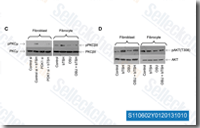
| Results | The siRNA targeting PDK1 attenuates TSH-dependent PKCm Ser 916 phosphorylation in fibroblasts (Fig. C) while the PDK1 inhibitor, OSU-03012 (5 mM) [54] blocks TSH-dependent phosphorylation of PKCm Ser 916 and PKCbII Ser 660 levels in the respective cell-types (Fig. C). The inhibitor also reduces levels of TSH-dependent pAKT Threonine 308 in fibroblasts but fails to do so in fibrocytes (Fig. D, 14.461.2% and 2.560.6%, respectively). |
Thyrotropin Regulates IL-6 Expression in CD34+ Fibrocytes: Clear Delineation of Its cAMP-Independent Actions. [Raychaudhuri N, et al. PLoS One 2013;8(9):e75100]
Endogenous adenosine contributes to renal sympathetic neurotransmission via postjunctional A1 receptor-mediated coincident signaling. [Edwin K, et al. Am J Physiol Renal Physiol 2011;302(4):F466-76]
Cryptococcus neoformans Phosphoinositide-Dependent Kinase 1 (PDK1) Ortholog Is Required for Stress Tolerance and Survival in Murine Phagocytes. [Chabrier-Roselló Y, et al. Eukaryot Cell 2012;12(1):12-22]
