
Antibodies


OSI-906 (Linsitinib) is a selective inhibitor of IGF-1R with IC50 of 35 nM; modestly potent to InsR with IC50 of 75 nM, and no activity towards Abl, ALK, BTK, EGFR, FGFR1/2, PKA etc. Phase 3.
| Size | Price | Stock | Quantity | ||||||||||||||||||||
|---|---|---|---|---|---|---|---|---|---|---|---|---|---|---|---|---|---|---|---|---|---|---|---|
| |||||||||||||||||||||||
 Distributor Tel: +886-2-2827-1197jimmy@new.abscience.com.tw
| Description | OSI-906 (Linsitinib) is a selective inhibitor of IGF-1R with IC50 of 35 nM; modestly potent to InsR with IC50 of 75 nM, and no activity towards Abl, ALK, BTK, EGFR, FGFR1/2, PKA etc. Phase 3. | |||||
|---|---|---|---|---|---|---|
| Targets | IGF-1R | InsR | ||||
| IC50 | 35 nM | 75 nM [1] | ||||
| In vitro | OSI-906 inhibits IGF-1R autophosphorylation and activation of the downstream signaling proteins Akt, ERK1/2 and S6 kinase with IC50 of 0.028 to 0.13 μM. OSI-906 enables an intermediate conformation of the target protein through interactions with the C-helix. OSI-906 displays favorable metabolic stability in liver microsomes. OSI-906 fully inhibits both IR and IGF-1R phosphorylation at a concentration of 1 μM. OSI-906 inhibits proliferation of several tumor cell lines including non-small-cell lung cancer and colorectal cancer (CRC) tumor cell line with EC50 of 0.021 to 0.810 μM. [1] | |||||
| In vivo | OSI-906 inhibits tumor growth in an IGF-1R-driven xenograft mouse model, with 100% TGI and 55% regression at a dose of 75 mg/kg and 60% TGI and no regression at a dose of 25 mg/kg. OSI-906 administration induces different elimination half-lives of itself in dog, rat and mice, the elimination half-lives are 1.18 hours, 2.64 hours and 2.14 hours, respectively. OSI-906 administration at different single dose once-daily in femal Sprague-Dawley rat and femal CD-1 mouse reveal that the Vmax is not dose-proportional to OSI-906 dose. OSI-906 elevates the blood glucose levels at a dose of 25 mg/kg after 12 days administration. OSI-906 administration at a single dose of 75 mg/kg in IGF-1R-driven full-length human IGF-1R (LISN) xenograft mouse model achieve maximal inhibition of IGF-1R phosphorylation (80%) between 4 and 24 hours with plasma drug concentrations of 26.6-4.77 μM. [1] OSI-906 administered as a single dose of at 60 mg/kg in NCI-H292 xenografts mice inhibits uptake of glucose at 2, 4, and 24 hours post-treatment in vivo. OSI-906 inhibits the growth of tumors in NCI-H292 xenograft mouse model. [2] | |||||
| Features | ||||||
| Protein kinase biochemical assays | Protein kinase assays are either performed in-house by ELISA-based assay methods (IGF-1R, IR, EGFR and KDR) or at Upstate Inc. by a radiometric method with ATP at 100 µM concentration. In-house ELISA assays use poly(Glu:Tyr) as the substrate bound to the surface of 96-well assay plates and phosphorylation is detected using an antiphosphotyrosine antibody conjugated to horseradish peroxidase. The bound antibody is quantified using ABTS as the peroxidase substrate by measuring absorbance at 405 / 490 nm. All assays use purified recombinant kinase catalytic domains. Recombinant enzymes of human IGF-1R or EGFR are expressed as an NH2-terminal glutathione S-transferase fusion protein in insect cells and are purified in house. IC50 values are determined from the sigmoidal dose–response plot of percent inhibition versus log10 compound concentration. A minimum of three measurements, performed in duplicate, are carried out with in-house assays unless otherwise indicated. OSI-906 at a concentration of 1 µM is profiled versus a panel of kinases using the ProfilerProTM Kinase Selectivity Assay Kit. |
|---|
| Cell lines | MCF7, NCI-H292, Colo-205, HT29, H358, H1703, BxPC3, A673, SW620, DU4475, HepG2 and Hepa-1, RKO 3T3/hulGF-IR and H292 cells |
|---|---|
| Concentrations | 0.02-0.8 μM |
| Incubation Time | 3 days |
| Method | For assays of cell proliferation, cells are seeded into 96-well plates in appropriate media containing FCS 10% and incubated for 3 days in the presence of OSI-906 at various concentrations. Inhibition of cell growth is determined by luminescent quantitation of intracellular ATP content using CellTiterGlo. Data is presented as a fraction of maximal proliferation, calculated by dividing the cellular density in the presence of varying concentrations of OSI-906 by the cellular density of control cells treated with vehicle (DMSO) only. |
| Animal Models | IGF-1R-driven full-length human IGF-1R (LISN) xenograft mouse model |
|---|---|
| Dosages | 25 mg / kg and 75 mg / kg |
| Administration | Orally administrated at once-daily oral dose for 14 days |
| Solubility | 30% PEG400/0.5% Tween80/5% propylene glycol, 30 mg/mL |
| NCT Number | Recruitment | Conditions | Sponsor /Collaborators | Start Date | Phases |
|---|---|---|---|---|---|
| NCT01560260 | Suspended | Carney Complex|Gastrointestinal Stromal Tumor|Paraganglioma|Sarcoma | Sarcoma Alliance for Research through Collaboration|National Cancer Institute (NCI) | 2012-03 | Phase 2 |
| NCT01600807 | Not yet recruiting | Pancreatic Cancer, Metastatic | Dana-Farber Cancer Institute | 2012-06 | Phase 1|Phase 2 |
| NCT01672736 | Recruiting | Multiple Myeloma | University Health Network, Toronto|Multiple Myeloma Research Consortium|Astellas Pharma Inc | 2012-09 | Phase 1|Phase 2 |
| NCT01427205 | Withdrawn | Head and Neck Cancer | M.D. Anderson Cancer Center|OSI Pharmaceuticals | 2013-06 | Phase 2 |
| NCT01567384 | Not yet recruiting | Cancer|Neoplasms|Tumors | Emory University|OSI Pharmaceuticals | 2013-12 | Phase 1 |
Download OSI-906 (Linsitinib) SDF
| Molecular Weight (MW) | 421.49 |
|---|---|
| Formula | C26H23N5O |
| CAS No. | 867160-71-2 |
| Storage | 3 years -20℃Powder |
|---|---|
| 6 months-80℃in DMSO | |
| Syonnyms | N/A |
| Solubility (25°C) * | In vitro | DMSO | 84 mg/mL (199 mM) |
|---|---|---|---|
| Water | <1 mg/mL (<1 mM) | ||
| Ethanol | <1 mg/mL (<1 mM) | ||
| In vivo | 30% PEG400/0.5% Tween80/5% propylene glycol, | 30 mg/mL | |
| * <1 mg/ml means slightly soluble or insoluble. * Please note that Selleck tests the solubility of all compounds in-house, and the actual solubility may differ slightly from published values. This is normal and is due to slight batch-to-batch variations. | |||
| Chemical Name | (1s,3s)-3-(8-amino-1-(2-phenylquinolin-7-yl)imidazo[1,5-a]pyrazin-3-yl)-1-methylcyclobutanol |
|---|
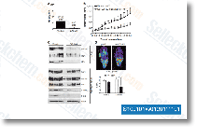 Click to enlarge | Rating | |
| Source | Cancer Res, 2011, 71(21), 6773-84. OSI-906 (Linsitinib) purchased from Selleck | |
| Method | [18 F]FDG –PET/ Western blot | |
| Cell Lines | MCF-7 cells/athymic mice | |
| Concentrations | 50 mg/kg/day | |
| Incubation Time | 6 weeks | |
| Results | mice without palpable tumors were randomized to treatment with vehicle or OSI-906. Six of 20 control mice (30%) developed tumors, whereas none of the 20 OSI-906–treated mice did (Fig. A). OSI-906 inhibited tumor growth compared with vehicle (Fig. B; P < 0.05). OSI-906–treated tumors exhibited markedly lower levels of phosphorylated IGF-IR, InsR, IRS-1, AKT, and S6 compared with vehicle controls (Fig. C). FDG uptake was significantly decreased 4 hours after a single dose of OSI-906 com-pared with baseline (Fig. D) |
Insulin-like growth factor 1 receptor (IGF1R) as a novel target in chronic lymphocytic leukemia. [Yaktapour N, et al. Blood 2013;122(9):1621-33]
Resistance to Irreversible EGFR Tyrosine Kinase Inhibitors through a Multistep Mechanism Involving the IGF1R Pathway. [Cortot AB, et al. Cancer Res 2012;73(2):834-43]
A kinome-wide screen identifies the insulin/IGF-I receptor pathway as a mechanism of escape from hormone dependence in breast cancer [Fox EM, et al. Cancer Res 2011;71(21):6773-84]
