
Antibodies


OSI-027 is a selective and potent dual inhibitor of mTORC1 and mTORC2 with IC50 of 22 nM and 65 nM, and more than 100-fold selectivity observed for mTOR than PI3Kα, PI3Kβ, PI3Kγ or DNA-PK.
| Size | Price | Stock | Quantity | ||||||||||||||||
|---|---|---|---|---|---|---|---|---|---|---|---|---|---|---|---|---|---|---|---|
| |||||||||||||||||||
 Distributor Tel: +886-2-2827-1197jimmy@new.abscience.com.tw
| Description | OSI-027 is a selective and potent dual inhibitor of mTORC1 and mTORC2 with IC50 of 22 nM and 65 nM, and more than 100-fold selectivity observed for mTOR than PI3Kα, PI3Kβ, PI3Kγ or DNA-PK. | |||||
|---|---|---|---|---|---|---|
| Targets | mTORC1 | mTORC2 | ||||
| IC50 | 22 nM [1] | 65 nM [1] | ||||
| In vitro | OSI-027 shows the selective and ATP competitive inhibition activities against mTORC1 and mTORC2 with IC50 of 22 nM and 65 nM, respectively. In addition, OSI-027 inhibits mTOR signaling of phospho-4E-BP1 with an IC50 of 1 μM in cell-based assays. [1] OSI-027 exhibits anti-proliferative activities against several acute leukemia cell lines of myeloid/megakaryocytic origin in a dose-dependent manner, including U937, KG-1, KBM-3B, ML-1, HL-60, and MEG-01 cells. [2] A recent study shows that inhibition of mTORC1/2 by OSI-027 effectively suppresses phosphorylation of Akt (S473) and cell proliferation in breast cancer cells. [3] | |||||
| In vivo | In GEO colorectal xenograft, OSI-027 (65 mg/kg) inhibits both mTORC1 and mTORC2 effectors, including 4E-BP1, Akt, and S6 phosphorylation. Furthermore, mTORC1 and mTORC2 inhibition together by OSI-027 potently inhibits tumor growth more than mTORC1 inhibition by rapamycin. [1] | |||||
| Features | ||||||
| Biochemical assays | mTORC1 and mTORC2 inhibition is assayed using native enzyme complex immunoprecipitated from HeLa lysates at 1 mM ATP. To prepare whole cell lysates from HeLa cells, 25 g cell pellet is lysed in 60 mL of ice-cold buffer A [40 mM HEPES (pH 7.5), 120 mM NaCl, 1 mM EDTA, 10 mM sodium pyrophosphate, 10 mM glycerophosphate, 50 mM NaF, 0.5 mM orthovanadate, and EDTA-free protease inhibitors containing 0.3% CHAPS] for 30 minutes on a magnetic stirrer in a cold room. After clearing of the lysates by centrifugation at 13,000 g for 10 minutes, Protein G-coated 384-well plates are incubated with 0.25 μg of mTOR antibody in 15 μL of buffer A for 1 hour at 4 °C. To each well, 40 μg of HeLa cell lysate in 15 μL of buffer A is added and incubated overnight at 4 °C to immunoprecipitate mTOR complexes. Plates are washed 3 times with buffer A and twice with immunoprecipitation wash buffer [Buffer B: 50 mM HEPES (pH 7.5) and 150 mM NaCl]. OSI-027 is added at 10 μM concentration to each well and DMSO is added to the control wells. The reaction is started by adding 150 ng of His-tagged 4E-BP1 as a substrate in the presence or absence of 100 μM ATP to each well in 25 μL of freshly prepared kinase buffer [Buffer C: 20 mM HEPES (pH 7.5), 10 mM MgCl2, 4 mM MnCl2, 10 mM β-mercaptoethanol, and 200 μM vanadate] and incubated at room temperature (RT) for 30 minutes. The reaction is stopped by transferring 25 μL of reaction mixture from each well to corresponding wells of fresh Ni-chelate-coated plates and incubated overnight at 4 °C followed by 2 hours at 37 °C. To detect phosphorylation of 4E-BP1, the plates are washed once with TBST (Tris-buffered saline containing 0.1% Tween-20) containing 5% skim milk powder. To each well, 25 μL of 1:1,000 diluted phospho-4E-BP1 antibodies in TBST containing 5% skim milk are added and incubated for 1 hour at RT. The plates are washed once with TBST and then 25 μL of anti-rabbit HRP (diluted 1:10,000) in TBST containing 5% skim milk is added. The plates are incubated for 1 hour at RT and washed 5 times with TBST. For detection of phospho-4E-BP1, 25 μL of chemiluminescent reagents A+B is added and chemiluminescence is measured using an Analyst plate reader. |
|---|
| Cell lines | U937, KG-1, KBM-3B, ML-1, HL-60, and MEG-01 |
|---|---|
| Concentrations | 0-10 μM |
| Incubation Time | 72 hours |
| Method | Inhibition of proliferation is measured using the Cell Titer Glo Assay , as noted in figure legends. To generate dose–response curves, cell lines are seeded at a density of 5,000 cells per well in a 96-well plate. After 24 hours of plating, cells are dosed with varying concentrations of either OSI-027 or rapamycin. The signal for Cell Titer Glo Assay is determined 72 hours after dosing and normalized to that of vehicle-treated controls. Inhibition of proliferation, relative to vehicle-treated controls, is expressed as a fraction of 1 and graphed using PRISM software. |
| Animal Models | GEO colorectal cells are injected s.c. into the right flank of nu/nu CD-1 mice. |
|---|---|
| Dosages | ≤65 mg/kg |
| Administration | Administered via gavage. |
| Solubility | 1% DMSO/30% polyethylene glycol/1% Tween 80, 30 mg/mL |
| NCT Number | Recruitment | Conditions | Sponsor /Collaborators | Start Date | Phases |
|---|---|---|---|---|---|
| NCT00698243 | Completed | Any Solid Tumor or Lymphoma | Astellas Pharma Inc | 2008-06 | Phase 1 |
| Molecular Weight (MW) | 406.44 |
|---|---|
| Formula | C21H22N6O3 |
| CAS No. | 936890-98-1 |
| Storage | 3 years -20℃Powder |
|---|---|
| 6 months-80℃in DMSO | |
| Syonnyms | N/A |
| Solubility (25°C) * | In vitro | DMSO | 18 mg/mL (44 mM) |
|---|---|---|---|
| Water | <1 mg/mL (<1 mM) | ||
| Ethanol | <1 mg/mL (<1 mM) | ||
| In vivo | 1% DMSO/30% polyethylene glycol/1% Tween 80, | 30 mg/mL | |
| * <1 mg/ml means slightly soluble or insoluble. * Please note that Selleck tests the solubility of all compounds in-house, and the actual solubility may differ slightly from published values. This is normal and is due to slight batch-to-batch variations. | |||
| Chemical Name | (1r,4r)-4-(4-amino-5-(7-methoxy-1H-indol-2-yl)imidazo[1,5-f][1,2,4]triazin-7-yl)cyclohexanecarboxylic acid |
|---|
| Stock Solution (1ml DMSO) | 1mM | 10mM | 20mM | 30mM |
|---|---|---|---|---|
| Mass(mg) | 0.40644 | 4.0644 | 8.1288 | 12.1932 |
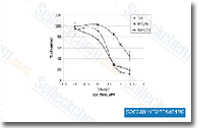 Click to enlarge | Rating | |
| Source | Urol Oncol. 2013 Sep 17. pii: S1078-1439(13)00251-2 . OSI-027 purchased from Selleck | |
| Method | Cell proliferation assays | |
| Cell Lines | T24, HT1376, and UM-UC-3 | |
| Concentrations | 0.1-25 uM | |
| Incubation Time | 72 h | |
| Results | Dual mTOR inhibitor OSI-027 inhibit bladder cancer cell growth in a dose-dependent manner. |
Benzofuran derivatives as a novel class of inhibitors of mTOR signaling [Christophe Salom? et al. European Journal of Medicinal Chemistry 2013;10.1016/j.ejmech.2013.12.020]
PI 3-kinase independent role for AKT in F-actin regulation during outer segment phagocytosis by RPE cells. [Bulloj A, et al. Exp Eye Res 2013;113:9-18]
The combination of an mTORc1/TORc2 inhibitor with lapatinib is synergistic in bladder cancer in vitro. [Becker MN, et al. Urol Oncol 2013;10.1016/j.urolonc.2013.06.002]
