
Antibodies


NVP-BHG712 is a specific EphB4 inhibitor with ED50 of 25 nM that discriminates between VEGFR and EphB4 inhibition; also shows activity against c-Raf, c-Src and c-Abl with IC50 of 0.395 μM, 1.266 μM and 1.667 μM, respectively.
| Size | Price | Stock | Quantity | ||||||||||||||||||||
|---|---|---|---|---|---|---|---|---|---|---|---|---|---|---|---|---|---|---|---|---|---|---|---|
| |||||||||||||||||||||||
 Distributor Tel: +886-2-2827-1197jimmy@new.abscience.com.tw
| Description | NVP-BHG712 is a specific EphB4 inhibitor with ED50 of 25 nM that discriminates between VEGFR and EphB4 inhibition; also shows activity against c-Raf, c-Src and c-Abl with IC50 of 0.395 μM, 1.266 μM and 1.667 μM, respectively. | |||||
|---|---|---|---|---|---|---|
| Targets | c-Raf | c-Src | c-Abl | |||
| IC50 | 0.395 μM | 1.266 μM | 1.667 μM [1] | |||
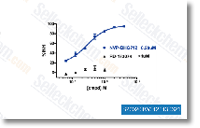
| In vitro | NVP-BHG712 treatment also dose dependently leads to the inhibition of RTK autophosphorylation in stable transfected A375 melanoma cells with EC50 of 25 nM and 4.2 μM for EphB4 and VEGFR2, respectively. [1] | |||||
| In vivo | In a growth factor-induced angiogenesis model, NVP-BHG712 (3 mg/kg, p.o) significantly suppresses VEGF stimulated tissue formation and vascularization by inhibiting EphB4 forward signaling. Furthermore, NVP-BHG712 (10 mg/kg/kg, p.o.) potently reverses VEGF enhanced tissue formation and vessel growth. NVP-BHG712 (3 mg/kg, p.o.) shows a long lasting exposure with concentrations around 10 μM in plasma as well as in lung and liver tissue for up to 8 hours, and thus results in a long lasting inhibition of EphB4 kinase activity in mice. [1] | |||||
| Features | Discriminates between VEGFR and EphB4. | |||||
| In vitro kinase assays | All in vitro kinase assays are performed with recombinant purified kinases either purchased from external vendors or produced in house. To estimate kinase activity both, TR-FRET-based LanthaScreenTM and Caliper mobility shift are used. In brief, the LanthaScreenTM assay technology is based on the discrimination between the unphosphorylated substrate and the phosphorylated product by a phospho-specific antibody, binding only to the phosphorylated version of the substrate. Both, antibody and substrate, carry fluorescent labels and the close proximity of the labels in the formed complex allows the measurement of a fluorescence resonance energy transfer (FRET) signal. Reading of the FRET signal in a time-dependent/time-gated manner further improves the assay performance by reducing background fluorescence. For dose–response measurements NVP-BHG712 is pre-diluted in 90% DMSO and 50 nL of compound solutions are dispensed directly into the empty assay plate using a HummingBird nanodispenser. The kinase reactions are started by addition of 4.5 μL ATP solution (4 μM ATP, 20 mM Tris/HCL, 1 mM DTT, 0.03% Tween20, 0.01 mM Na3VO4) and 4.5 μL enzyme/substrate mix (100 nM fluorescein poly-GAT), 0.5% bovine serum albumin, 20 mM Tris/HCL, 1 mM DTT, 0.03% Tween20, 0.01 mM Na3VO4). Further components of the enzyme/substrate mix are the enzymes as well as MgCl2/MnCl2 which are adjusted specifically to the requirements of the individual enzyme. After incubation for 60 minutes at r.t. the kinase reactions are stopped by addition of 4.5 μL stop solution (50 mM EDTA pH 8.0, 0.04% NP-40, 20 mM Tris/HCl pH 7.4) followed by 4.5 μL of detection mix (1.72 μg/mL Tb-PY20 antibody), 1% bovine serum albumin, 20 mM Tris/HCl, 1 mM DTT, 0.03% Tween20, 0.01 mM Na3VO4). After incubation for 45 minutes at r.t. plates are analyzed in a BMG PHERAstar plate reader. In the Caliper mobility shift assays kinase reactions are analyzed by microfluidic capillary electrophoresis. The transfer of phosphate from ATP to a short peptide by a kinase causes a change in the net-charge of the peptide by −2. The charge difference between the unphosphorylated and phosphorylated entities of the peptide can be separated in an electrical field. Using peptides attached with a fluorescent label allows detection and quantification of both forms and hence the calculation of the reaction turnover. For dose–response measurements NVP-BHG712 is pre-diluted in 90% DMSO and 50 nL aliquots of solution are dispensed directly into the empty assay plate using a HummingBird nanodispenser. The kinase reactions are started by addition of 4.5 μL substrate mix consisting of ATP and peptide substrate in assay buffer (50 mM HEPES pH 7.5, 0.02% bovine serum albumin, 1 mM DTT, 0.02% Tween20, 0.01 mM Na34, 10 mM beta-glycerophosphate) and 4.5 μL enzyme solution in assay buffer. The peptide concentration is 2 μM in the assays. Concentrations for the enzyme, as well as for MgCl2 and MnCl2are adjusted specifically to the requirements of the individual enzyme. ATP concentrations are adjusted to the Km values of the specific enzyme. After incubation for 60 minutes at 30 °C the kinase reactions are stopped by addition of 16 μL stop solution (100 mM HEPES pH 7.5, 5% DMSO, 0.1% coating reagent 10 mM EDTA pH 8.0, 0.015% BRIJ35). Stopped kinase reactions are analyzed in a LC3000 reader. |
|---|
| Animal Models | VEGF-mediated angiogenesis in vivo is induced in a growth factor implant model in mice. |
|---|---|
| Dosages | ≤30 mg/kg |
| Administration | Administered via p.o. |
| Solubility | NMP/polyethylene glycol 300 (10/90, v/v), 30 mg/mL |
| Molecular Weight (MW) | 503.48 |
|---|---|
| Formula | C26H20F3N7O |
| CAS No. | 940310-85-0 |
| Storage | 3 years -20℃Powder |
|---|---|
| 6 months-80℃in DMSO | |
| Syonnyms | N/A |
| Solubility (25°C) * | In vitro | DMSO | 101 mg/mL (200 mM) |
|---|---|---|---|
| Water | <1 mg/mL (<1 mM) | ||
| Ethanol | 3 mg/mL (5 mM) | ||
| In vivo | NMP/polyethylene glycol 300 (10/90, v/v), | 30 mg/mL | |
| * <1 mg/ml means slightly soluble or insoluble. * Please note that Selleck tests the solubility of all compounds in-house, and the actual solubility may differ slightly from published values. This is normal and is due to slight batch-to-batch variations. | |||
| Chemical Name | 4-methyl-3-(1-methyl-6-(pyridin-3-yl)-1H-pyrazolo[3,4-d]pyrimidin-4-ylamino)-N-(3-(trifluoromethyl)phenyl)benzamide |
|---|
| Stock Solution (1ml DMSO) | 1mM | 10mM | 20mM | 30mM |
|---|---|---|---|---|
| Mass(mg) | 0.50348 | 5.0348 | 10.0696 | 15.1044 |
 Click to enlarge | Rating | |
| Source | NVP-BHG712 purchased from Selleck | |
| Method | autophosphorylation assay | |
| Cell Lines | HEK293 cells | |
| Concentrations | 0.29 μM | |
| Incubation Time | ||
| Results | An autophosphorylation assay was performed in the presence of NVP - BHG712, an EPHB4 inhibitor, and PD- 173074, a compound that is not expected to inhibit EPHB4. % inhibition data were plotted to determine EC50s. |
