
Antibodies


NVP-AEW541 is a potent inhibitor of IGF-1R with IC50 of 86 nM, 27-fold greater selectivity for IGF-1R than InsR.
| Size | Price | Stock | Quantity | ||||||||||||||||||||
|---|---|---|---|---|---|---|---|---|---|---|---|---|---|---|---|---|---|---|---|---|---|---|---|
| |||||||||||||||||||||||
 Distributor Tel: +886-2-2827-1197jimmy@new.abscience.com.tw
| Description | NVP-AEW541 is a potent inhibitor of IGF-1R with IC50 of 86 nM, 27-fold greater selectivity for IGF-1R than InsR. | |||||
|---|---|---|---|---|---|---|
| Targets | IGF-1R | |||||
| IC50 | 86 nM [1] | |||||
| In vitro | NVP-AEW541 also inhibits InsR, Tek, Flt1 and Flt3 with IC50 of 140 nM, 530 nM, 600 nM and 420 nM in purified kinases/recombinant kinase domains assay. NVP-AEW541 is more selective and shows 27-fold more potent than InsR at the cellular level. NVP-AEW541 suppresses the IGF-I-mediated survival, soft agar and proliferation of MCF-7 cells with IC50 of 0.162 μM, 0.105 μM and 1.64 μM, respectively. NVP-AEW541 also reduces the level of phospho-IGF-1R and phospho-PKB in NWT-21 cells. [1] NVP-AEW541 shows growth inhibitory effect on TC-71 musculoskeletal sarcoma cells in low-serum medium as well as in 10% FBS–containing medium. NVP-AEW541 inhibits cell cycle progression and induces specific G1 arrest in sarcoma cell lines (TC-71, SK-N-MC, SaoS-2, RD/18 and RH4). [2] NVP-AEW541 could inhibit the growth of human neuroblastoma cells with IC50 of 0.4-6.8 μM. An increase in the hypodiploid fraction and the depletion of the S and G2-M compartments could be detected in these cell lines. NVP-AEW541-driven inhibition of IGF-1R causes a reduction of phosphorylation of Akt, but not of Erk1 and Erk2 in neuroblastoma cells. [3] NVP-AEW541 inhibits glioma cell growth and disrupts the autocrine loop initiated by HIF1α stabilization. [4] A recent study shows that NVP-AEW541 suppresses the proliferation and viability of PC3, DU145, and 22Rv1 prostate cancer cells, without necessarity of associated cell death. NVP-AEW541 decreases phospho-Akt levels in 22Rv1 and DU415 cells but not PC3 cells, without affecting total Akt levels, which shows that PTEN status could determine the effectiveness of NVP-AEW541 with essential Akt. NVP-AEW541-induced radiosensization is dependent on Akt activation status. NVP-AEW541 could increase the H2AX phosphorylation (a measure of DSBs) in PC3, DU145, and 22Rv1 cells. [5] | |||||
| In vivo | NVP-AEW541 (50 mg/kg, p.o.) results in abrogation of basal and IGF-I-induced receptor, and PKB and MAPK phosphorylation, with T/C value of 14% in the NWT-21 tumor xenograft. [1] NVP-AEW541 (50 mg/kg) causes tumor shrinkage in both HTLA-230 and SK-N-BE2c xenografts, without signs of systemic toxicity. NVP-AEW541 could inhibit tumor invasion both in Matrigel-coated chambers and in HTLA-230 xenografts. [3] | |||||
| Features | ||||||
| In vitro kinase assays | NVP-AEW541 is dissolved in DMSO (10 mM) and stored at -20 °C. Dilutions are freshly made in DMSO/water 1:1. The final concentration of DMSO in the enzyme assays is <0.5 %. The protein kinase assays are carried out in 96-well plates at RT and terminated by the addition of 20 μL of 125 mM EDTA. Subsequently, 30 μL (c-Abl, c-Src, IGF-1R) of the reaction mixture are transferred onto Immobilon-PVDF presoaked for 5 min with methanol, rinsed with water, then soaked for 5 min with 0.5 % H3PO4 and mounted on vacuum manifold. After spotting all samples, vacuum is connected and each well rinsed with 200 μL 0.5 % H3PO4. Membranes are removed and washed 4× on a shaker with 1.0 % H3PO4, once with ethanol. After drying, mounting in Packard TopCount 96-well frame, and adding of 10 μL/well of Microscint, membranes are counted. IC50 values are calculated by linear regression analysis of the percentage inhibition of NVP-AEW541 in duplicate, at four concentrations (usually 0.01, 0.1, 1, and 10 μM). One unit of protein kinase activity is defined as 1 nmol of 33P transferred from [γ33P]ATP to the substrate protein per minute per mg of protein at 37 °C. |
|---|
| Cell lines | MCF-7 cells |
|---|---|
| Concentrations | ~ 10 μM |
| Incubation Time | 72 hours |
| Method | Between 3 × 10³ and 6 × 10³ cells/well are seeded in 96-well plates with a total media volume of 100 μL/well. Increasing concentrations of NVP-AEW541 is added 24 hours thereafter in quadruplicate. 72 hours later, cells are fixed by addition of 25 μL/well Glutaraldehyde (20%) and incubation for 10 min at RT. Cells are then washed 2× with 200 μL/well H2O and 100 μL Methylene Blue (0.05%) is added. After incubation for 10 min at RT, cells are washed 3× with 200 μL/well H2O. 200 μL/well HCl (3%) is added, and following incubation for 30 min at RT on a plate shaker, absorbance is measured at 650 nm. |
| Animal Models | Female Harlan athymic nude mice weighing 18-25 g with NWT-21 cells |
|---|---|
| Dosages | 20, 30, or 50 mg/kg |
| Administration | Administered via p.o. twice daily |
| Solubility | 30% PEG400/0.5% Tween80/5% propylene glycol, 20 mg/mL |
| Molecular Weight (MW) | 439.55 |
|---|---|
| Formula | C27H29N5O |
| CAS No. | 475489-16-8 |
| Storage | 3 years -20℃Powder |
|---|---|
| 6 months-80℃in DMSO | |
| Syonnyms | N/A |
| Solubility (25°C) * | In vitro | DMSO | 88 mg/mL (200 mM) |
|---|---|---|---|
| Water | <1 mg/mL (<1 mM) | ||
| Ethanol | <1 mg/mL (<1 mM) | ||
| In vivo | 30% PEG400/0.5% Tween80/5% propylene glycol, | 20 mg/mL | |
| * <1 mg/ml means slightly soluble or insoluble. * Please note that Selleck tests the solubility of all compounds in-house, and the actual solubility may differ slightly from published values. This is normal and is due to slight batch-to-batch variations. | |||
| Chemical Name | 7-((1s,3s)-3-(azetidin-1-ylmethyl)cyclobutyl)-5-(3-(benzyloxy)phenyl)-7H-pyrrolo[2,3-d]pyrimidin-4-amine |
|---|
| Stock Solution (1ml DMSO) | 1mM | 10mM | 20mM | 30mM |
|---|---|---|---|---|
| Mass(mg) | 0.43955 | 4.3955 | 8.791 | 13.1865 |
 Click to enlarge | Rating | |
| Source | Mol Cancer Ther 2011.April 10:697-707. NVP-AEW541 purchased from Selleck | |
| Method | Western blotting/colony formation assay | |
| Cell Lines | mouse tumor primary cell | |
| Concentrations | 0-5 µmol/L | |
| Incubation Time | ||
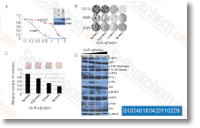
| Results | NVP-AEW541 inhibited tumor cell growth better in the primary cell culture with the higher baseline Igf1r level (IC50 1.5 µmol/L vs. 300 nmol/L for low and high Igf1r expressing cells, respectively; Fig. A). Anchorage-dependent colony formation assays showed that the colony forming ability of the tumor cells was drastically reduced on treatment with 1 mmol/L NVP-AEW541(Fig. B), but again sensitivity was increased for the cell culture with the higher baseline level of Igf1r expression. Similar results were obtained for anchorage-independent soft agar colony formation assays (Fig. C). Biochemical interrogation revealed that phosphorylation of Igf1r and downstream mediators Mapk, Akt, IRS-1, and P70-S6 kinase were inhibited on treatment with NVP-AEW541(Fig. D) |
Receptor tyrosine kinases exert dominant control over PI3K signaling in human KRAS mutant colorectal cancers. [Ebi H, et al. J Clin Invest 2011;121(11):4311-21]
EGFR-mediated re-activation of MAPK signaling contributes to insensitivity of BRAF mutant colorectal cancers to RAF inhibition with vemurafenib. [Corcoran RB, et al. Cancer Discov 2012;2(3):227-35]
A kinome-wide screen identifies the insulin/IGF-I receptor pathway as a mechanism of escape from hormone dependence in breast cancer. [Fox EM, et al. Cancer Res 2011;71(21):6773-84]
