
Antibodies


NVP-ADW742 is an IGF-1R inhibitor with IC50 of 0.17 μM, >16-fold more potent against IGF-1R than InsR; little activity to HER2, PDGFR, VEGFR-2, Bcr-Abl and c-Kit.
| Size | Price | Stock | Quantity | ||||||||||||||||||||
|---|---|---|---|---|---|---|---|---|---|---|---|---|---|---|---|---|---|---|---|---|---|---|---|
| |||||||||||||||||||||||
 Distributor Tel: +886-2-2827-1197jimmy@new.abscience.com.tw
| Description | NVP-ADW742 is an IGF-1R inhibitor with IC50 of 0.17 μM, >16-fold more potent against IGF-1R than InsR; little activity to HER2, PDGFR, VEGFR-2, Bcr-Abl and c-Kit. | |||||
|---|---|---|---|---|---|---|
| Targets | IGF-1R | |||||
| IC50 | 0.17 μM [1] | |||||
| In vitro | NVP-ADW742 exhibits a 6-fold greater selectivity for IGF-1R versus InsR with IC50 of 2.8 μM; minimal inhibitory activity against c-Kit, HER1, PDGFR, VEGFR2, or Bcr-Abl p210 with IC50 greater than 5 μM. NVP-ADW742 significantly inhibits the serum-stimulated cell proliferation in a variety of tumor cell lines in dose-dependent manner, with IC50 values of 0.1-0.5 μM for the multiple myeloma (MM) cell lines, and the antitumor effects on MM cells can not be overcome by the co-culture with BMSCs. NVP-ADW742 also abrogates the responsiveness of tumor cells to IL-6 in the presence of serum. In addition, NVP-ADW742 is active against MM cell lines with resistance to conventional (cytotoxic chemotherapy, dexamethasone) or investigational (thalidomide, CC-5013, TRAIL/Apo2L, PS-341) anticancer agents, as well as primary tumor cells from MM patients with multi-drug-resistant disease. NVP-ADW742 decreases the production of VEGF by tumor cells and bone marrow stromal cells, and suppresses the IGF-1-induced secretion of VEGF by various tumor types such as thyroid cancer cells or MM cells. IGF-1R inhibition by NVP-ADW742 (0.75 μM) sensitizes MM cells or prostate cancer cells to other anticancer agents such as doxorubicin, melphalan, dexamethasone, TRAIL/Apo2L, or PS-341. [1] | |||||
| In vivo | Administration of NVP-ADW742 at 10 mg/kg twice daily significantly inhibits tumor growth, prolongs survival, and enhances the antitumor effect of cytotoxic chemotherapy melphalan in the mice model of diffuse MM. [1] | |||||
| Features | ||||||
| Cellular kinase activity assay | The IC50 value for the effect of NVP-ADW742 on the autophosphorylation of IGF-1R is determined at the cellular level in the presence of increasing concentrations of NVP-ADW742, using 96-well “Capture ELISAs” assays. Briefly, NWT-21 cells are seeded into 96-well tissue culture plates in complete growth medium and grown to 70-80% confluency, and are then starved for 24 hours in 0.5% FCS medium. Subsequently, cells are incubated for 90 minutes in the presence of NVP-ADW742 followed by the stimulation with of IGF-I (10 ng/mL) for 10 minutes at 37 °C. Subsequently, the cells are washed twice with ice-cold PBS and lysed at 4 °C with 50 μL/well RIPA-buffer (50 mM Tris-HCl, pH 7.2, 120 mM NaCl, 1 mM EDTA, 6 mM EGTA, 1% NP-40, 20 mM NaF, 1 mM benzamidine, 15 mM sodium pyrophosphate, 1 mM PMSF and 0.5 mM Na3VO4). The lysates from each experiment are then transferred to black ELISA plates precoated with capture antibodies specific for IGF-1R. After capture by the antibodies, lysates are mixed with 40 μL of an alkaline phosphatase (AP) labelled anti-phosphotyrosine Ab (PY20(AP) diluted to 0.2 μg/mL in RIPA buffer, and incubated overnight at 4 °C. After washing (PBST) and incubation for 45 minutes at RT with the luminescent AP-substrate CDPStar RTU with Emerald II (90 μL/well), luminescence is measured using a Packard Top Count Scintillation Counter. |
|---|
| Cell lines | MM-1S, MM-1R, RPMI-8226/S, OPM-1, OCI-My5, SKMM2, KMS-12-BM, XG-1, L363, S6B45 cells and et al. |
|---|---|
| Concentrations | Dissolved in DMSO, final concentrations ~ 10 μM |
| Incubation Time | 48 hours |
| Method | Cells are exposed to various concentrations of NVP-ADW742 for 48 hours in the presence or absence of serum. Cell survival is examined using MTT assay. |
| Animal Models | Male SCID/NOD mice injected i.v. with MM-1S-Luc+ human MM cells |
|---|---|
| Dosages | 10 mg/kg twice daily |
| Administration | Injection i.p. or oral gavage |
| Molecular Weight (MW) | 453.58 |
|---|---|
| Formula | C28H31N5O |
| CAS No. | 475488-23-4 |
| Storage | 3 years -20℃Powder |
|---|---|
| 6 months-80℃in DMSO | |
| Syonnyms | ADW742 |
| Solubility (25°C) * | In vitro | DMSO | 10 mg/mL (22 mM) |
|---|---|---|---|
| Water | <1 mg/mL (<1 mM) | ||
| Ethanol | 3 mg/mL (6 mM) | ||
| * <1 mg/ml means slightly soluble or insoluble. * Please note that Selleck tests the solubility of all compounds in-house, and the actual solubility may differ slightly from published values. This is normal and is due to slight batch-to-batch variations. | |||
| Chemical Name | 5-(3-(benzyloxy)phenyl)-7-((1r,3r)-3-(pyrrolidin-1-ylmethyl)cyclobutyl)-7H-pyrrolo[2,3-d]pyrimidin-4-amine |
|---|
| Stock Solution (1ml DMSO) | 1mM | 10mM | 20mM | 30mM |
|---|---|---|---|---|
| Mass(mg) | 0.45358 | 4.5358 | 9.0716 | - |
 Click to enlarge | Rating | |
| Source | Biomaterials, 2013, 34(38):9737-46 . NVP-ADW742 purchased from Selleck | |
| Method | Western blot | |
| Cell Lines | SKOV3/T cells | |
| Concentrations | 2 uM | |
| Incubation Time | 24 h | |
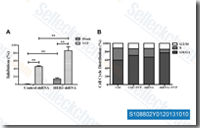
| Results | As shown in Fig. A, both NVP-ADW742 and shRNA-HER3 transfection could dramatically inhibit SKOV3/T cell proliferation, suggesting that both IGF-1R and HER3 contributed to cell proliferation in SKOV3/T cells and IGF-1R seems to show greater importance than HER3. As shown in Fig. 4B, the S-phase was about 9% (HER3 knockdown and IGF-1R inhibition) contrasting to the value of 16% in SKOV3/T treated with NVP-ADW742 (IGF-1R inhibition), and that of 21% in HER3 knockdown cells and 29% (control, untreated) in SKOV3/T. |
IGF-1R and ErbB3/HER3 contribute to enhanced proliferation and carcinogenesis in trastuzumab-resistant ovarian cancer model. [Jia Y, et al. Biochem Biophys Res Commun 2013;436(4):740-5]
