


Antibodies


NU7441 is a highly potent and selective DNA-PK inhibitor with IC50 of 14 nM and also inhibits PI3K with IC50 of 5 μM.
| Size | Price | Stock | Quantity | |||||||||||||||||||
|---|---|---|---|---|---|---|---|---|---|---|---|---|---|---|---|---|---|---|---|---|---|---|
| ||||||||||||||||||||||
Distributor Tel: +886-2-2827-1197jimmy@new.abscience.com.tw
| Description | NU7441 is a highly potent and selective DNA-PK inhibitor with IC50 of 14 nM and also inhibits PI3K with IC50 of 5 μM. | |||||
|---|---|---|---|---|---|---|
| Targets | DNA-PK | |||||
| IC50 | 14 nM [1] | |||||
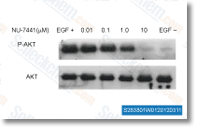
| In vitro | NU7441 increases the persistence of γH2AX foci after ionizing radiation–induced or etoposide-induced DNA damage. NU7441 (0.5 μM or 1 μM) appreciably increases G2-M accumulation induced by ionizing radiation, etoposide, and doxorubicin in both SW620 and LoVo cells. [2] NU7441 causes persistence of doxorubicin- and ionising radiation-induced DNA double-strand break and also slightly decreases homologous recombination activity DNA-PK-proficient M059-Fus-1 and DNA-PK-deficient M059 J human tumour cells. [3] NU7441 inhibits UV-induced RPA p34 hyperphosphorylation in a dose-dependent manner both in cells lacking and cells expressing polymerase η. [4] NU7441 increases levels of fludarabine-induced γH2AX foci and correspondingly decreased fludarabine-induced cell death in chronic lymphocytic leukemia cells. [5] NU7441 also inhibits mitoxantrone-induced DNA-PKcs autophosphorylation and repair in chronic lymphocytic leukemia cells. [6] | |||||
| In vivo | NU7441 intraperitoneally administrated at dose of 10 mg/kg maintains for at least 4 hours shows nontoxic and increases etoposide-induced tumor growth delay 2-fold in mice bearing SW620 xenografts. [2] | |||||
| Features | ||||||
| Cell lines | SW620, LoVo, V3-YAC and V3 cells |
|---|---|
| Concentrations | 0.5 μM or 1 μM |
| Incubation Time | 17 hours |
| Method | The effect of NU7441 on cellular survival following exposure to etoposide, doxorubicin, and ionizing radiation is measured in SW620, LoVo, V3, and V3-YAC cells by clonogenic assays. Briefly, growing cells in six-well plates or 6-cm dishes are exposed to etoposide or doxorubicin with or without NU7441 (0.5 or 1.0 μM) for 16 hours. For radiosensitization studies, NU7441 is added to the cells 1 hour before irradiation. V3 and V3-YAC cells are exposed to γ-irradiation (3.1 Gy/min 137Cesium). SW620 and LoVo are exposed to X-irradiation (2.9 Gy/min at 230 kV, 10 mA) due to the equipment available. After irradiation, the cells are incubated with or without NU7441 for a further 16 hours. Cells are then harvested by trypsinization, counted, and seeded into 10-cm diameter Petri dishes at densities varying from 100 to 105 per dish in drug-free medium for colony formation. Colonies are stained with crystal violet after 10 to 14 days and counted with an automated colony counter. The survival reduction factor (SRF) is calculated as the surviving fraction of cells in the absence of NU7441 divided by the surviving fraction of cells in the presence of NU7441 for any given dose or concentration of cytotoxic agent. The dose modification ratio (DMR90) is calculated as the concentration/dose of cytotoxic agent required to kill 90% of the cells in the absence of NU7441 divided by the concentration/dose of cytotoxic agent required to kill 90% of the cells in the presence of NU7441. |
| Animal Models | Female rude mice bearing SW620 xenografts |
|---|---|
| Dosages | 10 mg/kg |
| Administration | Intraperitoneally administrated |
| Molecular Weight (MW) | 413.49 |
|---|---|
| Formula | C25H19NO3S |
| CAS No. | 503468-95-9 |
| Storage | 2 years -20℃Powder |
|---|---|
| 6 months-80℃in DMSO | |
| Syonnyms | N/A |
| Solubility (25°C) * | In vitro | DMSO | 3 mg/mL (7 mM) |
|---|---|---|---|
| Water | <1 mg/mL (<1 mM) | ||
| Ethanol | <1 mg/mL (<1 mM) | ||
| * <1 mg/ml means slightly soluble or insoluble. * Please note that Selleck tests the solubility of all compounds in-house, and the actual solubility may differ slightly from published values. This is normal and is due to slight batch-to-batch variations. | |||
| Chemical Name | 4H-1-Benzopyran-4-one, 8-(4-dibenzothienyl)-2-(4-morpholinyl)- |
|---|
Click to enlarge | Rating | |
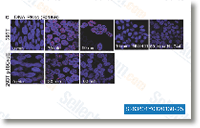
| Source | Nucleic Acids Research, 2013, 1–13. NU7441 (KU-57788) purchased from Selleck | |
| Method | Confocal immunostaining | |
| Cell Lines | 293T | |
| Concentrations | ||
| Incubation Time | 30min ,60min | |
| Results | the number of IRIFs was reduced significantly in p18CycE-expressing HEK 293T cells compared with parental cells. Pharmacological inhibition of ATM with KU55933 Revealed that S25-53BP1 phosphorylation was ATM-dependent in these cells as IRIFs of S25-53BP1 were abolished in both parental, as well as p18CycE-expressing cells. |
Defective chromatin recruitment and retention of NHEJ core components in human tumor cells expressing a Cyclin E fragment. [Chatterjee P, et al. Nucleic Acids Res 2013;41(22):10157-69]
The PARP3- and ATM-dependent phosphorylation of APLF facilitates DNA double-strand break repair. [Fenton AL, et al. Nucleic Acids Res 2013;41(7):4080-92]
Co-targeting Deoxyribonucleic Acid-Dependent Protein Kinase and Poly(Adenosine Diphosphate-Ribose) Polymerase-1 Promotes Accelerated Senescence of Irradiated Cancer Cells. [Azad A, et al. Int J Radiat Oncol Biol Phys 2013;88(2):385-94]
