
Antibodies


Nintedanib (BIBF 1120) is a potent triple angiokinase inhibitor for VEGFR1/2/3, FGFR1/2/3 and PDGFRα/β with IC50 of 34 nM/13 nM/13 nM, 69 nM/37 nM/108 nM and 59 nM/65 nM. Phase 3.
| Size | Price | Stock | Quantity | ||||||||||||||||||||
|---|---|---|---|---|---|---|---|---|---|---|---|---|---|---|---|---|---|---|---|---|---|---|---|
| |||||||||||||||||||||||
 Distributor Tel: +886-2-2827-1197jimmy@new.abscience.com.tw
| Description | Nintedanib (BIBF 1120) is a potent triple angiokinase inhibitor for VEGFR1/2/3, FGFR1/2/3 and PDGFRα/β withIC50 of 34 nM/13 nM/13 nM, 69 nM/37 nM/108 nM and 59 nM/65 nM. Phase 3. | |||||
|---|---|---|---|---|---|---|
| Targets | VEGFR1/2/3 | FGFR1/2/3 | PDGFRα/β | |||
| IC50 | 34 nM/13 nM/13 nM | 69 nM/37 nM/108 nM | 59 nM/65 nM [1] | |||
| In vitro | BIBF1120 inhibits PDGFR kinase activity of PDGFR alpha and PDGFR beta types with IC50 values of 59 nM and 65 nM, respectively. In addition, BIBF1120 suppresses the FGFR subtypes with IC50 of 60 nM, 37 nM and 108 nM for FGFR1, FGFR2, and FGFR3, respectively. BIBF1120 binds to the ATP-binding site in the cleft between the amino and carboxy terminal lobes of the kinase domain. The indolinone scaffold forms two hydrogen bonds with the backbone nitrogen of Cys919 and the backbone carbonyl oxygen of Glu917 in the hinge region. BIBF 1120 inhibits proliferation of PDGF-BB stimulated BRPs with EC50 of 79 nM in cell assays. BIBF1120 at concentrations as low as 100 nM blocks activation of MAPK after stimulation with 5% serum plus PDGF-BB. In cultures of human vascular smooth muscle cells (HUASMC), BIBF1120 prevents PDGF-BB stimulated proliferation with an EC50 of 69 nM. [1] | |||||
| In vivo | In all tumor models tested thus far, including human tumor xenografts growing in nude mice and a syngeneic rat tumor model, BIBF1120 is highly active at well-tolerated doses (25-100 mg/kg daily p.o.). This is evident in the magnetic resonance imaging of tumor perfusion after 3 days, reducing vessel density and vessel integrity after 5 days, and profound growth inhibition. [1] | |||||
| Features | ||||||
| VEGFR2 Kinase Assay | The cytoplasmic tyrosine kinase domain of VEGFR2 (residues 797-1355 according to sequence deposited in databank SWISS-PROT P35968) is cloned into pFastBac fused to GST and extracted. Enzyme activity is assayed in the presence or absence of serial dilutions of BIBF1120 performed in 25% DMSO. Each microtiter plate contains internal controls such as blank, maximum reaction, and historical reference compound. All incubations are conducted at room temperature on a rotation shaker. 10 μL of each BIBF1120 dilution is added to 10 μL of diluted kinase (0.8 μg/mL VEGFR2, 10 mM Tris pH 7.5, 2 mM EDTA, and 2 mg/mL BSA) and preincubated for 1 hour. The reaction is started by addition of 30 μL of substrate mix containing 62.4 mM Tris pH 7.5, 2.7 mM DTT, 5.3 mM MnCl2, 13.3 mM Mg-acetate, 0.42 mM ATP, 0.83 mg/mL Poly-Glu-Tyr(4:1), and 1.7 μg/mL Poly-Glu-Tyr(4:1)-biotin and incubated for 1 hour. The reaction is stopped by addition of 50 μL of 250 mM EDTA, 20 mM HEPES, pH 7.4. 90 μL of the reaction mix is transferred to a streptavidin plate and incubated for 1-2 hours. After three washes with PBS the EU-labeled antibody, PY20 is added (recommended dilution 1:2000 of 0.5 mg/mL labeled antibody in DELFIA assay buffer). Excessive detection antibody is removed by three washes of DELFIA washing buffer. Then 10 minutes before measurement on the multilabel reader, each well is incubated with 100 μL of DELFIA enhancement solution. |
|---|
| Cell lines | HUVEC, HUASMC, and BRP cell lines |
|---|---|
| Concentrations | 50 nM |
| Incubation Time | 2 hours |
| Method | The cell lines HUVEC, HUASMC, and BRP are used for the assay. BIBF1120 is added to the cultures two hours before the addition of ligands. Cell lysates are generated. Western blotting is done using standard SDS-PAGE methods, loading 50 to 75 μg of protein per lane. Detection is facilitated by enhanced chemiluminescence. Total and phosphorylated mitogen-activated protein kinase (MAPK) is analyzed using monoclonal antibodies M3807 and M8159. Total Akt is detected using the corresponding polyclonal antibody and phosphorylated Akt (Ser473) is analyzed by using its monoclonal antibody. Monoclonal antibody is also used to detect cleaved caspase-3 while KDR (VEGFR2) protein is detected using a corresponding antibody. |
| Animal Models | FaDu, Caki-1, SKOV-3, H460, HT-29, or PAC-120 xenografts in Athymic NMRI-nu/nu female mice |
|---|---|
| Dosages | 100 mg/kg |
| Administration | p.o. |
| Solubility | 30% PEG400/0.5% Tween80/5% propylene glycol, 30 mg/mL |
| NCT Number | Recruitment | Conditions | Sponsor /Collaborators | Start Date | Phases |
|---|---|---|---|---|---|
| NCT01548924 | Recruiting | Solid Tumors | Centro Nacional de Investigaciones Oncologicas CARLOS III|Hospital Universitario Fuenlabrada|M.D. Anderson Cancer Center|Hospital Universitari de Bellvitge | 2012-04 | Phase 1 |
| NCT01695408 | Recruiting | Idiopathic Pulmonary Fibrosis | Dresden University of Technology|GWT-TUD GmbH|Boehringer Ingelheim Pharmaceuticals | 2012-10 | |
| NCT01658462 | Not yet recruiting | Locally Recurrent or Metastatic Breast Cancer | Centre Oscar Lambret | 2012-11 | Phase 2 |
| NCT01770392 | Completed | Healthy | Boehringer Ingelheim Pharmaceuticals | 2013-01 | Phase 1 |
| NCT01669798 | Recruiting | Ovarian Cancer|Fallopian Tube Cancer|Peritoneal Cancer | Duke University|AA Secord|Boehringer Ingelheim Pharmaceuticals | 2013-02 | Phase 2 |
Download Nintedanib (BIBF 1120) SDF
| Molecular Weight (MW) | 539.62 |
|---|---|
| Formula | C31H33N5O4 |
| CAS No. | 656247-17-5 |
| Storage | 3 years -20℃Powder |
|---|---|
| 6 months-80℃in DMSO | |
| Syonnyms | N/A |
| Solubility (25°C) * | In vitro | DMSO | 6 mg/mL (11 mM) |
|---|---|---|---|
| Water | <1 mg/mL (<1 mM) | ||
| Ethanol | 3 mg/mL (5 mM) | ||
| In vivo | 30% PEG400/0.5% Tween80/5% propylene glycol, | 30 mg/mL | |
| * <1 mg/ml means slightly soluble or insoluble. * Please note that Selleck tests the solubility of all compounds in-house, and the actual solubility may differ slightly from published values. This is normal and is due to slight batch-to-batch variations. | |||
| Chemical Name | (Z)-methyl 3-((4-(N-methyl-2-(4-methylpiperazin-1-yl)acetamido)phenylamino)(phenyl)methylene)-2-oxoindoline-6-carboxylate |
|---|
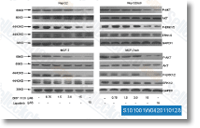 Click to enlarge | Rating | |
| Source | Cellular Onc 2011 34, 33–44. Nintedanib (BIBF 1120) purchased from Selleck | |
| Method | Western blotting | |
| Cell Lines | Hep G2/adr cell, MCF-7/adr cell | |
| Concentrations | 0-15 µM | |
| Incubation Time | 24 h | |
| Results | Our results showed that treatment with BIBF1120 of 3 μ M for 24 h did not affect the phosphorylation of AKT and ERK1/2. |
PDGF signalling controls age-dependent proliferation in pancreatic b-cells. [Chen H, et al. Nature 2011;478(7369):349-55]
Inhibition of Lck enhances glucocorticoid sensitivity and apoptosis in lymphoid cell lines and in chronic lymphocytic leukemia. [Harr MW, et al. Cell Death Differ 2010;17(9):1381-91]
S49076 is a Novel Kinase Inhibitor of MET, AXL and FGFR with Strong Preclinical Activity Alone and in Association with Bevacizumab. [Burbridge MF, et al. Mol Cancer Ther 2013;12(9):1749-62]
