
Antibodies


Neratinib (HKI-272) is a highly selective HER2 and EGFR inhibitor with IC50 of 59 nM and 92 nM; weakly inhibits KDR and Src, no significant inhibition to Akt, CDK1/2/4, IKK-2, MK-2, PDK1, c-Raf and c-Met. Phase 3.
| Size | Price | Stock | Quantity | ||||||||||||||||
|---|---|---|---|---|---|---|---|---|---|---|---|---|---|---|---|---|---|---|---|
| |||||||||||||||||||
 Distributor Tel: +886-2-2827-1197jimmy@new.abscience.com.tw
| Description | Neratinib (HKI-272) is a highly selective HER2 and EGFR inhibitor with IC50 of 59 nM and 92 nM; weakly inhibits KDR and Src, no significant inhibition to Akt, CDK1/2/4, IKK-2, MK-2, PDK1, c-Raf and c-Met. Phase 3. | |||||
|---|---|---|---|---|---|---|
| Targets | HER2 | EGFR | ||||
| IC50 | 59 nM | 92 nM [1] | ||||
| In vitro | Neratinib weakly inhibits tyrosine kinases KDR and Src with IC50 of 0.8 μM and 1.4 μM, respectively, being 14- and 24-fold less active compared with HER2. Neratinib displays no activity against other serine-threonine kinases such as Akt, cyclin D1/cdk4, cyclin E/cdk2, cyclin B1/cdk1, IKK-2, MK-2, PDK1, c-Raf, and Tpl-2, as well as the tyrosine kinase c-Met. Neratinib selectively inhibits the proliferation of 3T3 cells transfected with the HER2 (3T3/neu), as well as two other HER-2-overexpressing SK-Br-3 and BT474 cells with IC50 values of 2-3 nM, displaying >230-fold potency compared with non-transfected 3T3 cells as well as MDA-MB-435 and SW620 which are EGFR- and HER2-negative. Neratinib also inhibits the proliferation of EGFR-dependent A431 cells with an IC50 of 81 nM. Neratinib reduces HER2 receptor autophosphorylation in BT474 cells with an IC50 of 5 nM, and EGF-dependent phosphorylation of EGFR in A431 cells with IC50 of 3 nM. Blocking of HER-2 by Neratinib results in inhibition of downstream MAPK and Akt pathways with IC50 of 2 nM, more potently than Trastuzumab. Neratinib inhibits the cyclin D1 expression and the phosphorylation of the Rb-susceptibility gene production in BT474 cells with IC50 of 9 nM, leading to G1-S arrest and ultimately decreased cell proliferation.[1] | |||||
| In vivo | Oral administration of Neratinib significantly inhibits the growth of 3T3/neu xenografts, with inhibition of 34%, 53%, 98%, and 98% at dose of 10, 20, 40, and 80 mg/kg/day, respectively. Consistent with the inhibition of HER-2 phosphorylation by 84% within 1 hour of administration at 40 mg/kg/day, Neratinib inhibits the growth of BT474 xenografts by 70-82%, 67%, and 93% at dose of 5, 10, and 40 mg/kg/day, respectively. Neratinib is also effective against SK-OV-3 xenografts with inhibition of 31% and 85% at 5 and 60 mg/kg/day, respectively. Neratinib is less potent against EGFR-dependent A431 xenografts than HER-2-dependent tumors, with 32% and 44% inhibition at 5 and 20 mg/kg/day, respectively. Neratinib displays little activity against MCF-7 and MX-1 xenografts expressing low levels of HER-2 and EGFR, with only 28% inhibition at 80 mg/kg/day, suggesting that Neratinib has selective activity for cells expressing HER-2 or EGFR. [1] | |||||
| Features | ||||||
| Cell-free autophosphorylation assay using time-resolved fluorometry | Neratinib is prepared as 10 mg/mL stocks in DMSO and diluted in 25 mM HEPES (pH 7.5; 0.002 ng/mL-20 μg/mL). Purified recombinant COOH-terminal fragments of HER2 (amino acids 676-1255) or epidermal growth factor receptor (EGFR) (amino acids 645-1186) [diluted in 100 mM HEPES (pH 7.5) and 50% glycerol] is incubated with increasing concentrations of Neratinib in 4 mM HEPES (pH 7.5), 0.4 mM MnCl2, 20 μM sodium vanadate, and 0.2 mM DTT for 15 minutes at room temperature in 96-well ELISA plates. The kinase reaction is initiated by the addition of 40 μM ATP and 20 mM MgCl2 and allowed to proceed for 1 hour at room temperature. Plates are washed, and phosphorylation is detected using Europium-labeled anti-phospho-tyrosine antibodies (15 ng/well). After washing and enhancement steps, signal is detected using a Victor2 fluorescence reader (excitation wavelength 340 nm, emission wavelength 615 nm). The concentration of Neratinib that inhibits receptor phosphorylation by 50% (IC50) is calculated from inhibition curves. |
|---|
| Cell lines | 3T3, 3T3/neu, A431, BT474, SK-Br-3, MDA-MB-435, and SW480 |
|---|---|
| Concentrations | Dissolved in DMSO, final concentrations 0.5 ng/mL-5 μg/mL |
| Incubation Time | 2 or 6 days |
| Method | Cells are exposed to various concentrations of Neratinib for 2, or 6 days. Cell proliferation is determined using sulforhodamine B, a protein binding dye. Briefly, cells are fixed with 10% trichloroacetic acid and washed extensively with water. Cells are then stained with 0.1% sulforhodamine B and washed in 5% acetic acid. Protein-associated dye is solubilized in 10 mM Tris, and absorbance is measured at 450 nM. The concentration of Neratinib that inhibits cell proliferation by 50% (IC50) is determined from inhibition curves. |
| Animal Models | Female athymic (nude) mice implanted s.c. with 3T3/neu, BT474, MCF-7, or SK-OV-3 cells |
|---|---|
| Dosages | ~80 mg/kg/day |
| Administration | Gavage |
| Solubility | 30% PEG400/0.5% Tween80/5% propylene glycol 5 mg/mL |
| NCT Number | Recruitment | Conditions | Sponsor /Collaborators | Start Date | Phases |
|---|---|---|---|---|---|
| NCT01111825 | Recruiting | Breast Cancer | Puma Biotechnology, Inc. | 2010-04 | Phase 1|Phase 2 |
| NCT01128842 | Completed | Advanced Malignant Solid Tumors | Puma Biotechnology, Inc. | 2010-04 | Phase 1 |
| NCT01142063 | Completed | Healthy | Puma Biotechnology, Inc. | 2010-06 | Phase 1 |
| NCT01494662 | Recruiting | Breast Cancer | Dana-Farber Cancer Institute|Translational Breast Cancer Research Consortium | 2012-02 | Phase 2 |
| NCT00932464 | Withdrawn | Healthy | Puma Biotechnology, Inc. | 2012-08 | Phase 1 |
Download Neratinib (HKI-272) SDF
| Molecular Weight (MW) | 557.04 |
|---|---|
| Formula | C30H29ClN6O3 |
| CAS No. | 698387-09-6 |
| Storage | 3 years -20℃Powder |
|---|---|
| 6 months-80℃in DMSO | |
| Syonnyms | N/A |
| Solubility (25°C) * | In vitro | DMSO | 2 mg/mL (3 mM) |
|---|---|---|---|
| Water | <1 mg/mL (<1 mM) | ||
| Ethanol | <1 mg/mL (<1 mM) | ||
| In vivo | 30% PEG400/0.5% Tween80/5% propylene glycol | 5 mg/mL | |
| * <1 mg/ml means slightly soluble or insoluble. * Please note that Selleck tests the solubility of all compounds in-house, and the actual solubility may differ slightly from published values. This is normal and is due to slight batch-to-batch variations. | |||
| Chemical Name | (E)-N-(4-(3-chloro-4-(pyridin-2-ylmethoxy)phenylamino)-3-cyano-7-ethoxyquinolin-6-yl)-4-(dimethylamino)but-2-enamide |
|---|
 Click to enlarge | Rating | |
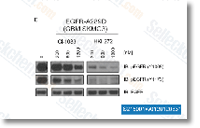
| Source | Cancer Discovery, 2012, 2, 458-471. Neratinib (HKI-272) purchased from Selleck | |
| Method | Western Blot | |
| Cell Lines | SKMG3 | |
| Concentrations | 200-1800 nM | |
| Incubation Time | 3 day | |
| Results | Immunoblots of whole-cell lysates from SKMG3 cells treated with either inhibitor showed that CI-1033 inhibited EGFR phosphorylation less effectively than HKI-272 (Fig. C). |
Differential sensitivity of glioma- versus lung cancer-specific EGFR mutations to EGFR kinase inhibitors. [Vivanco I, et al. Cancer Discov 2012;2(5):458-71]
Non-Covalent Wild-Type-Sparing Inhibitors of EGFR T790M. [Lee HJ, et al. Cancer Discov 2013;3(2):168-81]
Activating HER2 mutations in HER2 gene amplification negative breast cancer. [Bose R, et al. Cancer Discov 2013;3(2):224-37]
