
Antibodies


MC1568 is a selective HDAC inhibitor for maize HD1-A with IC50 of 100 nM. It is 34-fold more selective for HD1-A than HD1-B.
| Size | Price | Stock | Quantity | ||||||||||||
|---|---|---|---|---|---|---|---|---|---|---|---|---|---|---|---|
| |||||||||||||||
 Distributor Tel: +886-2-2827-1197jimmy@new.abscience.com.tw
| Description | MC1568 is a selective HDAC inhibitor for maize HD1-A with IC50 of 100 nM. It is 34-fold more selective for HD1-A than HD1-B. | |||||
|---|---|---|---|---|---|---|
| Targets | HD1-A (Maize) | HD1-B (Maize) | ||||
| IC50 | 100 nM | 3400 nM [1] | ||||
| In vitro | MC1568 is a selective class II (IIa) histone deacetylas (HDAC II) inhibitor with IC50 of 220 nM and 176-fold class II selectivity (against class I). In human breast cancer ZR-75.1 cell lysates, MC1568 (5 μM) shows no inhibitory activity against HDAC1 but is able to inhibit HDAC4. [1] In MCF-7 cells, MC1568 (20 μM) increases the accumulation of acetylated H3 and H4 histones, as well as the levels of acetyl-tubulin, which indicates a inhibitory effect of MC1568 on HDAC6. [2] In C2C12 cells, MC1568 (5 μM) arrests myogenesis by decreasing myocyte enhancer factor 2D (MEF2D) expression, stabilizing the HDAC4-HDAC3-MEF2D complex, and by inhibiting differentiation-induced MEF2D acetylation. [3] MC1568 (5 or 10 μM) interferes with the RAR- and PPARγ-mediated differentiation-inducing signaling pathways. In F9 cells, MC1568 specifically blocks endodermal differentiation despite not affecting retinoic acid-induced maturation of promyelocytic NB4 cells. In 3T3-L1 cells, MC1568 attenuates PPARγ-induced adipogenesis. [4] | |||||
| In vivo | In mice, MC1568 (50 mg/kg) shows an apparent tissue-selective HDAC inhibition. In skeletal muscle and heart, MC1568 inhibits the activity of HDAC4 and HDAC5 without affecting HDAC3 activity, thereby leaving MEF2-HDAC complexes in a repressed state. [3] In reporting PPRE-Luc mice, MC1568 (50 mg/kg) impairs PPARγ signaling mostly in the heart and adipose tissues. [4] In a recent study of pancreatic explants, MC1568 enhances expression of Pax4, a key factor required for proper β-and δ-cell differentiation and amplifies endocrine β- and δ-cells. [5] | |||||
| Features | ||||||
| Maize HD2, HD1-B, and HD1-A Enzyme Inhibition. | The enzyme liberats tritiated acetic acid from the substrate, which is quantified by scintillation counting. IC50 values are results of triple determinations. A 50 μL sample of maize enzyme (at 30 °C) is incubated (30 min) with 10 μL of total [3H]acetate-prelabeled chicken reticulocyte histones (2 mg/mL). Reaction is stopped by addition of 50 μL of 1 M HCl/0.4 M acetate and 800 μL of ethyl acetate. After centrifugation (1×10⁴ g, 5 min), an aliquot of 600 μL of the upper phase is counted for radioactivity in 3 mL of liquid scintillation cocktail. MC1568 is tested at a starting concentration of 40 μM, and active substances are diluted further. NaB, VPA, TSA, SAHA, 85TPX, HC-toxin, and tubacin are used as the reference compounds, and blank solvents are used as negative controls. |
|---|
| Cell lines | 3T3-L1 cells |
|---|---|
| Concentrations | ~10 μM, dissolved in DMSO |
| Incubation Time | 8 days |
| Method | The 3T3-L1 cells are propagated and differentiated using a cocktail of isobutylmethylxanthine, dexamethasone, and insulin. From the second day post-confluence and throughout the differentiation period of 8 days, the 3T3-L1 cells are induced by: (1) no induction: at post-confluence and throughout the differentiation period of 8 days, the cells are incubated with DMSO or MC1568. (2) troglitazone: at post-confluence and throughout the differentiation period of 8 days, the cells are induced with 5 μM troglitazone, MC1568, or both. (3) rosiglitazone: at post-confluence and throughout the differentiation period of 8 days, the cells are incubated with 1 μM rosiglitazone and either DMSO or MC1568. (4) rosiglitazone and dexamethasone: at post-confluence, the cells received 1 μM of rosiglitazone and 390 ng/mL dexamethasone. Throughout the differentiation period of 8 days, the cells are induced with 1 μM of rosiglitazone and either DMSO or MC1568. All medium is renewed every second day. |
| Animal Models | PPRE-Luc transgenic mouse (C57BL/6) |
|---|---|
| Dosages | 50 mg/kg |
| Administration | By gavage once a day |
| Solubility | 0.5% CMC 5 mg/mL |
| Molecular Weight (MW) | 314.31 |
|---|---|
| Formula | C17H15FN2O3 |
| CAS No. | 852475-26-4 |
| Storage | 3 years -20℃Powder |
|---|---|
| 6 months-80℃in DMSO | |
| Syonnyms | N/A |
| Solubility (25°C) * | In vitro | DMSO | 13 mg/mL (41 mM) |
|---|---|---|---|
| Water | <1 mg/mL (<1 mM) | ||
| Ethanol | <1 mg/mL (<1 mM) | ||
| In vivo | 0.5% CMC | 5 mg/mL | |
| * <1 mg/ml means slightly soluble or insoluble. * Please note that Selleck tests the solubility of all compounds in-house, and the actual solubility may differ slightly from published values. This is normal and is due to slight batch-to-batch variations. | |||
| Chemical Name | (E)-3-(4-((E)-3-(3-fluorophenyl)-3-oxoprop-1-enyl)-1-methyl-1H-pyrrol-2-yl)-N-hydroxyacrylamide |
|---|
| Stock Solution (1ml DMSO) | 1mM | 10mM | 20mM | 30mM |
|---|---|---|---|---|
| Mass(mg) | 0.31431 | 3.1431 | 6.2862 | 9.4293 |
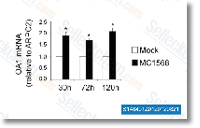 Click to enlarge | Rating | |
| Source | Proc Natl Acad Sci U S A, 2012, 109(34). MC1568 purchased from Selleck | |
| Method | Real time PCR | |
| Cell Lines | HeLa-OA1myc cells | |
| Concentrations | 20 uM | |
| Incubation Time | 30-120 h | |
| Results | To investigate the functional role of HDAC4 in transgene derepression, we incubated HeLa-OA1myc cells with MC1568, a selective inhibitor of class II HDAC enzymatic activity . The treatment led to an increase of about twofold in the OA1 mRNA at every examined time point (Fig. C). |
Selective cancer targeting with prodrugs activated by histone deacetylases and a tumour-associated protease. [Ueki N, et al. Nat Commun 2013;4:2735]
Amino acid starvation induces reactivation of silenced transgenes and latent HIV-1 provirus via down-regulation of histone deacetylase 4 (HDAC4). [Palmisano I, et al. Proc Natl Acad Sci U S A 2012;109(34):E2284-93]
Epigenetic mechanisms linking diabetes and synaptic impairments. [Wang J, et al. Diabetes 2013;10.2337/db13-1063]
