
Antibodies


M344 is a potent HDAC inhibitor with IC50 of 100 nM and able to induce cell differentiation.
| Size | Price | Stock | Quantity | ||||||||||||
|---|---|---|---|---|---|---|---|---|---|---|---|---|---|---|---|
| |||||||||||||||
 Distributor Tel: +886-2-2827-1197jimmy@new.abscience.com.tw
| Description | M344 is a potent HDAC inhibitor with IC50 of 100 nM and able to induce cell differentiation. | |||||
|---|---|---|---|---|---|---|
| Targets | HDAC | |||||
| IC50 | 100 nM [1] | |||||
| In vitro | M344 produces a more significant effect on cell proliferation than on cell differentiation in MEL DS19 cells. M344 is toxic at concentrations above 10 μM, while a maximum of only 20% of the surviving cell population are induced to differentiate. [1] In vitro, M344 shows the significant anti-proliferative activities against the endometrial cancer cell line Ishikawa and the ovarian cancer cell line SK-OV-3 with EC50 of 2.3 μM and 5.1 μM, respectively. While the normal human endometrial epithelial cells shows little sensitivity to M344. In addition, M344 also leeads to decreased proportion of cells in the S-phase and increased proportion in the G0/G1 phases of the cell cycle, induces apoptosis and decreases the transmembrane potential of mitochondria. [2]M344 potently inhibits proliferation of embryonal nervous system tumor cells including medulloblastoma cells (D341 Med, Daoy) and neuroblastoma cells (CH-LA 90,SHSY-5Y ) with GI50 of 0.65 μM, 0.63 μM, 0.63 μM and 0.67 μM, respectively. [3] | |||||
| In vivo | ||||||
| Features | An inducer of terminal cell differentiation and a potent HDAC inhibitor. | |||||
| Enzyme Inhibition | Radioactively labeled chicken core histones are used as the enzyme substrate. The enzyme liberated tritiated acetic acid from the substrate which is quantitated by scintillation counting. IC50 values are results of triple determinations. 50 μL of maize enzyme (at 30 °C) is incubated (30 minutes) with 10 μL of total [3H]acetate-prelabeled chicken reticulocyte histones (1 mg/mL). Reaction is stopped by addition of 36 μL of 1 M HCl/0.4 M acetate and 800 μL of ethyl acetate. After centrifugation (10000g, 5 minutes) an aliquot of 600 μL of the upper phase is counted for radioactivity in 3 mL of liquid scintillation cocktail. M344 is tested in a starting concentration of 40 μM, and active substances are diluted further. |
|---|
| Cell lines | MEL DS19 cells |
|---|---|
| Concentrations | 0 to 50 μM |
| Incubation Time | 72 hours |
| Method | MEL DS19 cells (murine erythroleukemia cells) are maintained in D-MEM containing 100 units/mL penicillin G sodium and 100 μg/mL streptomycin sulfate supplemented with 10% fetal bovine serum at 37 °C in a 5% CO2atmosphere. To test M344 for potential to induce cell differentiation, log-phase cells with a population doubling time of 11−13 hours are used. Serial dilutions of M344 are prepared in 24-well plates using 1 mL of D-MEM/well. If M344 are dissolved in DMSO, control wells contains the same amount of solvent (generally 2 μL/mL of medium). Subsequently, the cell suspension is added to the wells. After 72 hours the experiment is evaluated. Cell numbers are counted using a Casy 1 TTC flow cytometer. The proliferation of treated cells is expressed as percent proliferation in comparison with the solvent control. Differentiated MEL cells accumulate hemoglobin. Therefore, the induction of cell differentiation is determined by benzidine staining according to the literature. To 100 μL of cell suspension is added 10 μL of a 0.4% solution of benzidine in 12% acetic acid containing 2% H2O2. Within 5 minutes hemoglobin-containing cells stains blue. Benzidine-positive and -negative cells are counted under the microscope in a hemocytometer, and the percentage of positive cells is calculated. M344 is first tested at 10 μM and 50 μM final concentration. According to activity/toxicity profile, a range of concentrations is chosen for a dose−response analysis. |
| NCT Number | Recruitment | Conditions | Sponsor /Collaborators | Start Date | Phases |
|---|---|---|---|---|---|
| NCT01593670 | Recruiting | Myelodysplastic Syndrome | Masonic Cancer Center, University of Minnesota | 2013-03 | Phase 2 |
| NCT01720875 | Not yet recruiting | Multiple Myeloma | University of Leeds | 2013-03 | Phase 2 |
| NCT01790568 | Not yet recruiting | Graft vs Host Disease|Hematologic Neoplasms|Non-Neoplastic Hematologic and Lymphocytic Disorder | University of Michigan Cancer Center|Pavan Reddy, MD|National Cancer Institute (NCI) | 2013-04 | Phase 2 |
| NCT01550224 | Not yet recruiting | Acute Myeloid Leukemia With 11q23-abnormality in Relapse | Stanford University|Merck | 2013-06 | Phase 2 |
| NCT01789255 | Not yet recruiting | Accelerated Phase Chronic Myelogenous Leukemia|Adult Acute Myeloid Leukemia in Remission|Adult Acute Myeloid Leukemia With 11q23 (MLL) Abnormalities etc. | National Cancer Institute (NCI) | 2013-12 | Phase 2 |
| Molecular Weight (MW) | 307.39 |
|---|---|
| Formula | C16H25N3O3 |
| CAS No. | 251456-60-7 |
| Storage | 3 years -20℃Powder |
|---|---|
| 6 months-80℃in DMSO | |
| Syonnyms | N/A |
| Solubility (25°C) * | In vitro | DMSO | 62 mg/mL (201 mM) |
|---|---|---|---|
| Water | <1 mg/mL (<1 mM) | ||
| Ethanol | 4 mg/mL (13 mM) | ||
| * <1 mg/ml means slightly soluble or insoluble. * Please note that Selleck tests the solubility of all compounds in-house, and the actual solubility may differ slightly from published values. This is normal and is due to slight batch-to-batch variations. | |||
| Chemical Name | 4-(dimethylamino)-N-(7-(hydroxyamino)-7-oxoheptyl)benzamide |
|---|
| Stock Solution (1ml DMSO) | 1mM | 10mM | 20mM | 30mM |
|---|---|---|---|---|
| Mass(mg) | 0.30739 | 3.0739 | 6.1478 | 9.2217 |
 Click to enlarge | Rating | |
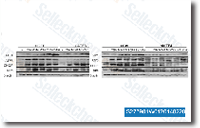
| Source | Biochem Biophys Res Commun, 2014, 10.1016/j.bbrc.2014.01.184. M344 purchased from Selleck | |
| Method | Western blot | |
| Cell Lines | HCT116 p53 null cells | |
| Concentrations | 5 uM | |
| Incubation Time | 24 h | |
| Results | Knockdown of ATF3 suppressed the induction of DR5 protein and knockdown of ATF4 suppressed the induction of ATF3, CHOP and DR5 proteins by these HDACIs(TSA, M344, MS-275). |
