
Antibodies


Linifanib (ABT-869) is a novel, potent ATP-competitive VEGFR/PDGFR inhibitor for KDR, CSF-1R, Flt-1/3 and PDGFRβ with IC50 of 4 nM, 3 nM, 3 nM/4 nM and 66 nM respectively, mostly effective in mutant kinase-dependent cancer cells (i.e. FLT3). Phase 3.
| Size | Price | Stock | Quantity | ||||||||||||||||||||
|---|---|---|---|---|---|---|---|---|---|---|---|---|---|---|---|---|---|---|---|---|---|---|---|
| |||||||||||||||||||||||
 Distributor Tel: +886-2-2827-1197jimmy@new.abscience.com.tw
| Description | Linifanib (ABT-869) is a novel, potent ATP-competitive VEGFR/PDGFR inhibitor for KDR, CSF-1R, Flt-1/3 and PDGFRβ with IC50 of 4 nM, 3 nM, 3 nM/4 nM and 66 nM respectively, mostly effective in mutant kinase-dependent cancer cells (i.e. FLT3). Phase 3. | |||||
|---|---|---|---|---|---|---|
| Targets | KDR | CSF-1R | Flt-1 | Flt-3 | PDGFRβ | |
| IC50 | 4 nM | 3 nM | 3 nM | 4 nM | 66 nM [1] | |
| In vitro | Linifanib shows inhibitory to Kit, PDGFRβ and Flt4 with IC50 of 14 nM, 66 nM and 190 nM in kinases assay. Linifanib also inhibits ligand-induced KDR, PDGFRβ, Kit, and CSF-1R phosphorylation with IC50 of 2 nM, 2 nM, 31 nM and 10 nM at cellular level and this cellular potency could be affected by serum protein. Linifanib suppresses VEGF-stimulated HUAEC proliferation with IC50 of 0.2 nM. While Linifanib has weak activity against tumor cells which are not induced by VEGF or PDGF, except for MV4-11 leukemia cells (with constitutively active form of Flt3) with IC50 of 4 nM. Linifanib could cause a decrease in S and G2-M phases with a corresponding increase in the sub-G0-G1 apoptotic population in MV4-11 cells. [1] Linifanib binds to the ATP-binding site of CSF-1R with Ki of 3 nM. [2] Linifanib (10 nM) exhibits a reduced phosphorylation of Akt at Ser473 and decreased phosphorylation of GSK3βat Ser9 in Ba/F3 FLT3 ITD cell lines. [3] | |||||
| In vivo | Linifanib (0.3 mg/kg) results in complete inhibition of KDR phosphorylation in lung tissue. Linifanib also inhibits the edema response with ED50 of 0.5 mg/kg. Linifanib (7.5 and 15 mg/kg, bid) significantly inhibits both bFGF- and VEGF-induced angiogenesis in the cornea. Linifanib inhibits tumor growth in flank xenograft models including HT1080, H526, MX-1 and DLD-1 with ED75 from 4.5-12 mg/kg. Linifanib also shows efficacy in A431 and MV4-11 xenografts at low dose levels. Linifanib (12.5 mg/kg bid) reveals a decrease of microvasculure density in MDA-231 xenograft. Linifanib shows a Cmax and AUC24 hours with 0.4 μg/mL and 2.7 μg•hour/mL in HT1080 fibrosarcoma model. [1] | |||||
| Features | ||||||
| Kinase assays | Potencies (IC50 values) are determined by assays of active kinase domains cloned and expressed in baculovirus using the FastBacbaculovirus expression system or obtained commercially. For tyrosine kinase assays, a biotinylated peptide substrate containing a single tyrosine is used with 1 mM ATP, anEu-cryptate–labeled anti-phosphotyrosine antibody (PT66), and Strepavidin-APC in a homogeneous time-resolved fluorescence assay. Serine/threonine kinases are assayed using 5 μM ATP, [33P]ATP, and a biotinylated peptide substrate with peptide capture and incorporation of 33P determined using a SA-Flashplate. Linifanib is assayed at multiple concentrations prepared by serial dilution of a DMSO stock solution of Linifanib. The concentration resulting in 50% inhibition of activity is calculated using nonlinear regression analysis of the concentration response data. |
|---|
| Cell lines | HUAEC, HT-29, HT1080, A431, MDA-435, MDA-231, H526, DLD-1, 9L and MV4-11 cells |
|---|---|
| Concentrations | 0-100 μM |
| Incubation Time | 72 hours |
| Method | Cells are seeded into 96-well plates at 2.5 × 10³ per well and incubated with serum-free medium for 24 hours. Linifanib and VEGF (final, 10 ng/mL) are added and incubated for 72 hours in serum-free medium. For carcinoma cell lines, 3 × 10³ cells/well are plated overnight in full growth medium. Linifanib is added to the cells in full growth medium and incubated for 72 hours. For leukemia cells, generally 5 × 10⁴ per well are plated in full growth medium, Linifanib is added, and incubated for 72 hours. The effects on proliferation are determined by addition of Alamar Blue (final solution, 10%), incubation for 4 hours at 37 °C in a CO2 incubator and analysis in a fluorescence plate reader (544 nm, excitation: 590 nm, emission |
| Animal Models | H526, DLD-1, MDA-231, MDA-435LM, HCT-116, H526, DLD-1, MDA-231, MDA-435LM, MV4-11 and MX-1 xenografts are established in mice. |
|---|---|
| Dosages | ~ 10 mg/kg |
| Administration | Oral administration |
| Solubility | 30% PEG400/0.5% Tween80/5% propylene glycol, 30 mg/mL |
| NCT Number | Recruitment | Conditions | Sponsor /Collaborators | Start Date | Phases |
|---|---|---|---|---|---|
| NCT01365910 | Suspended | Recurrent Colon Cancer|Recurrent Rectal Cancer|Stage IVA Colon Cancer|Stage IVA Rectal Cancer|Stage IVB Colon Cancer|Stage IVB Rectal Cancer | Vanderbilt-Ingram Cancer Center | 2011-06 | Phase 2 |
| NCT01413893 | Completed | Advanced Solid Tumors | Abbott | 2011-06 | Phase 1 |
| NCT01286974 | Terminated | Advanced Solid Tumors | Abbott | 2011-08 | Phase 1 |
| NCT01506934 | Terminated | Advanced or Metastatic Solid Tumors | Abbott | 2011-10 | Phase 1 |
Download Linifanib (ABT-869) SDF
| Molecular Weight (MW) | 375.41 |
|---|---|
| Formula | C21H18FN5O |
| CAS No. | 796967-16-3 |
| Storage | 3 years -20℃Powder |
|---|---|
| 6 months-80℃in DMSO | |
| Syonnyms | AL-39324 |
| Solubility (25°C) * | In vitro | DMSO | 75 mg/mL (199 mM) |
|---|---|---|---|
| Water | <1 mg/mL (<1 mM) | ||
| Ethanol | <1 mg/mL (<1 mM) | ||
| In vivo | 30% PEG400/0.5% Tween80/5% propylene glycol, | 30 mg/mL | |
| * <1 mg/ml means slightly soluble or insoluble. * Please note that Selleck tests the solubility of all compounds in-house, and the actual solubility may differ slightly from published values. This is normal and is due to slight batch-to-batch variations. | |||
| Chemical Name | 1-(4-(3-amino-1H-indazol-4-yl)phenyl)-3-(2-fluoro-5-methylphenyl)urea |
|---|
| Stock Solution (1ml DMSO) | 1mM | 10mM | 20mM | 30mM |
|---|---|---|---|---|
| Mass(mg) | 0.37541 | 3.7541 | 7.5082 | 11.2623 |
 Click to enlarge | Rating | |
| Source | J Pharmacol Exp Ther, 2012, 343(3), 617-27. Linifanib (ABT-869) purchased from Selleck | |
| Method | ELISA/Kinase Assays | |
| Cell Lines | Mice-bearing tumors | |
| Concentrations | 25 mg/kg | |
| Incubation Time | 0-7 day | |
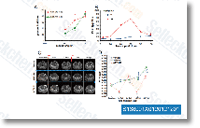
| Results | ABT-348 inhibited the VEGF response with a potency (ED 50 = 0.2 mg/kg i.v.) that is comparable with another potent anti-VEGF agent, ABT-869, which has intrinsic VEGFR2 potency similar to ABT-348 (IC 50 = 4 and 3 nM, respectively). On-target VEGF receptor inhibition was also implicated by the observation that administration of ABT-348 to tumor-bearing mice resulted in increased plasma levels of the proangiogenic PLGF (Fig. B). acute changes in the MRI signal were observed during treatment with ABT-348 (Fig. C). After a sharp decrease in Ktrans that was apparent within 24 h after the first treatment cycle of ABT-348, the MRI signal returned to pretreatment levels by 6 days when reassessed longitudi-nally, which was reflective of the Q7D-dosing sequence. (Fig. D) the reduction in Ktrans (75%) was similar in magnitude to that previously reported for the selective EGFR/PDGFR inhibitor. |
TSLP signaling network revealed by SILAC-based phosphoproteomics. [Zhong J, et al. Mol Cell Proteomics 2012;11(6):M112]
Targeting PDGFR-β in Cholangiocarcinoma. [Fingas CD, et al. Liver Int 2011;32(3):400-9]
