
Antibodies


LAQ824 (Dacinostat) is a novel HDAC inhibitor with IC50 of 32 nM and is known to activate the p21 promoter.
| Size | Price | Stock | Quantity | ||||||||||||||||
|---|---|---|---|---|---|---|---|---|---|---|---|---|---|---|---|---|---|---|---|
| |||||||||||||||||||
 Distributor Tel: +886-2-2827-1197jimmy@new.abscience.com.tw
| Description | LAQ824 (Dacinostat) is a novel HDAC inhibitor with IC50 of 32 nM and is known to activate the p21 promoter. | |||||
|---|---|---|---|---|---|---|
| Targets | HDAC | |||||
| IC50 | 32 nM [1] | |||||
| In vitro | LAQ824 activates the expression of the gene encoding the p21 cell cycle inhibitor by activating the p21 promoter with 50% of the maximal promoter activation (AC50) of 0.30 μM. LAQ824 inhibits the cell growth of both H1299, a non-small cell lung carcinoma line, and HCT116, a colon cancer cell line with IC50 of 0.15 μM and 0.01 μM, respectively, and the antiproliferative effect of LAQ824 is selective toward the tumor cell lines while inducing only growth arrest in normal fibroblasts. Furthermore, LAQ824 induces a dose-dependent increase of p21 protein in A549 cells and an increase in the hypophosphorylated state of the Rb tumor suppressor. [1] A recent study shows that LAQ824 induces chromatin changes at the level of the IL-10 gene promoter that lead to enhanced recruitment of the transcriptional repressors HDAC11 and PU.1 and inhibits IL-10 production in BALB/c murine macrophages. [2] | |||||
| In vivo | In HCT116 and human colon tumor xenografts in nude mice, LAQ824 treatment at 100 mg/kg produces the inhibitory effects on tumor growth in a dose-dependent mode without general cytotoxicity. [1] | |||||
| Features | ||||||
| In Vitro Histone Deacetylase Assay | HDAC enzymes are partially purified from H1299 cell lysate by ion exchange chromatography using the Q Sepharose Fast Flow column. Enzyme complexes are collected from 500 mg of total cell lysate by immunoprecipitation with cdk2 polyclonal antibody or cdk1/cdc2 monoclonal antibody. Immunoprecipitates are resuspended in kinase buffer (50 mM Hepes, pH 8, 10 mM MgCl2, 2.5 mM EDTA, 1 mM dithiothreitol, 20 mM ATP, 10 mM β-glycerophosphate, 0.1 mM NaVO4, 1 mM sodium fluoride, 50 mM ATP, 10 μCi of [γ-32P]ATP) along with 1 μg of pRb recombinant protein substrate (cdk2) or 10 mL of H1 histone mixture containing 20 μg of substrate (cdc2). Phosphorylated Rb and H1 histone are resolved by electrophoresis and quantitated using a PhosphorImager. |
|---|
| Cell lines | H1299, HCT116, DU145, PC3 and MDA435 cells |
|---|---|
| Concentrations | 0-10 μM |
| Incubation Time | 48 hours |
| Method | Cell proliferation is measured using an adaptation of published procedures (3-(4,5-dimethylthiazol-2-yl)-5-(3-carboxymethoxy-phenyl)-2-(4-sulfonyl)-2H-tetrazolium assay). The cells are seeded in 12-well dishes and cultured in RPMI 1640 containing 10% FBS. The cells are cultured in the presence of various concentrations of TSA (up to 1,000 ng/mL). To examine the growth inhibition by TSA, viable cell numbers are determined by trypan blue dye exclusion, counted in a Nesbauer-type hemocytometer for 0 hour, 24 hours, and 48 hours. The same amount of ethanol is added to the RPMI 1640 medium as the control experiment. All experiments are performed in duplicate and repeated 3 times The average background value (treatment with medium alone) is subtracted from each experimental well; triplicate values are averaged for each compound dilution. The following formulas are used to calculate the percentage of growth: If X |
| Animal Models | HCT116 cells is injected s.c. into the right axillary (lateral) region of outbred athymic (nu/nu) female mice. |
|---|---|
| Dosages | ≤100 mg/kg |
| Administration | Administered via i.v. |
| Solubility | 1% DMSO/30% polyethylene glycol/1% Tween 80, 30 mg/mL |
Download LAQ824 (Dacinostat) SDF
| Molecular Weight (MW) | 379.459 |
|---|---|
| Formula | C22H25N3O3 |
| CAS No. | 404951-53-7 |
| Storage | 3 years -20℃Powder |
|---|---|
| 6 months-80℃in DMSO | |
| Syonnyms | N/A |
| Solubility (25°C) * | In vitro | DMSO | 76 mg/mL (200 mM) |
|---|---|---|---|
| Water | <1 mg/mL (<1 mM) | ||
| Ethanol | <1 mg/mL (<1 mM) | ||
| In vivo | 1% DMSO/30% polyethylene glycol/1% Tween 80, | 30 mg/mL | |
| * <1 mg/ml means slightly soluble or insoluble. * Please note that Selleck tests the solubility of all compounds in-house, and the actual solubility may differ slightly from published values. This is normal and is due to slight batch-to-batch variations. | |||
| Chemical Name | (E)-3-(4-(((2-(1H-indol-3-yl)ethyl)(2-hydroxyethyl)amino)methyl)phenyl)-N-hydroxyacrylamide |
|---|
| Stock Solution (1ml DMSO) | 1mM | 10mM | 20mM | 30mM |
|---|---|---|---|---|
| Mass(mg) | 0.379459 | 3.79459 | 7.58918 | 11.38377 |
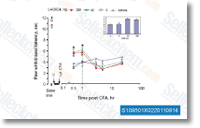 Click to enlarge | Rating | |
| Source | Molecular Pain 2010 6, 51. LAQ824 (Dacinostat) purchased from Selleck | |
| Method | Paw withdrawal latency analysis | |
| Cell Lines | C57BL/6NTac mice | |
| Concentrations | 8-200 ng | |
| Incubation Time | 30 min | |
| Results | CFA-induced thermal hyperalgesia was significantly attenuated by all HDACIs, except for MS-275, in comparison to vehicle. Of these tested HDACIs, LAQ824 showed similar inhibitory effects between 40 and 200 ng suggesting saturation above 40 ng dosage. |
Chemoproteomics profiling of HDAC inhibitors reveals selective targeting of HDAC complexes. [Bantscheff M, et al. Nat Biotechnol 2011;29(3):255-65]
Histone deacetylases 1 and 3 but not 2 mediate cytokine-induced beta cell apoptosis in INS-1 cells and dispersed primary islets from rats and are differentially regulated in the islets of type 1 diabetic children. [Lundh M, et al. Diabetologia 2012;55(9):2421-31]
Inhibition of class II histone deacetylases in the spinal cord attenuates inflammatory hyperalgesia. [Bai G,et al. Mol Pain 2010;6:51]
