
Antibodies


Lapatinib Ditosylate (GW572016, GW2016) is a potent EGFR and ErbB2 inhibitor with IC50 of 10.8 and 9.2 nM, respectively.
| Size | Price | Stock | Quantity | ||||||||||||
|---|---|---|---|---|---|---|---|---|---|---|---|---|---|---|---|
| |||||||||||||||
 Distributor Tel: +886-2-2827-1197jimmy@new.abscience.com.tw
Biological Activity
| Description | Lapatinib Ditosylate (GW572016, GW2016) is a potent EGFR and ErbB2 inhibitor with IC50 of 10.8 and 9.2 nM, respectively. | |||||
|---|---|---|---|---|---|---|
| Targets | EGFR | ErbB2 | ||||
| IC50 | 10.8 nM | 9.2 nM [1] | ||||
| In vitro | Lapatinib Ditosylate weakly inhibits the activity of ErbB4 with IC50 of 367 nM, and displays >300-fold selectivity for EGFR and ErbB2 over other kinases such as c-Src, c-Raf, MEK, ERK, c-Fms, CDK1, CDK2, p38, Tie-2, and VEGFR2. Lapatinib Ditosylate significantly inhibits receptor autophosphorylation of EGFR and ErbB2 in a dose-dependent manner with IC50 of 170 nM and 80 nM, respectively in HN5 cells; as well as 210 nM and 60 nM, respectively in BT474 cells. Unlike OSI-774 and Iressa (ZD1839) which preferentially inhibit the growth of the EGFR-overexpressing cells, Lapatinib Ditosylate inhibits the growth of both EGFR- and ErbB2-overexpressing cells. Lapatinib Ditosylate displays higher inhibitory activity against EGFR- or ErbB2-overexpressing cells with IC50 of 0.09-0.21 μM, compared with cells expressing low levels of EGFR or ErbB2 with IC50 of 3-12 μM, and exhibits ~100-fold selectivity over the normal fibroblast cells. Lapatinib Ditosylate potently inhibits the outgrowth of EGFR-overexpressing HN5 and A-431 cells, as well as ErbB2-overexpressing BT474 and N87 cells, and significantly induces G1 arrest of HN5 cells and apoptosis of BT474 cells, which are associated with inhibition of AKT phosphorylation. [1] | |||||
| In vivo | Oral administration of Lapatinib Ditosylate (~100 mg/kg) twice daily significantly inhibits the growth of BT474 and HN5 xenografts in a dose-dependent manner. [1] | |||||
| Features | ||||||
| In vitro kinase assays | The IC50 values for inhibition of enzyme activity are generated by measuring inhibition of phosphorylation of a peptide substrate. The intracellular kinase domains of EGFR and ErbB2 are purified from a baculovirus expression system. EGFR and ErbB2 reactions are performed in 96-well polystyrene round-bottomed plates in a final volume of 45 μL. Reaction mixtures contain 50 mM 4-morpholinepropanesulfonic acid (pH 7.5), 2 mM MnCl2, 10 μM ATP, 1 μCi of [γ33P] ATP/reaction, 50 μM Peptide A [Biotin-(amino hexonoic acid)-EEEEYFELVAKKK-CONH2], 1 mM dithiothreitol, and 1 μL of DMSO containing serial dilutions of Lapatinib beginning at 10 μM. The reaction is initiated by adding the indicated purified type-1 receptor intracellular domain. The amount of enzyme added is 1 pmol/reaction (20 nM). Reactions are terminated after 10 minutes at 23°C by adding 45 μL of 0.5% phosphoric acid in water. The terminated reaction mix (75 μL) is transferred to phosphocellulose filter plates. The plates are filtered and washed three times with 200 μL of 0.5% phosphoric acid. Scintillation cocktail (50 μL) is added to each well, and the assay is quantified by counting in a Packard Topcount. IC50 values are generated from 10-point dose-response curves. |
|---|
| Cell lines | HFF, MCF-7, T47D, A-431, HN5, BT474, N87, CaLu-3, HB4a, and HB4a c5.2 |
|---|---|
| Concentrations | Dissolved in DMSO, final concentrations ~100 μM |
| Incubation Time | 72 hours |
| Method | Cells are exposed to various concentrations of Lapatinib for 72 hours. Relative cell number is estimated using methylene blue staining. The absorbance at 620 nm is read in a Spectra microplate reader. Cell death and cell cycle analysis are assessed by propidium iodide staining and antibody detection of incorporated BrdUrd and staining with propidium iodide. |
| Animal Models | CD-1 nude female mice implanted s.c. with HN5 cells, and C.B-17 SCID female mice implanted s.c. with BT474 cells |
|---|---|
| Dosages | ~100 mg/kg |
| Administration | Orally twice daily |
| Solubility | 15% Captisol, 5 mg/mL |
| NCT Number | Recruitment | Conditions | Sponsor /Collaborators | Start Date | Phases |
|---|---|---|---|---|---|
| NCT01705340 | Terminated | Adenocarcinoma of the Gastroesophageal Junction|HER2-positive Breast Cancer|Male Breast Cancer|Recurrent Breast Cancer|Recurrent Esophageal Cancer|Recurrent Gastric Cancer|Stage IIIC Breast Cancer|Sta | National Cancer Institute (NCI) | 2012-09 | Phase 1 |
| NCT01783756 | Recruiting | Central Nervous System Metastases|HER2-positive Breast Cancer|Male Breast Cancer|Recurrent Breast Cancer|Stage IV Breast Cancer | Jonsson Comprehensive Cancer Center | 2013-06 | Phase 1|Phase 2 |
| NCT01868503 | Recruiting | Male Breast Cancer|Recurrent Breast Cancer|Stage IIIA Breast Cancer|Stage IIIB Breast Cancer|Stage IIIC Breast Cancer | Stanford University|National Cancer Institute (NCI) | 2013-07 | Phase 2 |
| NCT01873833 | Recruiting | HER2-positive Breast Cancer|Recurrent Breast Cancer|Stage IV Breast Cancer | USC/Norris Comprehensive Cancer Center|National Cancer Institute (NCI) | 2013-07 | Phase 2 |
| NCT01947023 | Recruiting | Recurrent Thyroid Cancer | National Cancer Institute (NCI) | 2013-08 | Phase 1 |
Download Lapatinib (GW-572016) Ditosylate SDF
| Molecular Weight (MW) | 925.46 |
|---|---|
| Formula | C29H26ClFN4O4S.2C7H8O3S |
| CAS No. | 388082-77-7 |
| Storage | 3 years -20℃Powder |
|---|---|
| 6 months-80℃in DMSO | |
| Syonnyms | GW-572016 |
| Solubility (25°C) * | In vitro | DMSO | 185 mg/mL (199 mM) |
|---|---|---|---|
| Water | <1 mg/mL (<1 mM) | ||
| Ethanol | <1 mg/mL (<1 mM) | ||
| In vivo | 15% Captisol, | 5 mg/mL | |
| * <1 mg/ml means slightly soluble or insoluble. * Please note that Selleck tests the solubility of all compounds in-house, and the actual solubility may differ slightly from published values. This is normal and is due to slight batch-to-batch variations. | |||
| Chemical Name | N-(4-(3-fluorobenzyloxy)-3-chlorophenyl)-6-(5-((2-(methylsulfonyl)ethylamino)methyl)furan-2-yl)quinazolin-4-amine,di4-methylbenzenesulfonate |
|---|
| Stock Solution (1ml DMSO) | 1mM | 10mM | 20mM | 30mM |
|---|---|---|---|---|
| Mass(mg) | 0.92546 | 9.2546 | 18.5092 | 27.7638 |
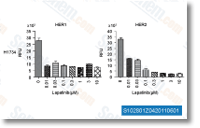 Click to enlarge | Rating | |
| Source | Int J Proteomics 2011 2011, Article ID 215496. Lapatinib (GW-572016) Ditosylate purchased from Selleck | |
| Method | CEER assay | |
| Cell Lines | H1734 cell line | |
| Concentrations | 0-10 μM | |
| Incubation Time | 4 h | |
| Results | HER1 and/or HER2 pathway-activated cell lines, H1734 , had their activation blocked by the HER1/2 kinase inhibitors Lapatinib. |
ErbB receptor tyrosine kinase/NF-κB signaling controls mammosphere formation in human breast cancer. [Hinohara K, et al. Proc Natl Acad Sci U S A 2012;109(17):6584-9]
Azacytidine and erlotinib exert synergistic effects against acute myeloid leukemia. [Lainey E, et al. Oncogene 2012;32(37):4331-42]
Secretory phospholipase A2-IIa is involved in prostate cancer progression and may potentially serve as a biomarker for prostate cancer. [Dong Z, et al. Carcinogenesis 2010;31(11):1948-55]
