
Antibodies


KU-60019 is an improved analogue of KU-55933, with IC50 of 6.3 nM for ATM, 270- and 1600-fold more selective for ATM than DNA-PK and ATR,and is a highly effective radiosensitizer.
| Size | Price | Stock | Quantity | ||||||||||||||||
|---|---|---|---|---|---|---|---|---|---|---|---|---|---|---|---|---|---|---|---|
| |||||||||||||||||||
 Distributor Tel: +886-2-2827-1197jimmy@new.abscience.com.tw
| Description | KU-60019 is an improved analogue of KU-55933, with IC50 of 6.3 nM for ATM, 270- and 1600-fold more selective for ATM than DNA-PK and ATR,and is a highly effective radiosensitizer. | |||||
|---|---|---|---|---|---|---|
| Targets | ATM | |||||
| IC50 | 6.3 nM [1] | |||||
| In vitro | Compared to KU-55933, KU-60019 is an improved more water-soluble inhibitor of the ATM kinase, while displaying similar target selectivity. KU-60019 has little activity against DNA-PKcs and ATR with IC50 values of 1.7 μM and >10 μM, respectively, as well as 229 other protein kinases such as PI3K, mTOR and mTOR/FKBP12. KU-60019 displays 3- to 10-fold more potency than KU-55933 at blocking radiation-induced phosphorylation of key ATM protein targets such as p53, γ-H2AX, and CHK2, in human glioma U87 and U1242 cells, as 1 μM of KU-60019 significantly induces >70% decrease of p53 (S15) phosphorylation to which extent ~10 μM of KU-55933 is required to achieve. KU-60019 effectively radiosensitizes human glioma cells with dose-enhancement ratio of 1.7 and 4.4 at 1 μM and 10 μM, respectively, and also radiosensitizes the normal fibroblasts but not the A-T fibroblasts. KU-60019 treatment (3 μM) blocks basal and insulin-induced AKT S473 phosphorylation by 70% and ~50%, respectively, and completely reduces radiation-induced AKT phosphorylation below the level of control. The effect of KU-60019 on AKT S473 phosphorylation can be seen in glioma cell lines and normal fibroblasts but not in A-T (h-TERT) cells, and can be significantly blocked by phosphatase inhibitor okadaic acid, suggesting a critical role of ATM kinase in regulating AKT phosphorylation via unknown phosphatase. Consistent with the inhibition of prosurvival AKT signaling, KU-60019 at 3 μM significantly inhibits migration and invasion of human glioma U87 cells by >70% and ~60%, respectively, as well as U1242 cells by >50% and ~60% respectively. [1] | |||||
| In vivo | In orthotopic glioma U1242/luc-GFP xenograft models, the combination of KU-60019 and radiation significantly increases survival of mice than KU-60019 alone, radiation alone, or no treatment. In addition, p53-mutant gliomas is much more sensitive to KU-60019 radiosensitization than wild-type glioma. [2] | |||||
| Features | Improved analog of KU-55933, and is more effective at blocking ATM-mediated DDR events. | |||||
| Cell lines | U87 and U1242 |
|---|---|
| Concentrations | Dissolved in water, final concentrations ~3 μM |
| Incubation Time | 1, 3, and 5 days |
| Method | Cells are exposed to KU-60019 for 1, 3, and 5 days. Cell growth is determined by AlamarBlue. AlamarBlue is added to the medium to the recommended final concentration. Plates are incubated for 1 hour at 37 °C, fluorescence is determined on a Fluoro-Count plate reader (excitation 530 nm, emission 590 nm), and values are taken as a measure of cell growth. Cell survival is determined by trypan blue/fluorescence activated cell sorting (FACS) assay. |
| Animal Models | Athymic female mice harboring orthotopic glioma U1242/luc-GFP tumors or human glioma U1242/luc-GFP tumors |
|---|---|
| Dosages | KU-60019 (10 μM) is delivered at a rate of 0.5 μL/h by osmotic pump; KU-60019 (250 μM) in 12.5 μL is infused by CED. |
| Administration | Administered intratumorally by convection-enhanced delivery or osmotic pump |
| Molecular Weight (MW) | 547.67 |
|---|---|
| Formula | C30H33N3O5S |
| CAS No. | 925701-49-1 |
| Storage | 3 years -20℃Powder |
|---|---|
| 6 months-80℃in DMSO | |
| Syonnyms | N/A |
| Solubility (25°C) * | In vitro | DMSO | 40 mg/mL (73 mM) |
|---|---|---|---|
| Water | <1 mg/mL (<1 mM) | ||
| Ethanol | 30 mg/mL (54 mM) | ||
| * <1 mg/ml means slightly soluble or insoluble. * Please note that Selleck tests the solubility of all compounds in-house, and the actual solubility may differ slightly from published values. This is normal and is due to slight batch-to-batch variations. | |||
| Chemical Name | 2-((2S,6R)-2,6-dimethylmorpholino)-N-(5-(6-morpholino-4-oxo-4H-pyran-2-yl)-9H-thioxanthen-2-yl)acetamide |
|---|
| Stock Solution (1ml DMSO) | 1mM | 10mM | 20mM | 30mM |
|---|---|---|---|---|
| Mass(mg) | 0.54767 | 5.4767 | 10.9534 | 16.4301 |
 Click to enlarge | Rating | |
| Source | Brain Pathol. 2012 Sep;22(5):677-88 . KU-60019 purchased from Selleck | |
| Method | MTT assays | |
| Cell Lines | BORRU stem cells | |
| Concentrations | 1 uM | |
| Incubation Time | 30 min | |
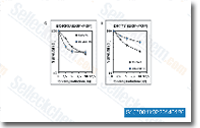
| Results | Specific sensitization of BORRU stem cells to ionizing radiation by ataxia telangiectasia mutated (ATM) inhibitor KU-60019. Cells grown under stem conditions were plated in 96-well plates in complete medium. The day after, cells were exposed to 1 μM KU-60019 for 30 minutes at 37°C and then irradiated. Survival was evaluated 192 hours later by the MTT-based assay. Data are the means ±SEM of 19 independent experiments. |
Characterization of glioma stem cells through multiple stem cell markers and their specific sensitization to double-strand break-inducing agents by pharmacological inhibition of ataxia telangiectasia mutated protein. [Raso A, et al. Brain Pathol 2012;22(5):677-88]
Ligand modulation of a dinuclear platinum compound leads to mechanistic differences in cell cycle progression and arrest. [Menon VR, et al. Biochem Pharmacol 2013;86(12):1708-20]
Predictability, efficacy and safety of radiosensitization of glioblastoma-initiating cells by the ATM inhibitor KU-60019 [Donatella Vecchio ,et al. International Journal of Cancer 2013;10.1002/ijc.28680]
