
Antibodies


JNJ-38877605 is an ATP-competitive inhibitor of c-Met with IC50 of 4 nM, 600-fold selective for c-Met than 200 other tyrosine and serine-threonine kinases. Phase 1.
| Size | Price | Stock | Quantity | ||||||||||||||||||||||||
|---|---|---|---|---|---|---|---|---|---|---|---|---|---|---|---|---|---|---|---|---|---|---|---|---|---|---|---|
| |||||||||||||||||||||||||||
 Distributor Tel: +886-2-2827-1197jimmy@new.abscience.com.tw
| Description | JNJ-38877605 is an ATP-competitive inhibitor of c-Met with IC50 of 4 nM, 600-fold selective for c-Met than 200 other tyrosine and serine-threonine kinases. Phase 1. | |||||
|---|---|---|---|---|---|---|
| Targets | c-Met | |||||
| IC50 | 4 nM [1] | |||||
| In vitro | JNJ-38877605 shows more than 600-fold selectivity for c-Met compared with more than 200 other diverse tyrosine and serine-threonine kinases and also potently inhibits HGF-stimulated and constitutively activated c-Met phosphorylation in vitro. [1] In EBC1, GTL16, NCI-H1993, and MKN45 cells, JNJ-38877605 (500 nM) leads to a significant reduction of phosphorylation of Met and RON, another key player in invasive growth. [2] A recent study shows that JNJ-38877605 is involved in modulating secretion of IL-8, GROa, uPAR and IL-6 in GTL16 cells. [3] | |||||
| In vivo | In mice bearing established GTL16 xenografts, JNJ-38877605, dosed orally with 40 mg/kg/day for 72 hours, results in a statistically significant decrease in the plasma levels of human IL-8 (from 0.150 ng/mL to 0.050 ng/mL) and GROα (from 0.080 ng/mL to 0.030 ng/mL). While concentrations of uPAR in the blood become reduced to more than 50% at the same dose. [3] | |||||
| Features | ||||||
| Animal Models | GTL16 cells are inoculated subcutaneously into the right posterior flank (or both right and left posterior flanks, for determination of uPAR and IL-6) of 6-week-old immunodeficient nu/nu female mice on Swiss CD1 background. |
|---|---|
| Dosages | ≤40 mg/kg/day |
| Administration | Administered via p.o. |
| Solubility | 30% propylene glycol, 5% Tween 80, 65% D5W, 30 mg/mL |
| NCT Number | Recruitment | Conditions | Sponsor /Collaborators | Start Date | Phases |
|---|---|---|---|---|---|
| NCT00651365 | Terminated | Neoplasms | Johnson & Johnson Pharmaceutical Research & Development, L.L.C.|Ortho Biotech, Inc. | 2008-02 | Phase 1 |
| Molecular Weight (MW) | 377.35 |
|---|---|
| Formula | C19H13F2N7 |
| CAS No. | 943540-75-8 |
| Storage | 3 years -20℃Powder |
|---|---|
| 6 months-80℃in DMSO | |
| Syonnyms | N/A |
| Solubility (25°C) * | In vitro | DMSO | 37 mg/mL (98 mM) |
|---|---|---|---|
| Water | <1 mg/mL (<1 mM) | ||
| Ethanol | <1 mg/mL (<1 mM) | ||
| In vivo | 30% propylene glycol, 5% Tween 80, 65% D5W, | 30 mg/mL | |
| * <1 mg/ml means slightly soluble or insoluble. * Please note that Selleck tests the solubility of all compounds in-house, and the actual solubility may differ slightly from published values. This is normal and is due to slight batch-to-batch variations. | |||
| Chemical Name | 6-(difluoro(6-(1-methyl-1H-pyrazol-4-yl)-[1,2,4]triazolo[4,3-b]pyridazin-3-yl)methyl)quinoline |
|---|
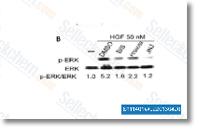 Click to enlarge | Rating | |
| Source | PLOS one, 2012. 7(9), e44937. JNJ-38877605 purchased from Selleck | |
| Method | Western Blot | |
| Cell Lines | RPE50 cells | |
| Concentrations | ||
| Incubation Time | 0.5 h | |
| Results |
Mesenchymal transition and dissemination of cancer cells is driven by myeloid-derived suppressor cells infiltrating the primary tumor. [Toh B, et al. PLoS Biol 2011;9(9):e1001162]
Identification of MET and SRC activation in melanoma cell lines showing primary resistance to PLX4032. [Vergani E, et al. Neoplasia 2011;13(12):1132-42]
Antitumour efficacy of MEK inhibitors in human lung cancer cells and their derivatives with acquired resistance to different tyrosine kinase inhibitors. [Morgillo F, et al. Brit J Cancer 2011;105(3):382-92]
