
Antibodies


Ispinesib (SB-715992, CK0238273) is a potent, specific and reversible inhibitor of kinesin spindle protein (KSP) with Ki app of 1.7 nM, no inhibition to CENP-E, RabK6, MCAK, MKLP1, KHC or Kif1A. Phase 1/2.
| Size | Price | Stock | Quantity | ||||||||||||||||
|---|---|---|---|---|---|---|---|---|---|---|---|---|---|---|---|---|---|---|---|
| |||||||||||||||||||
 Distributor Tel: +886-2-2827-1197jimmy@new.abscience.com.tw
| Description | Ispinesib (SB-715992, CK0238273) is a potent, specific and reversible inhibitor of kinesin spindle protein (KSP) with Ki app of 1.7 nM, no inhibition to CENP-E, RabK6, MCAK, MKLP1, KHC or Kif1A. Phase 1/2. | |||||
|---|---|---|---|---|---|---|
| Targets | KSP (HsEg5) | |||||
| IC50 | 1.7 nM (Ki app) [1] | |||||
| In vitro | Ispinesib is a potent, allosteric, reversible, and specific inhibitor of KSP, which changes the binding property of KSP to microtubules and disturbs its movement by inhibiting ADP release without altering the release of the KSP-ADP complex from the microtubule. [1] Ispinesib shows potent cytotoxic activity in a panel of tumor cell lines, including Colo205, Colo201, HT-29, M5076, Madison-109, and MX-1, with IC50 of 1.2 nM to 9.5 nM. [2] In PC-3 prostate cancer cells, Ispinesib (15 nM and 30 nM) blocks cell proliferation and induces apoptosis by regulating the expression levels of genes that controls apoptosis, cell proliferation, cell cycle, and cell signaling, such as EGFR, p27, p15, and IL-11. [3] In a panel of 53 breast cell lines, Ispinesib (7.4 nM–600 nM) demonstrates broad inhibitory activity. In BT-474 and MDA-MB-468 cells, Ispinesib (150 nM) induces apoptosis, as revealed by a higher proportion of apoptotic cells, lower antiapoptotic Bcl-XL level, and higher proapoptotic Bax and Bid levels. [4] | |||||
| In vivo | Ispinesib (4.5 mg/kg–15 mg/kg) exhibits inhibitory effects against Colo205, Colo201, HT-29, but not MX-1 cells, in mouse xenograft models. SB-715992 (6 mg/kg–10 mg/kg ) also inhibits murine solid tumors, including Madison 109 lung carcinoma, M5076 sarcoma, as well as L1210 and P388 leukemias. [2] In mice xenograft models of breast cancer cells MCF-7, HCC1954, MDA-MB-468, and KPL4, Ispinesib (8 mg/kg–10 mg/kg) inhibits tumor growth. [4] | |||||
| Features | An allosteric, potent, specific, and reversible inhibitor of the mitotic kinesin spindle protein (KSP) (HsEg5). | |||||
| Steady-State Kinetic Analysis of Human KSP ATPase Activity and Inhibition by Ispinesib | Kinesin specificity analysis is carried out using a pyruvate kinase-lactate dehydrogenase detection system that couples the production of ADP to oxidation of NADH. Absorbance changes are monitored at 340 nm. Steady-state studies using nanomolar concentrations of KSP are performed using a sensitive fluorescence-based assay utilizing a pyruvate kinase, pyruvate oxidase, and horseradish peroxidase (HRP) coupled detection system that couples the generation of ADP to oxidation of Amplex Red to fluorescent resorufin. Generation of resorufin is monitored by fluorescence (λexcitation = 520 nm and λemission = 580 nm). Steady-state biochemical experiments are performed in PEM25 buffer [25 mM Pipes-K+ (pH 6.8), 2 mM MgCl2, 1 mM EGTA] supplemented with 10 µM paclitaxel for experiments involving microtubules. The IC50 for steady-state inhibition is determined at 500 µM ATP, 5 µM Microtubules, and 1 nM KSP in PEM25 buffer. Ki app (apparent inhibitor dissociation constant) values of Ispinesib are extracted from the dose-response curves, with explicit correction for enzyme concentration by using the Morrison equation. Inhibitor modality (e.g., competitive, noncompetitive, uncompetitive, or mixed) under steady-state conditions is determined by measuring the effect of inhibitor concentration on initial velocity as a function of substrate concentrations. Data are fit using equations in GraFit to velocity equations for the various modes of inhibition. |
|---|
| Cell lines | Breast cancer cells, including MCF-7, HCC1954, MDA-MB-468, and KPL4 |
|---|---|
| Concentrations | 0.085 nM–33 µM |
| Incubation Time | 72 hours |
| Method | Cells are plated in log phase of growth in 96-well plates and treated with Ispinesib for 72 hours. Then, cell growth is measured using CellTiter-Glo, and luminescence is detected using BioTek FLx800. Data are analyzed and the IC50 value, defined as the drug concentration that results in 50% growth inhibition relative to control, is calculated. |
| Animal Models | Nude (nu/nu) mice models of MCF7, KPL4, and HCC1954 cells; severe combined immunodeficient (SCID) mice model of MDA-MB-468 cells; |
|---|---|
| Dosages | 10 mg/kg for nude mice or 8 mg/kg for SCID mice |
| Administration | Intraperitoneal injection on a q4d× schedule (3 doses, every 4 day |
| NCT Number | Recruitment | Conditions | Sponsor /Collaborators | Start Date | Phases |
|---|---|---|---|---|---|
| NCT00095628 | Completed | Metastatic Squamous Neck Cancer With Occult Primary Squamous Cell Carcinoma|Recurrent Metastatic Squamous Neck Cancer With Occult Primary|Recurrent Salivary Gland Cancer etc. | National Cancer Institute (NCI) | 2005-01 | Phase 2 |
| NCT00096499 | Completed | Adenocarcinoma of the Prostate|Recurrent Prostate Cancer|Stage IV Prostate Cancer | National Cancer Institute (NCI) | 2005-04 | Phase 2 |
| NCT00354250 | Completed | Recurrent Renal Cell Cancer|Stage III Renal Cell Cancer|Stage IV Renal Cell Cancer | National Cancer Institute (NCI) | 2006-05 | Phase 2 |
| NCT00363272 | Completed | Childhood Burkitt Lymphoma|Childhood Central Nervous System Germ Cell Tumor|Childhood Choroid Plexus Tumor|Childhood Craniopharyngioma etc. | National Cancer Institute (NCI) | 2006-06 | Phase 1 |
| NCT00607841 | Completed | Breast Neoplasms | Cytokinetics | 2007-12 | Phase 1|Phase 2 |
Download Ispinesib (SB-715992) SDF
| Molecular Weight (MW) | 517.06 |
|---|---|
| Formula | C30H33ClN4O2 |
| CAS No. | 336113-53-2 |
| Storage | 3 years -20℃Powder |
|---|---|
| 6 months-80℃in DMSO | |
| Syonnyms | N/A |
| Solubility (25°C) * | In vitro | DMSO | 103 mg/mL (199 mM) |
|---|---|---|---|
| Water | <1 mg/mL (<1 mM) | ||
| Ethanol | 103 mg/mL (199 mM) | ||
| * <1 mg/ml means slightly soluble or insoluble. * Please note that Selleck tests the solubility of all compounds in-house, and the actual solubility may differ slightly from published values. This is normal and is due to slight batch-to-batch variations. | |||
| Chemical Name | (R)-N-(3-aminopropyl)-N-(1-(3-benzyl-7-chloro-4-oxo-3,4-dihydroquinazolin-2-yl)-2-methylpropyl)-4-methylbenzamide |
|---|
| Stock Solution (1ml DMSO) | 1mM | 10mM | 20mM | 30mM |
|---|---|---|---|---|
| Mass(mg) | 0.51706 | 5.1706 | 10.3412 | 15.5118 |
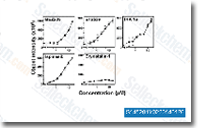 Click to enlarge | Rating | |
| Source | PLoS One. 2013 Apr 10;8(4):e60334 . Ispinesib (SB-715992) purchased from Selleck | |
| Method | Cell imaging-based efflux assay | |
| Cell Lines | KB-V1 cells | |
| Concentrations | 0-20 uM | |
| Incubation Time | 24 h | |
| Results | Ispinesib inhibited ABCB1-medicated calcein AM efflux in the flow cytometry assay and displayed dose-dependent inhibition of ABCB1-mediated efflux in our cell imaging-based efflux assay. |
