
Antibodies


GSK690693 is a pan-Akt inhibitor targeting Akt1/2/3 with IC50 of 2 nM/13 nM/9 nM, also sensitive to the AGC kinase family: PKA, PrkX and PKC isozymes. Phase 1.
| Size | Price | Stock | Quantity | ||||||||||||||||
|---|---|---|---|---|---|---|---|---|---|---|---|---|---|---|---|---|---|---|---|
| |||||||||||||||||||
 Distributor Tel: +886-2-2827-1197jimmy@new.abscience.com.tw
| Description | GSK690693 is a pan-Akt inhibitor targeting Akt1/2/3 with IC50 of 2 nM/13 nM/9 nM, also sensitive to the AGC kinase family: PKA, PrkX and PKC isozymes. Phase 1. | |||||
|---|---|---|---|---|---|---|
| Targets | Akt1 | Akt2 | Akt3 | |||
| IC50 | 2 nM | 13 nM | 9 nM [1] | |||
| In vitro | GSK690693 is very selective for the Akt isoforms versus the majority of kinases in other families. However, GSK690693 is less selective for members of the AGC kinase family including PKA, PrkX, and PKC isozymes with IC50 of 24 nM, 5 nM, and 2-21 nM, respectively. GSK690693 also potently inhibits AMPK and DAPK3 from the CAMK family with IC50 of 50 nM and 81 nM, respectively, and PAK4, 5, and 6 from the STE family with IC50 of 10 nM, 52 nM, and 6 nM, respectively. GSK690693 inhibits the phosphorylation of GSK3β in tumor cells with IC50 ranging from 43 nM to 150 nM. GSK690693 treatment leads to a dose-dependent increase in the nuclear accumulation of the transcription factor FOXO3A. GSK690693 potently inhibits the proliferation of T47D, ZR-75-1, BT474, HCC1954, MDA-MB-453, and LNCaP cells with IC50 of 72 nM, 79 nM, 86 nM, 119 nM, 975 nM, and 147 nM, respectively. GSK690693 treatment induces apoptosis at concentrations >100 nM in both LNCaP and BT474 cells. [1] Consistent with the role of AKT in cell survival, GSK690693 induces apoptosis in sensitive ALL cell lines. [2] | |||||
| In vivo | A single administration of GSK690693 inhibits GSK3β phosphorylation in human breast carcinoma (BT474) xenografts in a dose- and time-dependent manner. Similarly, GSK690693 induces a reduction in phosphorylation of the Akt substrates, PRAS40, and FKHR/FKHRL1. GSK690693 also results in an acute increase in blood glucose, returning to baseline 8 to 10 hours after drug administration. Administration of GSK690693 induces reductions in phosphorylated Akt substrates in vivo, and potently inhibits the growth of human SKOV-3 ovarian, LNCaP prostate, and BT474 and HCC-1954 breast carcinoma xenografts, with maximal inhibition of 58% to 75% at the dose of 30 mg/kg/day. [1] GSK690693 exhibits efficacy irrespective of the mechanism of Akt activation involved. GSK690693 is most effective in delaying tumor progression in Lck-MyrAkt2 mice expressing a membrane-bound, constitutively active form of Akt. [3] | |||||
| Features | ||||||
| In vitro kinase assays | His-tagged full-length Akt1, 2, or 3 are expressed and purified from baculovirus. Activation is carried out with purified PDK1 to phosphorylate Thr308 and purified MK2 to phosphorylate Ser473. To more accurately measure time-dependent inhibition of Akt, activated Akt enzymes are incubated with GSK690693 at various concentrations at room temperature for 30 minutes before the reaction is initiated with the addition of substrate. Final reaction contains 5 nM to 15 nM Akt1, 2, and 3 enzymes; 2 μM ATP; 0.15 μCi/μL[γ-33P]ATP; 1 μM Peptide (Biotin-aminohexanoicacid-ARKR-ERAYSFGHHA-amide); 10 mM MgCl2; 25 mM MOPS (pH 7.5); 1 mM DTT; 1 mM CHAPS; and 50 mM KCl. The reactions are incubated at room temperature for 45 minutes, followed by termination with Leadseeker beads in PBS containing EDTA (final concentration, 2 mg/mL beads and 75 mM EDTA). The plates are then sealed, the beads are allowed to settle for at least 5 hours, and product formation is quantitated using a Viewlux Imager. |
|---|
| Cell lines | T47D, ZR-75-1, BT474, HCC1954, MDA-MB-453, LNCaP, etc. |
|---|---|
| Concentrations | Dissolved in DMSO, final concentrations ~30 μM |
| Incubation Time | 72 hours |
| Method | Cells are plated at densities that allow untreated cells to grow logarithmically during the course of a 3-day assay. Briefly, cells are plated in 96- or 384-well plates and incubated overnight. Cells are then treated with GSK690693 (ranging from 30 μM-1.5 nM) and incubated for 72 hours. Cell proliferation is measured using the CellTiter Glo reagent. Data are analyzed using the XLFit curve-fitting tool for Microsoft Excel. IC50 values are obtained by fitting data to Eq, 2. |
| Animal Models | Female CD1 Swiss Nude mice injected with LNCaP, SKOV-3, or PANC1 cells, and C.B-17 SCID mice with HCC1954, MDA-MB-453, or BT474 cells |
|---|---|
| Dosages | ~30 mg/kg/day |
| Administration | Administered via i.p. |
| Solubility | 15% Captisol, 30 mg/mL |
| NCT Number | Recruitment | Conditions | Sponsor /Collaborators | Start Date | Phases |
|---|---|---|---|---|---|
| NCT00493818 | Terminated | Tumor|Lymphoma | GlaxoSmithKline | 2007-04 | Phase 1 |
| NCT00666081 | Withdrawn | Cancer | GlaxoSmithKline | 2008-04 | Phase 1 |
| Molecular Weight (MW) | 425.48 |
|---|---|
| Formula | C21H27N7O3 |
| CAS No. | 937174-76-0 |
| Storage | 3 years -20℃Powder |
|---|---|
| 6 months-80℃in DMSO | |
| Syonnyms | N/A |
| Solubility (25°C) * | In vitro | DMSO | 39 mg/mL (91 mM) |
|---|---|---|---|
| Water | <1 mg/mL (<1 mM) | ||
| Ethanol | <1 mg/mL (<1 mM) | ||
| In vivo | 15% Captisol, | 30 mg/mL | |
| * <1 mg/ml means slightly soluble or insoluble. * Please note that Selleck tests the solubility of all compounds in-house, and the actual solubility may differ slightly from published values. This is normal and is due to slight batch-to-batch variations. | |||
| Chemical Name | 4-(2-(4-amino-1,2,5-oxadiazol-3-yl)-1-ethyl-7-((S)-piperidin-3-ylmethoxy)-1H-imidazo[4,5-c]pyridin-4-yl)-2-methylbut-3-yn-2-ol |
|---|
| Stock Solution (1ml DMSO) | 1mM | 10mM | 20mM | 30mM |
|---|---|---|---|---|
| Mass(mg) | 0.42548 | 4.2548 | 8.5096 | 12.7644 |
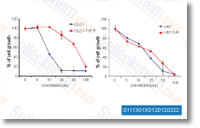 Click to enlarge | Rating | |
| Source | Dr. Milica Pesic of Institute for Biological Research.GSK690693 purchased from Selleck | |
| Method | Sulforhodamine B assay | |
| Cell Lines | DLD1 cells, U87 cells, DLD1-TxR cells, U87-TxR cells | |
| Concentrations | 0-100 nM | |
| Incubation Time | 72 h | |
| Results | GSK690693 efficacy decreased in DLD1-TxR in comparison to its sensitive counterpart - DLD1. concentration-dependent cell growth inhibition induced by GSK690693 does not differ between sensitive (U87) and resistant (U87-TxR) glioblastoma cell lines |
Epithelial to mesenchymal transition rewires the molecular path to PI3-Kinase-dependent proliferation. [Salt MB, et al. Cancer Discov 2013;10.1158/2159-8290.CD-13-0520]
Modulation of Akt/mTOR signaling overcomes sunitinib resistance in renal and prostate cancer cells. [Makhov PB, et al. Mol Cancer Ther 2012;11(7):1510-7]
IKBKE protein activates Akt independent of phosphatidylinositol 3-kinase/PDK1/mTORC2 and the pleckstrin homology domain to sustain malignant transformation. [Guo JP, et al. J Biol Chem 2013;286(43):37389-98]
