
Antibodies


GSK1904529A is a selective inhibitor of IGF-1R and IR with IC50 of 27 nM and 25 nM, >100-fold more selective for IGF-1R/InsR than Akt1/2, Aurora A/B,B-Raf, CDK2, EGFR etc.
| Size | Price | Stock | Quantity | ||||||||||||||||
|---|---|---|---|---|---|---|---|---|---|---|---|---|---|---|---|---|---|---|---|
| |||||||||||||||||||
 Distributor Tel: +886-2-2827-1197jimmy@new.abscience.com.tw
| Description | GSK1904529A is a selective inhibitor of IGF-1R and IR with IC50 of 27 nM and 25 nM, >100-fold more selective for IGF-1R/InsR than Akt1/2, Aurora A/B,B-Raf, CDK2, EGFR etc. | |||||
|---|---|---|---|---|---|---|
| Targets | IGF-1R | IR | ||||
| IC50 | 27 nM | 25 nM [1] | ||||
| In vitro | GSK1904529A is a reversible, ATP-competitive inhibitor and has enzyme-inhibitor binding values against IGF-1R and IR with Ki of 1.6 nM and 1.3 nM, respectively. GSK1904529A potently inhibits the ligand-induced phosphorylation of IGF-1R and IR at concentrations above 0.01 μM, followed by blocking downstream signaling (AKT, IRS-1, and ERK). GSK1904529A potently inhibits NIH-3T3/LISN, TC-71, SK-N-MC, SK-ES RD-ES cells with IC50 of 60 nM, 35 nM, 43 nM, 61 nM and 62 nM, respectively. GSK1904529A also inhibits other multiple myeloma and Ewing’s sarcoma cell lines including NCI-H929, MOLP-8, LP-1 and KMS-12-BM etc. GSK1904529A induces cell cycle arrest at the G1 phase in cell lines COLO 205, MCF-7, and NCI-H929, which are sensitive to GK1904529A. [1] | |||||
| In vivo | GSK1904529A indicates 98% tumor growth inhibition in NIH-3T3/LISN tumor-bearing mice at a dose of 30 mg/kg (orally, twice-daily) and 75% in COLO 205 xenografts mice (once daily). Among HT29 and BxPC3 xenografts, GSK1904529A produces moderate tumor growth inhibition with no side effects at a dose of 30 mg/kg. Meanwhile, GSK1904529A shows minimal effects on blood glucose levels. GSK1904529A (~3.5 μM in blood) completely inhibits IGF-1R phosphorylation. GSK1904529A has been implicated in treatment of various IGF-1R-dependent tumors including prostate, colon, breast, pancreatic, ovarian, and sarcomas. [1] | |||||
| Features | ||||||
| Kinase assays | GSK1904529A is dissolved in DMSO as stock solution at 10 mM. Baculovirus-expressed glutathione S-transferase-tagged proteins encoding the intracellular domain of IGF-1R (amino acids 957-1367) and IR (amino acids 979-1382) are used for determination of IC50. Kinases are activated by preincubating the enzyme (2.7 μM final concentration) in 50 mM HEPES (pH 7.5), 10 mM MgCl2, 0.1mg/mL bovine serum albumin, and 2 mM ATP. GSK1904529A is diluted in DMSO and dispensed into the assay plates (100 nL/well). Kinase reactions contained (in 10 μL) 50 mM HEPES (pH 7.5), 3 mM DTT, 0.1mg/mL bovine serum albumin, 1mM CHAPS, 10 mM MgCl2, 10 μM ATP, 500 nM substrate peptide (biotin-aminohexylAEEEEYMMMMAKKKK-NH2; QPC), and 0.5 nM activated enzyme. Reactions are stopped after 1 hour at room temperature with 33 μM EDTA. Peptide phosphorylation is measured by time-resolved fluorescence resonance energy transfer with 7 nM streptavidin Surelight allophycocyanin and 1nM europium-conjugated phosphotyrosine antibodies. Plates are read in a multilabel reader. |
|---|
| Cell lines | Tumor cell lines including multiple myeloma, ewing’s sarcoma, askin’s tumor, colon, breast, anaplastic large cell lymphoma, lung, cervix, head and neck, prostate and ovary. |
|---|---|
| Concentrations | ~ 100 μM, stocked in DMSO at 10 mM. |
| Incubation Time | 72 hours |
| Method | Cells are seeded in 96-well plates and incubated overnight at 37 °C, and treated with various concentrations of GSK1904529A for 72 hours. For the NIH-3T3/LISN, cells are seeded on collagen-coated 96-well tissue culture plates and allowed to adhere for 24 hours. The tissue culture medium is replaced with serum-free medium and the cells are treated with DMSO or GSK1904529A for 2 hours. IGF-I (30 ng/mL) is added and the cells are incubated at 37 °C for 72 hours. Cell proliferation is quantified using the CellTiter-Glo Luminescent Cell Viability Assay. IC50 values are determined. |
| Animal Models | NIH-3T3/LISN, COLO 205, HT29, and BxPC3 cells are implanted s.c. into the right flank of 8- to 10-wk-old female nu/nu CD-1athymic mice. |
|---|---|
| Dosages | ~30 mg/kg |
| Administration | Orally administered |
| Molecular Weight (MW) | 851.96 |
|---|---|
| Formula | C44H47F2N9O5S |
| CAS No. | 1089283-49-7 |
| Storage | 3 years -20℃Powder |
|---|---|
| 6 months-80℃in DMSO | |
| Syonnyms | N/A |
| Solubility (25°C) * | In vitro | DMSO | 124 mg/mL (145 mM) |
|---|---|---|---|
| Water | <1 mg/mL (<1 mM) | ||
| Ethanol | <1 mg/mL (<1 mM) | ||
| * <1 mg/ml means slightly soluble or insoluble. * Please note that Selleck tests the solubility of all compounds in-house, and the actual solubility may differ slightly from published values. This is normal and is due to slight batch-to-batch variations. | |||
| Chemical Name | N-(2,6-difluorophenyl)-5-(3-(2-(5-ethyl-2-methoxy-4-(4-(4-(methylsulfonyl)piperazin-1-yl)piperidin-1-yl)phenylamino)pyrimidin-4-yl)H-imidazo[1,2-a]pyridin-2-yl)-2-methoxybenzamide |
|---|
| Stock Solution (1ml DMSO) | 1mM | 10mM | 20mM | 30mM |
|---|---|---|---|---|
| Mass(mg) | 0.85196 | 8.5196 | 17.0392 | 25.5588 |
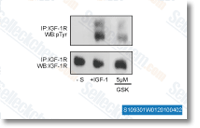 Click to enlarge | Rating | |
| Source | Dr. Ursula Broder from Institut. GSK1904529A purchased from Selleck | |
| Method | Western blot | |
| Cell Lines | A549 cells | |
| Concentrations | 5 μM | |
| Incubation Time | 4 h | |
| Results | Inhibition of IGF-1 induced IGF-1R phosphorylation by GSK1904529A |
BRCA1 negatively regulates IGF-1 expression through an estrogen-responsive element-like site. [Kang HJ, et al. Cell Death Dis 2012;3:e336]
Joint inhibition of TOR and JNK pathways interacts to extend the lifespan of Brachionus manjavacas (Rotifera). [Snell TW, et al. Exp Gerontol 2014;10.1016/j.exger.2014.01.022]
