
Antibodies


GSK1059615 is a dual inhibitor of PI3Kα/β/δ/γ (reversible) and mTOR with IC50 of 0.4 nM/0.6 nM/2 nM/5 nM and 12 nM, respectively. Phase 1.
| Size | Price | Stock | Quantity | ||||||||
|---|---|---|---|---|---|---|---|---|---|---|---|
| |||||||||||
 Distributor Tel: +886-2-2827-1197jimmy@new.abscience.com.tw
| Description | GSK1059615 is a dual inhibitor of PI3Kα/β/δ/γ (reversible) and mTOR with IC50 of 0.4 nM/0.6 nM/2 nM/5 nM and 12 nM, respectively. Phase 1. | |||||
|---|---|---|---|---|---|---|
| Targets | PI3Kα | PI3Kβ | PI3Kδ | PI3Kγ | mTOR | |
| IC50 | 0.4 nM | 0.6 nM | 2 nM | 5 nM | 12 nM [1] | |
| In vitro | The pyridinylquinoline derivative GSK1059615 is a novel, ATP-competitive, and reversible inhibitor of the class I family of PI3Ks. GSK1059615 inhibits PI3K signaling, induces G1 arrest and apoptosis, especially in breast tumor cells. [2] Data summarized in another review also shows that GSK1059615 inhibits PI3Kα, β, γ and δ, with Ki of 0.42 nM, 0.6 nM, 0.47 nM and 1.7 nM, respectively. [3] Another report shows that GSK1059615 inhibits PI3Kα with IC50 of 2 nM. In T47D and BT474 cancer cells, GSK1059615 inhibits the phosphorylation of Akt at S473, with IC50 of 40 nM. [4] | |||||
| In vivo | In xenograft mice models of BT474 or HCC1954 breast cancer cells, GSK1059615 (25 mg/kg) effectively inhibits tumor growth. [3] | |||||
| Features | A novel, ATP-competitive, and reversible inhibitor of both PI3Kα, β, δ, and γ, and mTOR. | |||||
| HTRF In vitro Profiling Assays for PI3K Inhibition | The measurement of the GSK1059615-dependent inhibition of the PI3Ks is accessed using a HTRF based PI3K profiling assay kit. 400 pM enzyme is used in PI3Kα and δ assays, 200 pM in PI3Kβ assays, and 1 nM in PI3Kγ assay. In addition, the PI3Kα, β, and δ assays are run with 150 mM NaCl and 100 μM ATP, while the PI3Kγ assay is run with no NaCl and 15 μM ATP. All reactions are run at 10 μM PIP2. GSK1059615 is serially diluted (3-fold in DMSO), and 50 nL is transferred to a 384-well low-volume assay plate. PI3K Reaction Buffer is prepared by diluting the stock 1:4 with de-ionized water. Freshly prepared DTT is added at a final concentration of 5 mM on the day of use. Enzyme addition and GSK1059615 pre-incubation are initiated by the addition of 2.5 µL of PI3K in reaction buffer. Plates are incubated at room temperature for 15 min. Reactions are initiated by addition of 2.5 µL of 2× substrate solution (PIP2 and ATP in 1× reaction buffer). Plates are incubated at room temperature for one hour. Reactions are quenched by the addition of 2.5 µL of stop solution. The quenched reactions are then processed to detect product formation by adding 2.5 µL of Detection Solution. Following a 1-hour incubation in the dark, the HTRF signal is measured on the Envision plate reader set for 330nm excitation and dual emission detection at 620nm (Eu) and 665nm (APC). The IC50 value is then obtained. |
|---|
| Cell lines | T47D and BT474 cells |
|---|---|
| Concentrations | 0–1 μM, serially diluted (3-fold) in DMSO |
| Incubation Time | 30 min |
| Method | Cells are plate at a density of 1 × 10⁴ cells per well in clear flat-bottomed 96-well plates and incubated overnight. Then, GSK1059615 is added and the plates are incubated for 30 min. At the end of incubation, media is aspirated from the plates, and the plate is wash once with cold PBS. 80 μL MSD Lysis buffer is added into each well and the plates are incubated on a shaker at 4 °C for at least 30 min. For Akt duplex assay, plates are washed with 200 μL/well wash buffer for 4 times and tapped on paper towel to blot. Then, 60 μL lysates is added to each well and the plates are incubated on shaker at room temperature for 1 hour. After another 4 times washing, antibody is added (25 μL per well) and the plates are incubated on shaker for 1 hour and washed again. Finally, Read Buffer is added (150 μL per well) and the plates are read immediately. IC50 values are then obtained. |
| Animal Models | Xenograft mice models of BT474 or HCC1954 cells |
|---|---|
| Dosages | 25 mg/kg |
| Administration | Oral gavage |
| NCT Number | Recruitment | Conditions | Sponsor /Collaborators | Start Date | Phases |
|---|---|---|---|---|---|
| NCT00695448 | Terminated | Solid Tumours|Metastatic Breast Cancer|Solid Tumor Cancer|Lymphoma|Endometrial Cancer | GlaxoSmithKline | 2008-06 | Phase 1 |
| Molecular Weight (MW) | 333.36 |
|---|---|
| Formula | C18H11N3O2S |
| CAS No. | 958852-01-2 |
| Storage | 3 years -20℃Powder |
|---|---|
| 6 months-80℃in DMSO | |
| Syonnyms | N/A |
| Solubility (25°C) * | In vitro | DMSO | 2 mg/mL (5 mM) |
|---|---|---|---|
| Water | <1 mg/mL (<1 mM) | ||
| Ethanol | <1 mg/mL (<1 mM) | ||
| * <1 mg/ml means slightly soluble or insoluble. * Please note that Selleck tests the solubility of all compounds in-house, and the actual solubility may differ slightly from published values. This is normal and is due to slight batch-to-batch variations. | |||
| Chemical Name | (Z)-5-((4-(pyridin-4-yl)quinolin-6-yl)methylene)thiazolidine-2,4-dione |
|---|
 Click to enlarge | Rating | |
| Source | Antonino Maria Spartà from University of Bologna.GSK1059615 purchased from Selleck | |
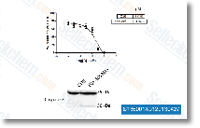
| Method | Western Blot/MTT | |
| Cell Lines | Molt-4 leukemia cell | |
| Concentrations | 2.7 μM | |
| Incubation Time | 48 h | |
| Results | PI3K Inhibitor GSK-1059615 was able to induce Molt-4 leukemia cell death after 48 h treatment with an IC50 of around 2.7 mM. It was also able to induce apoptosis, but to a very limited extent as shown by Caspase 7 western blot. |
Emergence of KRAS mutations and acquired resistance to anti-EGFR therapy in colorectal cancer. [Misale S, et al. Nature 2012;486(7404):532-6]
Metrics other than potency reveal systematic variation in responses to cancer drugs [Fallahi-Sichani M, et al. Nat Chem Biol 2013;9(11):708-14]
