
Antibodies


Givinostat (ITF2357) is a potent HDAC inhibitor for HDAC2, HDAC1B and HDAC1A with IC50 of 10 nM, 7.5 nM and 16 nM. Phase 1/2.
| Size | Price | Stock | Quantity | ||||||||||||||||||||
|---|---|---|---|---|---|---|---|---|---|---|---|---|---|---|---|---|---|---|---|---|---|---|---|
| |||||||||||||||||||||||
 Distributor Tel: +886-2-2827-1197jimmy@new.abscience.com.tw
| Description | Givinostat (ITF2357) is a potent HDAC inhibitor for HDAC2, HDAC1B and HDAC1A with IC50 of 10 nM, 7.5 nM and 16 nM. Phase 1/2. | |||||
|---|---|---|---|---|---|---|
| Targets | HDAC | |||||
| IC50 | 7.5 to 16 nM [1] | |||||
| In vitro | In LPS-stimulated cultured human peripheral blood mononuclear cells (PBMCs), ITF2357 reduces the release of TNFα, IL-1α, IL-1β, and IFNγ, with IC50 of 10-25 nM, respectively. Using the combination of IL-12 plus IL-18, ITF2357 reduces IFNγ and IL-6 production with IC50 of 12.5-25 nM, independent of decreased IL-1 or TNFα. [1]ITF2357 is cytotoxic in multiple myeloma (MM) cell lines (RPMI8226, NCI-H929, JJN3, KMS 11, KMS 12, KMS 18, and KMS 20) and acute myelogenous leukemia (AML) cell lines (HL-60, THP-1, U937, KASUMI, KG-1, and TF-1), with IC50 of 200 nM. ITF2357 activates the intrinsic apoptotic pathway, upregulates p21 and downmodulates Bcl-2 and Mcl-1. ITF2357 inhibits the production of IL-6, VEGF, and IFNγ in mesenchymal stromal cells (MSCs) by 80-95%. [2] ITF2357 favors β-cell survival during inflammatory conditions. ITF2357 at concentrations of 25 and 250 nM increases islet cell viability, enhances insulin secretion, inhibits release of MIP-1α and MIP-2, reduces NO production and decreases apoptosis rates. [3] | |||||
| In vivo | ITF2357 (1-10 mg/kg) reduces LPS-induced serum TNFα and IFNγ by more than 50% in mice. Anti-CD3-induced cytokines are not suppressed by ITF2357 in PBMCs in the circulation in mice. In concanavalin-A-induced hepatitis, ITF2357 (1 or 5 mg/kg) significantly reduces liver damage. [1] ITF2357 (10 mg/kg) significantly prolongs survival of severe combined immunodeficient mice inoculated with the AML-PS in vivo passaged cell line. [2] In a mouse model of closed head injury (CHI), ITF2357 (10 mg/kg) improves neurobehavioral recovery, decreases neuronal degeneration, reduces lesion volume, and induces glial apoptosis. [4] | |||||
| Features | An orally active, potent inhibitor of histone deacetylases (HDACs). | |||||
| Enzymatic Assay for HDAC Inhibitory Activity of Synthetic Compounds | The assay is performed by adding 100 μL substrate (2×10⁵ cpm), 40 μL buffer (50 mM Tris-HCl, pH 8.0, 750 mM NaCl, 5 mM PMSF, 50% glycerol) and 95 μL distilled water to the crude cellular extract (5 μL). ITF2357 (50 μL) is added to test for HDAC inhibition. The mixture is incubated overnight at room temperature and the reaction quenched by adding 50 μL of a solution containing 259 μL 37% HCl and 28 μL acetic acid in 1 mL distilled water. The [3H]acetyl residues released from the substrate are separated by organic extraction with 600 μL of ethyl acetate, 200 μL of the organic phase is added to standard scintillation fluid, and radioactivity is measured by a beta-counter. Inhibition of HDACs is expressed as the concentration inhibiting 50% of the control activity (by comparing the radioactivity of the samples containing inhibitors to that of the control containing cellular crude extract alone). |
|---|
| Cell lines | peripheral blood mononuclear cells (PBMCs) |
|---|---|
| Concentrations | 1 nM - 1 μM |
| Incubation Time | 24 hours |
| Method | After washing, the isolated PBMCs are resuspended in RPMI containing 5% FCS at 5×10⁶/mL, added to a 50-mL conical polypropylene tube, and placed at 4 °C overnight. The PBMCs are resuspended the next morning and added to a 96-well flat microtiter plate (100 μL per well). ITF2357 is then added for inhibition studies, and the plates are incubated at 37 °C for 1 hour, after which the cells are stimulated with LPS or other stimulants in a final volume of 200 μL per well. The supernatants are removed after incubation at 37 °C for 24 hours, and frozen at -80 °C until assayed for cytokines. |
| Animal Models | Mice. For LPS induction of serum cytokines: BALB/c; for anti-CD3-induced cytokines: CD1; for concanavalin A (Con A)-induced acute hepatitis: BALB/c or C57Bl6. |
|---|---|
| Dosages | 0.01-50 mg/kg |
| Administration | By gavage in 100 μL water. |
| Solubility | 30% propylene glycol, 5% Tween 80, 65% D5W, 30 mg/mL |
| NCT Number | Recruitment | Conditions | Sponsor /Collaborators | Start Date | Phases |
|---|---|---|---|---|---|
| NCT00928707 | Completed | Polycythemia Vera | Italfarmaco | 2009-06 | Phase 2 |
| NCT01761968 | Recruiting | Chronic Myeloproliferative Neoplasms (cMPN) | Italfarmaco | 2013-03 | Phase 2 |
Download Givinostat (ITF2357) SDF
| Molecular Weight (MW) | 475.97 |
|---|---|
| Formula | C24H27N3O4.HCl.H2O |
| CAS No. | 732302-99-7 |
| Storage | 3 years -20℃Powder |
|---|---|
| 6 months-80℃in DMSO | |
| Syonnyms | N/A |
| Solubility (25°C) * | In vitro | DMSO | 95 mg/mL (199 mM) |
|---|---|---|---|
| Water | <1 mg/mL (<1 mM) | ||
| Ethanol | 3 mg/mL (6 mM) | ||
| In vivo | 30% propylene glycol, 5% Tween 80, 65% D5W, | 30 mg/mL | |
| * <1 mg/ml means slightly soluble or insoluble. * Please note that Selleck tests the solubility of all compounds in-house, and the actual solubility may differ slightly from published values. This is normal and is due to slight batch-to-batch variations. | |||
| Chemical Name | (6-((diethylamino)methyl)naphthalen-2-yl)methyl 4-(hydroxycarbamoyl)phenylcarbamate hydrochloride hydrate |
|---|
| Stock Solution (1ml DMSO) | 1mM | 10mM | 20mM | 30mM |
|---|---|---|---|---|
| Mass(mg) | 0.47597 | 4.7597 | 9.5194 | 14.2791 |
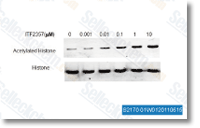 Click to enlarge | Rating | |
| Source | Dr. Zhang of Tianjin Medical University. Givinostat (ITF2357) purchased from Selleck | |
| Method | Western blot | |
| Cell Lines | ||
| Concentrations | 0-10 μM | |
| Incubation Time | ||
| Results | Increased Histone acetylation in cells treated with ITF2357 was observed. |
