
Antibodies


Etoposide is a semisynthetic derivative of podophyllotoxin, which inhibits DNA synthesis via topoisomerase II inhibition activity.
| Size | Price | Stock | Quantity | ||||||||||||
|---|---|---|---|---|---|---|---|---|---|---|---|---|---|---|---|
| |||||||||||||||
 Distributor Tel: +886-2-2827-1197jimmy@new.abscience.com.tw
| Description | Etoposide is a semisynthetic derivative of podophyllotoxin, which inhibits DNA synthesis via topoisomerase IIinhibition activity. | |||||
|---|---|---|---|---|---|---|
| Targets | ||||||
| IC50 | ||||||
| In vitro | Etoposide inhibits DNA synthesis by forming a complex with topoisomerase II and DNA, which induces breaks in double stranded DNA and prevents repair by topoisomerase II binding. Accumulated breaks in DNA prevent entry into the mitotic phase of cell division, and lead to cell death. Etoposide acts primarily in the G2 and S phases of the cell cycle. [1] Etoposide inhibits the growth of murine angiosarcoma cell line (ISOS-1) in a 5 days-period with IC50 of 0.25 μg/mL. Cell growth of normal murine microvascular endothelial cells (mECs) is less sensitive to Etoposide with IC50 of 10 μg/mL). [2] Etoposide treated for 6 hr inhibits colonies of tetraploid variant of the human leukemic lymphoblast line CCRF-CEM with IC50 of 0.6 μM. [3] Etoposide treated for 2 hr inhibits growth of human pancreatic cancer cell line Y1, Y3, Y5, Y19, YM. YS, and YT with IC50s of 300 μg/mL, 300 μg/mL, 300 μg/mL, 91 μg/mL, 0.68 μg/mL, 300 μg/mL, 300 μg/mL, and 260 μg/mL, respectively. [4] Etoposide exposed for 1 hr inhibits growth of human glioma cell lines CL5, G142, G152, G111, and G5 with IC50 of 8, 9, 9.8, 10, and 15.8 μg/mL respectively for 12 days. Under same condition, the IC90 value is attained in cell lines CL5, G152, G142, and G111 at 26, 27, 32, and 33 μg/mL. Etoposide inhibition of topoisomerase II is homogeneous for each cell. The average inhibition rates are 15%, 21.8%, 31.8%, 41.5%, and 49.5% for 1, 2, 4, 8, and 16 μg Etoposide, respectively. [5] | |||||
| In vivo | Etoposide administrated as a single agent is found to been ineffective in many xenografts growth, such as Heterotransplanted Hepatoblastoma NMHB1, and NMHB 2, [6] human neuroblastoma xenograft, [7] and human gastrointestinal cancer xenograft, [8] while the dose of 10 mg/kg i.p. Etoposide inhibits murine angiosarcoma cell ISOS-1 tumors in 36% of controls. [2] Etoposide induces tumor immunity in Lewis lung cancer. A single administration of 50 mg/kg Etoposide i.p., induces a 60% survival of C57B1/6 mice injected with Lewis lung cancer cell (3LL) over 60 days. About 40% of these surviving mice reject a subsequent challenge with 3LL, while none of control mice survive beyond 30 days. 3LL cells which have survived an 90% lethal concentration of Etoposide in vitro kill 75% of recipient mice, but 60% surviving mice reject challenge with 3LL. Splenocytes harvested from tumor rejecting mice protect naive mice injected with 3LL. [9] | |||||
| Features | ||||||
| Topoisomerase II activity assay | Nuclear extracts are prepared, and nuclei are isolated. The activity of topoisomerase II is calculated from the percentage of decatenation obtained. Tritiated kinoplast DNA (KDNA 0.22 μg) is used as a substrate. Etoposide and topoisomerase II are incubated for 30 min at 37 ℃ and are stopped with 1% sodium dodecyl sulfate (SDS) and proteinase K (100 μg/mL). The percentages of decatenation and inhibition of topoisomerase II by Etoposide are obtained. |
|---|
| Cell lines | Human glioma cell lines CL5 |
|---|---|
| Concentrations | 80 μg/mL |
| Incubation Time | 1 hour |
| Method | After the Etoposide treatment, cells are removed from the dish with phosphate-buffered saline (PBS) containing 0.03% trypsin and 0.27 mM ethylenediaminetetraacetic acid (EDTA) and are diluted into culture dishes in appropriate numbers to yield between 20 and 200 colonies. After 12 days, cultures are fixed with methanol-acetic acid, stained with crystal violet, and scored for colonies containing more than 50 cells. The standard errors are typically less than 15% of the mean value unless otherwise stated. |
| Animal Models | Murine angiosarcoma xenografts ISOS-1 |
|---|---|
| Dosages | 10 mg/kg |
| Administration | i.p. every day for 5 days from day 7 |
| Solubility | 30% propylene glycol, 5% Tween 80, 65% D5W, 30 mg/mL |
| NCT Number | Recruitment | Conditions | Sponsor /Collaborators | Start Date | Phases |
|---|---|---|---|---|---|
| NCT01969435 | Not yet recruiting | Hodgkin Disease|Lymphoma, Non-Hodgkin | Washington University School of Medicine | 2014-01 | Phase 2 |
| NCT01775475 | Not yet recruiting | AIDS-related Diffuse Large Cell Lymphoma|AIDS-related Diffuse Mixed Cell Lymphoma|AIDS-related Diffuse Small Cleaved Cell Lymphoma|AIDS-related Immunoblastic Large Cell Lymphoma|AIDS-related Lymphobla | AIDS Malignancy Clinical Trials Consortium|National Cancer Institute (NCI) | 2014-01 | Phase 2 |
| NCT02013167 | Not yet recruiting | Adult Subjects With Relapsed/Refractory B-precursor Acute Lymphoblastic Leukemia | Amgen | 2014-01 | Phase 3 |
| NCT02008006 | Not yet recruiting | Follicular Lymphoma | Centre Leon Berard | 2014-02 | Phase 2 |
| NCT01993810 | Not yet recruiting | Stage IIA Non-small Cell Lung Cancer|Stage IIB Non-small Cell Lung Cancer|Stage IIIA Non-small Cell Lung Cancer|Stage IIIB Non-small Cell Lung Cancer | Radiation Therapy Oncology Group|National Cancer Institute (NCI) | 2014-02 | Phase 3 |
| Molecular Weight (MW) | 588.56 |
|---|---|
| Formula | C29H32O13 |
| CAS No. | 33419-42-0 |
| Storage | 3 years -20℃Powder |
|---|---|
| 6 months-80℃in DMSO | |
| Syonnyms | Vepesid |
| Solubility (25°C) * | In vitro | DMSO | 100 mg/mL (169 mM) |
|---|---|---|---|
| Water | <1 mg/mL (<1 mM) | ||
| Ethanol | <1 mg/mL (<1 mM) | ||
| In vivo | 30% propylene glycol, 5% Tween 80, 65% D5W, | 30 mg/mL | |
| * <1 mg/ml means slightly soluble or insoluble. * Please note that Selleck tests the solubility of all compounds in-house, and the actual solubility may differ slightly from published values. This is normal and is due to slight batch-to-batch variations. | |||
| Chemical Name | Furo[3’,4’:6,7]naphtho[2,3-d]-1,3-dioxol-6(5aH)-one, 9-[(4,6-O-ethylidene-β-D-glucopyranosyl)oxy]-5,8,8a,9-tetrahydro-5-(4-hydroxy-3,5-dimethoxyphenyl)-, [5R-[5α,5aβ,8aα,9β(R*)]]- |
|---|
| Stock Solution (1ml DMSO) | 1mM | 10mM | 20mM | 30mM |
|---|---|---|---|---|
| Mass(mg) | 0.58856 | 5.8856 | 11.7712 | 17.6568 |
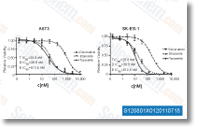 Click to enlarge | Rating | |
| Source | Mol Cancer Ther 2011 10, 1846-56. Etoposide purchased from Selleck | |
| Method | Viability screen | |
| Cell Lines | SK-ES-1 cell, A673 cell | |
| Concentrations | 0-10000 nM | |
| Incubation Time | ||
| Results | In both cell lines, SK-ES-1 cell and A673 cell, Etoposide proved to be effective of the 3 agents. |
TGFβ/TNFα-Mediated Epithelial–Mesenchymal Transition Generates Breast Cancer Stem Cells with a Claudin-Low Phenotype. [Asiedu MK, et al. Cancer Res 2011;71(13):4707-19]
An integrated chemical biology approach identifies specific vulnerability of Ewing’s sarcoma to combined inhibition of Aurora kinases A and B. [Winter GE, et al. Mol Cancer Ther 2011;10(10):1846-56]
